When is Navratri 2026? Navratri 2026 begins on 11 October and runs for 9 days till 19 October with Vijayadashami (Dussehra) on 20 October.
In brief: Ghatasthapana (Kalash Sthapana) will be performed on the 11th of October, in the morning, during Pratipada Tithi. In North India, Ashtami Tithi falls on the 18th of October and Navami Tithi on the 19th of October. In Bengal, the same Tithis fall on the 19th and 21st of October respectively.
The date changes every year as Navratri is based on the lunar calendar. It starts on Ashwin Shukla Pratipada, the first day of the bright fortnight after Pitru Paksha. So, the English date changes by about 11 days each year and resets when a leap month is added to the calendar. This post provides the 2026 dates, the timings, the complete day-wise calendar, the Ashtami and Navami dates for North India and Bengal, the food to be eaten by those keeping fasts, and the reason behind each of them.
When Is Navratri 2026? Start and End Dates
Every Navratri date comes from the panchang, the Hindu almanac built on five elements: tithi, nakshatra, yoga, karana and vara. Reading it is the first skill taught in any Vedic astrology course in India, because every festival, muhurat and vrat is calculated from it.
When does Navratri start in 2026?
Sharad Navratri 2026 starts on Sunday, 11 October 2026. Pratipada tithi of Ashwin Shukla Paksha begins at 9:19 PM on Saturday, 10 October and ends at 9:30 PM on Sunday, 11 October. Because Pratipada is the tithi at sunrise on 11 October, that is the day Navratri begins and the day the kalash is installed.
Navratri begins on a Sunday this year. That weekday fixes the Goddess’s traditional arrival vehicle, covered in the calendar section below.
When does Navratri end in 2026?
Navratri ends on Monday, 19 October 2026 with Maha Navami. Vijayadashami, the tenth day, follows on Tuesday, 20 October. In the North Indian reckoning this is when Ravana Dahan takes place, and Bengal celebrates Vijaya Dashami a day later on 21 October (explained below).
Is Navratri 8 days or 9 days in 2026?
Navratri of 2026 is for the full nine days from 11-19 October. No day is dropped in the North Indian count. The first day of Navratri is Pratipada on 11 October and the last is Navami on 19 October. This does sometimes stretch or shorten so that a Navratri may have eight or ten days. In 2026, Navratri is for the full nine days.
The difference between Shashthi and Navami is of interest here. Durga Puja calendar of Bengal and the North Indian calendars differ by a day for Ashtami, Navami and Dashami. The difference is explained in the section on Ashtami and Navami.
Does Navratri 2026 fall in Adhik Maas?
No. The extra (Adhik) month of 2026 was Adhik Jyeshtha which ran from 17th May to 15th June, 2026. Aswin is a normal month this year, so Sharad Navratri is in its normal place. The leap month still affects the calendar indirectly: it pushed all festivals which were after June, to later than their actual position in 2025. This is the reason Navratri is celebrated about 19 days later than its position in 2025.
Chaitra Navratri 2026 vs Sharad Navratri 2026
The two publically observed Navratris are Chaitra and Sharad. Chaitra Navratri took place from 19-27 March and ended on Ram Navami. The second Navratri, Sharad, occurs from 11-19 October and culminates on Dussehra.
In a given year, one is likely to observe four Navratris. Chaitra and Sharad are the two prominent Navratris and are publicly celebrated. The other two are Gupt or hidden Navratris, and are celebrated primarily by practitioners of tantra and Shakti in the months of Ashadha and Magha (a few regional almanacs name Paush instead of Magha). Sharad Navratri is celebrated on a larger scale due to the inclusion of Durga Puja in West Bengal, Ramlila and Garba in the rest of North India and Dussehra on the tenth day.
What Is the Ghatasthapana Muhurat for Navratri 2026?
Ghatasthapana, also called Kalash Sthapana, is the installation of a sanctified pot that holds the Goddess for nine days. It takes place on 11 October 2026, and the muhurat is where most households need a clear answer. Understanding why the timing is fixed the way it is makes the rule easier to follow, and it is the kind of reasoning you learn in a Vedic astrology diploma course.
Ghatasthapana timings on 11 October 2026
- Pratipada tithi: 9:19 PM on 10 October to 9:30 PM on 11 October
- Morning muhurat: in most North Indian calculations, roughly 6:26 AM to 10:17 AM
- Abhijit muhurat: around local noon, about 11:44 AM to 12:30 PM in Delhi and 12:01 PM to 12:48 PM in Mumbai
The morning window shifts with sunrise. Kolkata’s sunrise is earlier than Delhi’s or Mumbai’s, so the window opens earlier there. Take your own city’s figures from a local panchang.
The 2026 complication: Chitra nakshatra and Vaidhriti yoga
The Moon will be in Chitra nakshatra on 11 October, and the prevailing yoga will be Vaidhriti. Both persist during the daytime. Chitra nakshatra ends at around 10.30 pm. Vaidhriti yoga ends at around 9.00 pm.
Classical texts warn against beginning Ghatasthapana during Chitra nakshatra and Vaidhriti yoga. According to Drik Panchang, both these are to be avoided and the stipulation is that the kalash is placed before midday with Pratipada prevailing. Therefore, several Panchangs recommend Abhijit Muhurta, a window around midday which no nakshatra or yoga fault can spoil. Both the morning Muhurta and Abhijit Muhurta fall during Pratipada this year, thus you have an option.
Performing Ghatasthapana at night or on Amavasya is completely ruled out. If you couldn’t do it during the recommended Muhurta, do it during Abhijit Muhurta this year, and complete it before the end of Pratipada on 11 October.
How to do Ghatasthapana at home
- Clean the puja space and place a clean tray or clay pot filled with soil.
- Sow barley (jau) in the soil and sprinkle a little water.
- Fill a copper or clay kalash with water, and add a little Gangajal if you have it.
- Place mango or ashoka leaves around the mouth of the kalash.
- Set a coconut wrapped in red cloth on top.
- Place the kalash beside the sown barley, light a diya, and invoke the Goddess with your sankalp.
Some families keep an Akhand Jyot, a lamp that burns unbroken for nine days. Keep it only if someone can tend it through the nine days. A lamp lit each morning and evening is a valid practice too.
The barley sprouts are watered daily. Their growth over nine days is read in tradition as a sign of the household’s coming abundance.
What Is the Navratri 2026 Calendar? Day-Wise Dates, Goddess, Colour and Bhog
Each of the nine days belongs to one form of Durga, together called Navadurga. Reading the Goddess through all nine forms is a lesson in how tradition maps energy to a sequence. If you want to study systems like this properly, a self-paced Vedic astrology course with lifetime access lets you return to the material at your own speed.
| Day | Date | Tithi | Goddess | Colour | Traditional bhog |
| 1 | Sun, 11 Oct | Pratipada | Shailputri | Yellow | Pure ghee |
| 2 | Mon, 12 Oct | Dwitiya | Brahmacharini | Green | Sugar or misri |
| 3 | Tue, 13 Oct | Tritiya | Chandraghanta | Grey | Kheer or milk sweets |
| 4 | Wed, 14 Oct | Chaturthi | Kushmanda | Orange | Malpua |
| 5 | Thu, 15 Oct | Panchami | Skandamata | White | Bananas |
| 6 | Fri, 16 Oct | Shashthi | Katyayani | Red | Honey |
| 7 | Sat, 17 Oct | Saptami | Kalaratri | Royal blue | Jaggery |
| 8 | Sun, 18 Oct | Ashtami | Mahagauri | Pink | Coconut |
| 9 | Mon, 19 Oct | Navami | Siddhidatri | Purple | Sesame, halwa-poori-chana |
| 10 | Tue, 20 Oct | Dashami | Vijayadashami (Dussehra) |
The tithi column follows the North Indian day count. Where a tithi straddles two dates, regional calendars assign it differently, which the next section covers.
The nine forms of Durga
- Shailputri is the daughter of the Himalayas, who rides a bull and carries a trident and lotus. She is worshipped first because the nine days begin with grounding.
- Brahmacharini is Parvati in her years of penance, with a rosary and water pot. She represents discipline and sustained practice.
- Chandraghanta wears a crescent moon like a bell on her forehead. She is the warrior form, associated with courage.
- Kushmanda is the creator of the universe, said to have brought it into being with a smile.
- Skandamata is the mother of Kartikeya (Skanda), shown with the child in her lap.
- Katyayani is the warrior form born to Sage Katyayana, who destroyed Mahishasura.
- Kalaratri is the fiercest form, the one that destroys darkness and fear.
- Mahagauri is the white, serene form, worshipped on Ashtami.
- Siddhidatri grants the siddhis, and she is worshipped on Navami.
Which colour to wear on each day of Navratri 2026?
The color for each day is provided in the table. This is a relatively recent practice, and more of a custom. There is no scriptural authority that imposes a penalty for not following this practice. So choose one practice and adhere to it for the duration of Navratri.
Which vehicle will Maa Durga arrive on in 2026?
According to the rule drawn from the Devi Bhagavata Purana, the day on which Navratri begins sets the Goddess’s arrival vehicle. A start on Sunday or Monday means she arrives on an elephant. The day on which Vijayadashami falls sets her departure vehicle: Saturday or Tuesday means she departs on a horse. In 2026 Navratri begins on a Sunday and Dussehra falls on a Tuesday, so the traditional reading is an arrival on an elephant and a departure on a horse.
Tradition regards the arrival of an elephant as auspicious, linked to good rainfall and harvest. Departure symbolism varies by almanac, and some regional calendars give a different departure vehicle. Treat the vahan as a part of the tradition’s symbolic vocabulary, a calendar-based convention, and not as a forecast of events.
When Are Maha Saptami, Maha Ashtami and Maha Navami in 2026?
The final three days of Navratri carry the peak rituals. This year the dates depend on which calendar your household follows, because the Ashtami tithi ends late on the morning of 19 October. The tithi is the same in both systems. What differs is which date each calendar assigns it to. If you want to learn how a panchang decides a date like this yourself, read how the panchang works in Vedic astrology.
| Observance | North Indian Navratri count | Bengal Durga Puja calendar |
| Maha Shashthi (Bodhon) | Fri, 16 Oct (Day 6) | Fri, 16 Oct |
| Maha Saptami | Sat, 17 Oct (Day 7) | Sat, 17 Oct, with Navpatrika; some calendars place the rites on 18 Oct |
| Maha Ashtami | Sun, 18 Oct (Day 8) | Mon, 19 Oct |
| Maha Navami | Mon, 19 Oct (Day 9) | Tue, 20 Oct in most calendars |
| Vijaya Dashami | Tue, 20 Oct | Wed, 21 Oct |
Households that follow the North Indian count observe Durga Ashtami on 18 October and Navami on 19 October. Households and pandals that follow a Bengal Panjika observe Maha Ashtami on 19 October, Navami on 20 October and Dashami on 21 October. Follow whichever your family, temple or puja committee follows. Both counts are valid for their tradition.
When is Kanya Pujan in 2026?
Kanya Pujan is performed on Ashtami or Navami, which means 18 or 19 October 2026 in the North Indian count (Bengal calls it Kumari Puja and holds it on Maha Ashtami, 19 October). Both days are traditional, and the choice follows family custom.
Nine girls, traditionally under the age of ten, are invited as the nine forms of the Goddess. Their feet are washed, a tilak is applied, and they are served poori, chana and halwa, then given a small gift. Many families add one young boy, called Langur or Batuk, to represent Bhairav, the guardian of the Goddess.
Durga Puja 2026 dates and Sandhi Puja
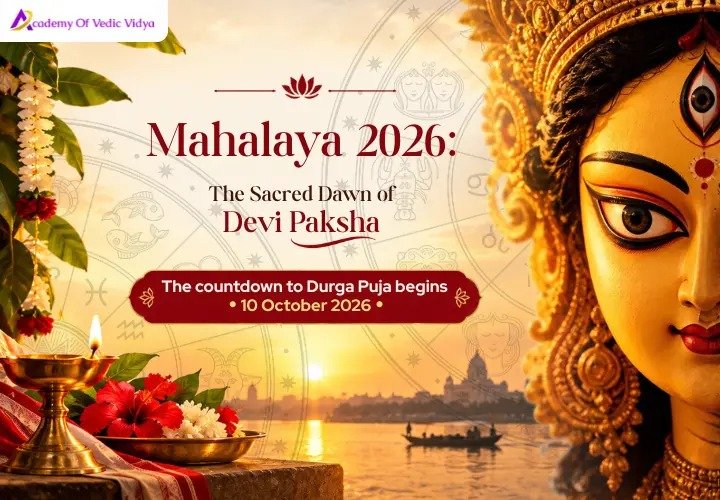
Durga Puja in Bengal begins with Mahalaya on 10 October 2026, which marks the start of Devi Paksha. Public worship runs from Maha Shashthi on 16 October to Vijaya Dashami on 21 October.
Sandhi Puja is the most charged rite of the festival. It is performed in the 48-minute window at the junction of Ashtami and Navami: the last 24 minutes of Ashtami and the first 24 of Navami. In 2026 that junction falls on the late morning of 19 October, with Ashtami ending around 11 AM. Exact minutes depend on the Panjika, so take them from the one your pandal committee follows. Tradition lights 108 lamps during Sandhi Puja.
When Is Dussehra (Vijayadashami) 2026?
Dussehra 2026 falls on Tuesday, 20 October. Vijayadashami marks Durga’s victory over Mahishasura and, in the North Indian tradition, Rama’s victory over Ravana. Effigies of Ravana, Kumbhakarna and Meghnad are burned at dusk, and the day is widely held auspicious for beginning new work. In Bengal, Vijaya Dashami is on 21 October and brings Sindoor Khela and the immersion of the idols.
What comes after Navratri 2026
- Sharad Purnima (Kojagari Lakshmi Puja): the night of Sunday, 25 October. The Purnima tithi runs from about 11:55 AM on 25 October to 9:41 AM on 26 October.
- Dhanteras: Friday, 6 November
- Diwali: Sunday, 8 November
What Can You Eat During Navratri Fasting? Day-Wise Vrat Menu
Fasting practice in Navratri varies by family and region. Some keep all nine days, some fast only on the first and the last, some only on Ashtami and Navami, and some do not fast at all. Choose the practice you can sustain for the full nine days. If you have diabetes, are pregnant, or take regular medication, speak to your doctor before restricting food.
Foods allowed in a traditional vrat:
- Flours: kuttu (buckwheat), singhara (water chestnut), rajgira (amaranth)
- Sabudana, samak rice (sama ke chawal), makhana
- Potato, sweet potato, pumpkin, bottle gourd, raw banana
- Fruits, nuts, milk, curd, paneer, ghee
- Sendha namak (rock salt) as the only salt
Foods avoided: wheat, ordinary rice, pulses and dals, onion, garlic, table salt, non-vegetarian food and alcohol.
A suggested day-wise vrat plan
| Day | Main vrat meal | Light meal or snack |
| 1 | Sabudana khichdi with curd | Fruit and milk |
| 2 | Kuttu poori with aloo sabzi | Makhana kheer |
| 3 | Samak rice with lauki raita | Banana and dry fruits |
| 4 | Singhara roti with paneer curry | Pumpkin soup |
| 5 | Rajgira paratha with curd | Banana shake |
| 6 | Sabudana vada with mint-curd dip | Roasted makhana |
| 7 | Kuttu chilla with potato filling | Sweet potato chaat |
| 8 | Poori, chana and halwa (Kanya Pujan prasad) | Coconut sweet |
| 9 | Kuttu or samak khichdi | Til-jaggery ladoo |
This plan is a suggestion built from the allowed foods and the traditional bhog. It is not a prescribed ritual menu.
Can you eat onion and garlic during Navratri?
No. Onion and garlic are avoided throughout the nine days. The tradition places them among the rajasic and tamasic foods, which are held to heat the body and agitate the mind, whereas the vrat aims at a sattvic state. Many households avoid onion and garlic for all nine days even when they are not fasting, and cook the family meals without them.
When Is Garba Night in Navratri 2026?
Garba and Dandiya Raas are held on every night of Navratri, from the evening of 11 October to the night of 19 October. In Gujarat the nine nights centre on the dance, performed in circles around a lamp or an image of the Goddess, with the clay lamp (garbo) at the centre symbolising the life-giving Shakti. Garba of Gujarat is recognised by UNESCO as part of the world’s intangible cultural heritage.
The weekend nights of 17 and 18 October, and the final night of Navami on 19 October, usually draw the largest crowds at public events. In Gujarat, Sharad Poonam on 25 October is also marked with Garba.
How Do You Observe Navratri 2026 Step by Step?
A workable plan for the nine days:
- Before 11 October: clean the puja space, gather the samagri (kalash, coconut, mango leaves, barley, red cloth, flowers, incense, a diya) and cook through or remove onion and garlic from the kitchen.
- Day 1: perform Ghatasthapana within the muhurat and take your sankalp.
- Days 1 to 9: light a lamp morning and evening, offer red flowers and the day’s bhog, and recite the Durga Saptashati, Durga Chalisa or a day-specific stotra. Chanting a mantra such as “Om Dum Durgayei Namah” a fixed number of times each day builds steadiness.
- Ashtami or Navami: perform Kanya Pujan, and conclude with a havan if your family follows one.
- Dashami: perform the concluding puja and visarjan, and distribute the prasad.
Sustained observance over nine days counts for more than a strict fast abandoned on day four. Keep a partial fast for all nine days before taking on a full fast you cannot finish.
What Are the Common Mistakes and Misconceptions About Navratri 2026?
- Doing Ghatasthapana in the evening. The kalash is installed before midday while Pratipada holds. It is never done at night.
- Assuming one date for all of India. North Indian and Bengal calendars differ by a day for Ashtami through Dashami this year, and both are correct for their traditions.
- Treating the colour as compulsory. The colour is a custom and not a ritual requirement, and the sequence differs between regions.
- Reading the vahan as a prediction. It is a calendar rule in the tradition, and it does not forecast individual outcomes.
- Believing a full nine-day fast is mandatory. The tradition allows a first-and-last-day fast, an Ashtami-and-Navami fast, or a partial fast.
- Using an old year’s panchang. Navratri dates change every year, so a screenshot from a previous year is not reliable.
Navratri 2026 FAQs
Is it compulsory to fast on all nine days?
No, many devotees fast for nine days. Some fast only on the first and last days, while many fast on the eighth and ninth days. It is more important to follow the rules and observe them with devotion than to follow them strictly.
What if I miss the Ghatasthapana muhurat on 11 October?
During Pratipada Tithi, do this at an auspicious time (Abhijit moment) around noon. Pratipada Tithi ends on the evening of October 11. Therefore, the Ghatasthapana is not done at night.
Is Durga Ashtami on 18 or 19 October 2026?
According to the North Indian calendar, today is October 18, and according to the Bengali Durga Puja calendar, it is October 19. The eighth day ends on the morning of October 19. That is why this difference in date is seen in the two calendars.
Which Navratri is more important, Chaitra or Sharad?
Both are big festivals, but Sharad Navratri is celebrated more widely. It includes Durga Puja, Garba, Ramlila, and Dussehra.
Do I need to wear the colour of the day?
No, the custom of wearing nine colors on nine days was actually introduced for joy and to celebrate the festival together. It must be accepted that there is no such obligation.
Final Thoughts
The panchang, tithi, nakshatra and muhurat logic behind every festival date in this guide is taught step by step in the Vedic Astrology Course at the Academy of Vedic Vidya. You learn to read the almanac, calculate muhurats and interpret charts with the guidance of experienced instructors.
Enroll now → Vedic astrology course online