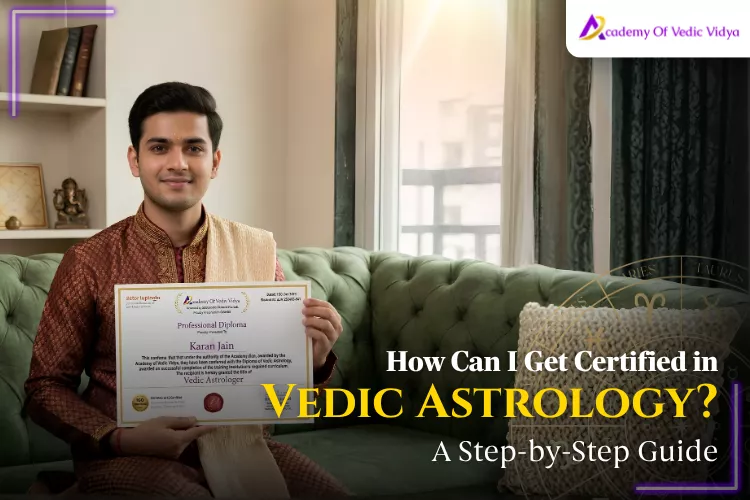
Almost every aspiring student of Vedic Astrology has this question: “How do I get certified in Vedic Astrology?” Before they spend a single rupee or a single minute in study, this is the question they ask.
Here is what I tell them. This is a process. You pick a program, you study and practice under its structure and curriculum, you take and pass the assessment. Then you receive the diploma from the institute. There are hundreds if not thousands of institutes awarding these diplomas. The worth of your diploma is what institute issues it and what it allows you to do.
This guide takes you through this process step by step. Knowing what to expect along the way is important before you enroll and it gives you peace of mind after you finish.
What Does Vedic Astrology Certification Mean?
A Vedic astrology certification is a document presented by a school, college, university, department, or association, providing evidence that an individual has completed a defined course of study in Vedic (Jyotish) astrology and has passed the assessment.
It certifies three things:
- Knowledge: you studied a stated syllabus.
- Skill: you demonstrated that you can read a birth chart (Kundli), not only recite definitions.
- Source: a named organisation stands behind the claim.
A certification does not provide a license to practice. In the majority of jurisdictions, no statutory authority requires an astrologer to possess a certificate in order to practice. The certificate is a mark of training, and the value is determined by the reputation of the body that issued it.
That is the reason a learner that understands this first makes a better choice than one that simply purchases the nearest “certified” course. A structured Vedic astrology certification course online gives you the syllabus, the practice, and the assessment in one sequence, but you should still be able to explain, in your own words, what the certificate proves.
Certificate, Diploma and Degree: What Is the Difference?
The three words are used loosely in the astrology market, so it helps to separate them by depth, duration, and the kind of institution that normally issues them.
| Credential | Typical depth | Typical duration | Usually issued by |
| Certificate | Foundations: planets, signs, houses, basic chart reading | 3 to 6 months | Institutes, university departments, private academies |
| Diploma | Foundations plus predictive techniques, dashas, transits, divisional charts, consultation practice | 6 months to 1 year | Institutes, Sanskrit and Jyotish departments, private academies |
| Degree (BA/MA with Jyotish, or Jyotish Acharya-level study) | Academic study including Sanskrit texts, astronomy, and philosophy | 2 to 3 years or more | Universities and Sanskrit universities |
Some practical points follow from this table:
- A certificate answers “Can this person read a basic chart?” It is the right first step for most learners.
- A diploma answers “Can this person predict and counsel using the full Jyotish toolkit?” It is the credential most people mean when they say they want to become a professional Vedic astrologer. If you are comparing programmes at this level, a professional Vedic astrology diploma with certificate is the format to evaluate against the curriculum checklist later in this article.
- A degree is an academic qualification. It matters if you want to teach in a university or pursue research, and it is not required to practise as a consulting astrologer.
Additionally, a number of other lineage-based organizations also have their own multi-level certification pathways. These are assessment-heavy and training-intensive pathways and are tied to a particular teaching tradition, and can span over a number of years. They are more appropriate for those that wish to gain a practitioner’s credential in the International Vedic astrology field rather than a short training pathway.
Do You Need Prior Knowledge to Join a Course?
No. Most Vedic astrology certificates and diploma courses are built for people who start from zero. You do not need to know your own chart, speak Sanskrit, or have studied mathematics beyond arithmetic.
What the entry requirements usually look like:
- Beginner-level private and online courses: typically no formal prerequisite beyond the ability to follow lessons in the language of instruction.
- University-linked or institute diplomas: many ask for a 10+2 pass from a recognised board, so check this before you apply.
- Advanced or practitioner pathways: often expect you to have finished a foundation level or to pass an entrance review.
The skills that help, though none are mandatory, are patience with detail, comfort with tables and calculations, and a willingness to look at the same chart several times. Jyotish is learned by repetition on real horoscopes. Learners who start with a step-by-step Vedic astrology course that moves from the zodiac to the predictive systems in order tend to progress faster than those who jump between topics.
If you are unsure where to begin, begin with the nine grahas, twelve rashis, and twelve bhavas. Everything else in the certification builds on them.
Step-by-Step Process to Get Certified
Follow these seven steps in order. Skipping the verification step is the most common mistake.
Choose your learning level
Decide whether you are aiming for a foundation certificate, a professional diploma, or an advanced practitioner credential. Your goal sets the length, fee, and depth.
- Interest and self-understanding: a foundation certificate is enough.
- Consultations and a practice: choose a diploma-level programme with chart-practice and case-study work.
- Teaching or research: look at university or Sanskrit-department routes and advanced lineage programmes.
Compare the curriculum
Ask for the full, detailed syllabus. A course that only names “Vedic astrology” with no detailed topics, is hiding something.
The Syllabus must name the subjects: the Lagna and house system, planetary strengths, nakshatras, Navamsa and other divisional charts, Vimshottari Dasha, Transits (Gochar), Yogas, Kundli matching, Prashna (Muhurta) and Remedies. The checklist in the next section gives details of what should be taught in a good course.
Check live classes and practical training
Certification is only as good as the practice behind it. Look for:
- Live or recorded classes plus a way to ask questions
- Real chart assignments, graded or reviewed by an instructor
- Case studies, not only definitions
- Training on chart software, so you can cast and read charts quickly
A purely video-based course with no assignments produces students who can recite rules but cannot read an unfamiliar chart.
Verify the issuing institute
You’ll want to look up who is actually issuing the certificate and check if you can access that later. Look for the institute’s registered name, a verifiable address, named instructors, an example of a certificate, and a way for someone to verify that a certificate is genuine.
Beware of badges. A quality-management (ISO) mark or company registration shows how an organization is run or is registered. It does not confirm that the Astrology curriculum is recognized. The full method for checking credibility is covered in our guide on Is a Vedic Astrology Diploma Recognized?, so read it before you commit to any diploma.
Complete assignments and chart practice
Certificate-based learning becomes competency through assessment (assignments) where you must interpret charts and write reports on your family, yourself, and sample cases. An instructor reviews those.
Most students can practice chart-making and interpretation on a particular schedule. Learning to read ten different ascendants is more valuable than reading one chart ten times.
Pass the assessment
In order to be certified, you must have passed a written or practical assessment that included chart reading and interpretation. This certification is valid for a stipulated period of time, and you will be required to take the assessment again.
Upon passing an assessment, you will be given a certificate, diploma, or both, in printed and digital formats. Keep all assessment related documents and your syllabus with your certificate.
Receive the completion credential
Certificates and diplomas are awarded in a variety of formats after completion of a course. Check that it mentions your name, the course title, dates, the name of the awarding body, and any unique identifiers such as a certificate number or verification route.
Keep a copy of your syllabus and your marksheet or assessment record alongside the certificate. Together they show a client or employer exactly what you studied.
What Should a Good Certification Course Teach?
Use this checklist to judge any Vedic astrology certification course. A diploma-level programme should cover every item. A foundation certificate should cover the first six.
- Basics of Jyotish: Nine planets, twelve zodiac signs, twelve houses, and the Panchang.
- Birth chart construction: Ascendant calculation, sidereal zodiac, Ayanamsha, and chart styles (North and South Indian).
- Planetary dignity and strength: Exaltation, debilitation, own sign, friendship tables, and aspects.
- Nakshatras: The 27 Nakshatras, their ruling lords, and their Padas.
- Reading houses and lords: How to evaluate a house or bhava based on its ruling planet, the planets situated within it, and planetary aspects.
- Core yogas: Major auspicious and inauspicious planetary combinations—such as Rajyoga, Dhanayoga, and Gajakeshari, as well as Kalsarpa and Mangal Dosha as defined in traditional texts.
- Divisional charts: Navamsha (D9), and at higher levels, D10 and others.
- Vimshottari dasha: Mahadasha, Antardasha, and the timing of results.
- Transits (gochar): Saturn, Jupiter, and the Nodes in relation to the natal Moon and Ascendant.
- Kundli matching and muhurta: Compatibility analysis and scheduling.
- Remedies: Guidelines regarding mantras, donations, and gemstones, and advice on when to exercise caution.
- Ethics and consultation skills:Maintaining confidentiality, avoiding fear-based predictions, and knowing when to refer a client to a doctor, lawyer, or counselor.
If a course promises “complete mastery” but leaves out dashas, divisional charts, or ethics, treat it as incomplete.
How Long Does Certification Take?
Duration depends on the level and on how many hours you can study each week.
| Level | Typical programme length | Weekly study time | What you can do at the end |
| Foundation certificate | 3 to 6 months | 4 to 6 hours | Read the basic structure of a chart |
| Professional diploma | 6 to 12 months | 6 to 10 hours | Interpret charts, time events with dashas, and begin consulting |
| Advanced or lineage pathway | 2 to 4 years | 8 hours or more | Practise at an experienced level and mentor others |
Keep a copy of your syllabus, mark sheet/assessment record and your certificate as a complete record of your studies. This is particularly important when presenting records to a prospective employer or client.
Fees vary from a few thousand rupees for a short online course to tens of thousands of rupees for year-long courses. In the world of distance learning, the quality of course delivery is of utmost importance. Compare what you receive in terms of tutor/mentor support and assessment before deciding on the price.
Is Online Vedic Astrology Certification Valid?
Flexible learning means that programmes can be completed at different speeds. An honest measure of readiness to practice is not the calendar; it’s whether you can give a reading of an unknown chart without your notes and support.
Online learning and astrology share a symbiotic relationship, both being reading/writing disciplines. Charts are read, feedback is provided, and assessments are submitted online. An online Vedic astrology certificate from a transparent provider is as credible as one from a other place. What matters is the integrity of the issuer and the quality of what is delivered, not the method of delivery. earned in a classroom, and one from an opaque provider is no more credible for being offline.
How to Verify a Diploma or Certificate
The detailed procedure for verifying certificates or credentials is outlined in a special guide, the link to which is provided in the verification steps mentioned above. Please keep three things in mind: before making any payment, inquire about the issuing institution’s name, valid contact details, a sample of the certificate, and the verification process; additionally, be wary of promises regarding guaranteed income or assured employment.
Verification confirms the authenticity of the certificate and the legitimacy of the training. However, it does not prove that any government or professional body ‘recognizes’ astrology as a regulated profession, as such regulatory mechanisms or legal frameworks do not exist in most places.
Can You Practise Professionally After Certification?
Yes. Certification is not a legal requirement to take clients, and it is what gives a new practitioner credibility. Here is how most certified astrologers move into practice:
- Consultations: Birth chart reading, horoscope matching, and selection of auspicious timings-online or in person.
- Teaching:Conducting classes or workshops for beginners after acquiring a high level of proficiency at the diploma level.
- Content and writing: Articles, videos, and courses that build an audience or readership.
- Specialisation: Relationship astrology, career guidance, medical astrology, or electional astrology (timing analysis).
Three habits separate practitioners who last from those who do not:
- Practice on at least 100 charts Before charging the full fee, preliminary charts could be provided as ‘case studies’-either free of charge or at a discounted rate, subject to permission.
- Frame readings as guidance based on the tradition,These are never viewed as guaranteed outcomes. Responsible astrology merely indicates various trends and the nature of the times, leaving the decision-making entirely to the client.
- Know your boundaries. Entrust health, legal, and financial matters to qualified professionals.
Certification vs Self-Study
You can learn Vedic astrology through books and videos without enrolling in any institution. Many successful astrologers have learned exactly this way. The advantages and disadvantages of this approach are also clear:
| Certification programme | Self-study | |
| Structure | Sequenced syllabus | You design your own order |
| Feedback | Instructor reviews your charts | Mostly none, unless you find a mentor |
| Assessment | Formal test and credential | None |
| Credibility with clients | Documented training | Depends on your track record |
| Cost | Course fee | Books and subscriptions |
| Pace | Set by programme, or self-paced | Fully flexible |
For most people, a realistic solution is to combine the two approaches. Gain the necessary structure, feedback, and certification through a well-organized program, and then continue to study classical texts and various charts or documents on your own throughout your career. The certification marks the beginning of your professional practice, not the end of your learning.
FAQs
Do I need to know Sanskrit to get certified in Vedic astrology?
No. Most courses are taught in English or Hindi, and Sanskrit terminology is introduced alongside the curriculum. However, knowing Sanskrit would be helpful later on if you wish to read classical texts like the Brihat Parashara Hora Shastra in the original language.
Is a government licence required to practise as an astrologer?
In most places, no. There is no licensing system for astrology; therefore, any diploma or certificate serves as proof of training, not as legal authorization.
Can I get certified in one month?
A one-month certificate course might provide you with a basic understanding of the subject, but it cannot equip you with the skills needed for chart analysis. Plan to obtain a qualification you can confidently rely on; this will require several months of study and practice.
How much does Vedic astrology certification cost?
Fees can range from a few thousand rupees for short-term online certificates to a few thousand rupees for year-long diplomas. Therefore, rather than focusing solely on the cost, compare aspects such as live support, assignments, and assessment methods.
Will my certificate be accepted abroad?
As there is no formal regulatory framework for astrology, it lacks institutional recognition. Clients and employers abroad evaluate you based on the reputation of the relevant institution and the skills you demonstrate.
Can I teach astrology after getting a certificate?
Yes, however, before providing training, most students should complete a diploma-level program and practice with numerous charts so that their guidance is reliable.
Does a Vedic astrology certificate expire?
Generally, no. Most certificates and diplomas serve as permanent proof of course completion. Some professional associations require members to renew their membership or complete continuing education.
Conclusion
The Professional Vedic Astrology course at Academy of Vedic Vidya It teaches you step-by-step, covering everything from the fundamentals of astrology to the methods of analyzing birth charts and making predictions; it offers the flexibility to learn at your own pace and provides lifetime access to the course content.
Enroll now → Professional Vedic Astrology Course