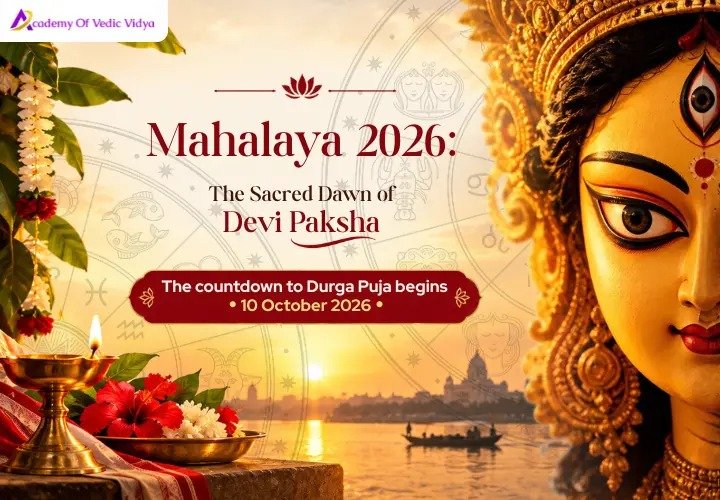
When is Mahalaya in 2026? Mahalaya falls on Saturday, 10 October 2026. It is the new moon that closes Pitru Paksha, and for Bengal it is the dawn on which the countdown to Durga Puja begins.
In short: Mahalaya (also called Sarva Pitru Amavasya) is the final day of the ancestors’ fortnight and the first morning of Devi Paksha, the fortnight of the Goddess. The Amavasya tithi runs from about 9:35 PM on 9 October to about 9:19 PM on 10 October (IST, New Delhi), so the daytime rites fall on 10 October. Sharad Navratri starts on 11 October. In Kolkata, Durga Puja’s main days run from Maha Shashthi on 17 October to Bijoya Dashami on 21 October.
Why Mahalaya Matters
Two meanings are contained in the word Mahalaya. Understanding these meanings is the key to comprehending the entirety of the festival season.
One meaning is paying respects to one’s ancestors. The approximately fourteen-day period preceding Mahalaya, called Pitru Paksha, is the time during which Hindus pay homage to their deceased relatives. During this period, each lunar day (tithi) has been allotted for the offering of prayers to the departed souls who passed away on that tithi. Mahalaya Amavasya is the last day of the Pitru Paksha. It is also called Sarva Pitru Amavasya. Amavasya literally means, “no moon day,” and, in this case, means “new moon day.” Since the Amavasya serves all the ancestors, it is also called Sarva Pitru Amavasya. The Garuda Purana is the text that lays down this prescript, stating that if the exact date of the fortnight is unknown or the ritual could not be performed on the correct tithi, then the Krishna Amavasya of Ashwin is to be observed.
The tradition of the fortnight itself is associated with the Mahabharata hero, Karna. The story states that after his death, Karna was offered gold and jewels in heaven; however, as he had given gold during his life for charity, he was sent back to earth for sixteen days to offer food to his ancestors so that he could break the cycle of charity of gold, and thereby earn a better state in heaven. That period has since been known as Pitru Paksha.
The other meaning of Mahalaya is the homecoming of the Goddess, and the beginning of the worship of the Goddess Durga. Mahalaya, therefore, has two aspects: one, the remembering of the ancestors, and the other, welcoming the Goddess.in workshops across Bengal, artisans paint the eyes of the idols on this day. The ritual is called Chokkhu Daan, the gift of sight.
The story of this invocation is drawn from the Devi Mahatmya or Chandi. There was an asura (demon) named Mahishasura who could assume the form of a buffalo. He had obtained a boon that made defeating him nearly impossible. Driven by his tyranny, the gods were banished from heaven. Goddess Durga was born from the combined powers of all the gods. Various deities equipped her with different weapons, and armed with these, she defeated Mahishasura. On the day of Mahalaya, this story is recounted through the recitation of the Chandi, and the Goddess is invoked to descend to the mortal realm.
Historically, the two traditions were separate. Scholars note that Mahalaya, as the new moon ending Pitru Paksha, had no original link to Durga Puja, and the two merged over time into the single threshold Bengal observes today. This is why the day feels like both a quiet farewell and a joyful welcome.
If you want to read a festival date the way a Jyotishi does, the groundwork is the same in every case: tithi, paksha, and the Sun–Moon relationship. Amavasya is the tithi on which the Sun and Moon are conjunct. Pitru Paksha is traditionally placed in the period when the Sun transits Kanya (Virgo). These are the first concepts a student meets when they learn Vedic astrology from scratch.
Mahalaya 2026 also falls on a Saturday, which makes it Shani Amavasya. Many panchang-based sources treat a Saturday Amavasya as doubly significant, since Saturn is the planet of karma, duty and ancestral debt in Vedic astrology. This is tradition and teaching, not prediction: it describes how the calendar is read, not a guarantee of any outcome in your own life.
Mahalaya 2026 at a glance
| Detail | 2026 |
| Date | Saturday, 10 October |
| Tithi | Amavasya, new moon of Ashwin |
| Amavasya begins | About 9:35 PM, 9 October (IST, New Delhi) |
| Amavasya ends | About 9:19 PM, 10 October (IST, New Delhi) |
| Also known as | Sarva Pitru Amavasya, Mahalaya Amavasya, Pitru Visarjani Amavasya |
| Bengal meaning | Start of Devi Paksha |
| Next day | Sharad Navratri begins, 11 October |
Tithi and muhurat timings shift with your city and sunrise, so confirm the exact windows for your location.
The Radio Programme That Became a Tradition
For the Bengalis, Mahalaya means the sounds before the ritual. It means the echo of a conch followed by a male voice in the darkness before the break of dawn.
“Mahishasuramardini” is the programme first produced by AIR, Calcutta in 1931. Since then the programme has been aired every year on the morning of Mahalaya. The programme lasts for about 90 minutes. It brings together the three elements, the Sanskrit verses of the Devi Mahatmya (the Chandi Path), Bengali devotional songs, and a narration of the story of Durga’s descent and the encounter between her and Mahishasura. The simple narration, written by Bani Kumar, has helped thousands understand and enjoy the story of Chandi Path. The programme was directed by Pankaj Mullick and the narration was done by the eminent Bengali scholar and dramatist, Birendra Krishna Bhadra. The music direction and rhythm of Pankaj Mullick added another dimension to the programme..
Three details show how deeply the broadcast is rooted in Bengali life.
There was some initial controversy. Some orthodox Brahmins did not want Bhadra, who was not a Brahmin, to recite the Chandi Path. However, the programme was ultimately produced and featured musicians of different faiths. A tradition that seems to have defied the test of time was created when, for the first time, a break was made with convention, by airing the Chandi Path in an audio programme.
It couldn’t be replaced. In 1976 an effort was made to replace Bhadra with renowned actor Uttam Kumar. Audiences boycotted this new version and the old was reinstated. Any subsequent attempts to modify the show have also resulted in the old, original version being reinstated.
It outlasted its own format. Bhadra passed away without ever having receiving royalties for his work at All India Radio and in 2006 his daughter received a royalty check from Saregama. Currently, the programme is available in a number of different formats, including CDs and online streaming and is available on YouTube. Bengalis around the world in places such as London, Houston, and Sydney can now wake up and hear this recitation just as people in Kolkata can.
The broadcast is the reason Mahalaya is popularly treated as the beginning of Durga Puja, even though the formal puja is a week away. Reading a festival through its ritual, its legend and its living tradition together is exactly the habit a professional Vedic astrology course builds in students: a date on the calendar is only the start of what it means.
When Does Durga Puja 2026 Begin?
There is a saying in Bengal that Durga Puja begins seven days after Mahalaya. In 2026 that count lands exactly: Mahalaya is on Saturday 10 October, and Maha Shashthi, the formal start of the main puja, is on Saturday 17 October.
Two calendars run in parallel, and keeping them apart removes most of the confusion.
- Sharad Navratri (the pan-Indian nine nights) begins on Sunday, 11 October, the day after Mahalaya, with Pratipada and Ghatasthapana.
- Durga Puja (the Bengali festival) concentrates its worship on Shashthi through Dashami, in 2026 from 17 to 21 October.
Durga Puja 2026 dates for Kolkata
These dates follow the Drik Panchang Durga Puja calendar for Kolkata.
| Day | Date (2026) | Main observance |
| Mahalaya | Sat, 10 Oct | End of Pitru Paksha, start of Devi Paksha, Chokkhu Daan |
| Panchami | Fri, 16 Oct | Bilva Nimantran |
| Maha Shashthi | Sat, 17 Oct | Kalparambha, Akal Bodhon, Amantran and Adhivas |
| Maha Saptami | Sun, 18 Oct | Kolabou (Nabapatrika) Puja |
| Maha Ashtami | Mon, 19 Oct | Kumari Puja, Sandhi Puja |
| Maha Navami | Tue, 20 Oct | Navami Homa |
| Bijoya Dashami | Wed, 21 Oct | Visarjan and Sindoor Khela |
Because the Shashthi tithi begins on the evening of 16 October and runs into 17 October, a few calendars show Bodhon on the 16th. The Drik Panchang calendar for Kolkata lists Maha Shashthi on the 17th, and your local puja committee’s announced schedule is the final word for your neighbourhood.
What each day means
Shashthi begins with worship. The first step in performing the puja is the recitation of a sankalpa. This is followed by Akal Bodhon. Lord Rama, before he fought Ravana, performed the Bodhon in spring as the Goddess generally resides in spring; this is called Akal Bodhon. It is believed that uncovering the face of the Goddess on this day brings prosperity to the devotees. Some pandals display the face of the Goddess on this day.
Durga Puja is incomplete without the Nabapatrika. Nabapatrika is a bundle of nine plants. It is worshipped along with Ganesha. On Saptami, the Nabapatrika is bathed early in the morning. The plants in the bundle represent the nine different forms of the Goddess. As such, it is known as Kola Bou.
The main attraction of Ashtami is the Sandhi Puja, performed at the intersection of Ashtami and Navami. Sandhi Puja is tied to the tithi change, and therefore the exact time it occurs varies. The Sandhi window is 48 minutes long and occurs at the last 24 minutes of Ashtami and the first 24 minutes of Navami. It is important to check with your local puja committee for the exact time it occurs, as it varies from place to place.
Navami closes the main worship with the Navami Homa, and its night is the busiest evening of pandal hopping.
Dashami is the farewell, covered in the last section below.
Kolkata’s Durga Puja was inscribed on UNESCO’s list of the Intangible Cultural Heritage of Humanity in 2021, which reflects the scale of the celebration: thousands of community pujas, themed pandals, and old household (bonedi bari) pujas open alongside them.
Festival calendars like this one are calculated, not guessed. They come from panchang mathematics, the same computation a practising astrologer uses for muhurta and chart work. If that precision appeals to you, the path of how to become a professional Vedic astrologer in India starts with learning exactly this system.
What to Do on Mahalaya
Mahalaya observance is simple at its heart. The sequence below follows common practice, and family and regional customs differ, so your elders’ way is a valid way.
Before sunrise
- Rise early and bathe. Adding a few drops of Gangajal to the bath water is a common practice.
- Listen to the Mahishasuramardini recitation, or chant the Chandi Path or Durga mantras yourself. In Bengali homes this is the first act of the day.
Morning: tarpan
Tarpan is the central ritual of the day.
- Wear clean clothes, preferably white.
- Fill a copper vessel with water and add black sesame seeds (til), kusha grass and a little rice.
- Face south, the direction associated with the ancestors, and offer the water slowly to the departed.
- If you know the names, say them. If you do not, offer collectively to all departed souls of your family line.
- Sit quietly for a few minutes in remembrance and gratitude.
Tarpan at the Ganga or another flowing river is regarded as especially meritorious. A home tarpan is complete in itself, and you do not need to travel to Gaya or Kashi to observe the day. On who may perform it: while many traditions name the son, a great many priests and families today welcome daughters, women and other relatives to offer tarpan. Ask within your own family and tradition.
Midday to afternoon: shraddha
Families who perform a full shraddha prepare a meal, offer a portion first, and then feed a priest, a guest, someone in need, or animals such as a cow, crow or dog. The Kutup Muhurat (11:45 AM to 12:32 PM) and the Aparahna period (1:19 PM to 3:40 PM) are the traditional windows, as published for New Delhi. The muhurat for your own city differs, so read a panchang for your city before fixing the hour. Because Amavasya covers the entire daytime of 10 October this year, the rites belong to that day.
Evening
- Light a ghee lamp at the entrance or beside the Tulsi plant, as an act of remembrance and welcome.
- Give daan: food, clothes or essentials to someone in need, in memory of your elders.
- Since Mahalaya falls on a Saturday this year, some families also offer water mixed with black sesame to a Peepal tree as a Shani Amavasya observance.
- Prepare your prayer space to receive the Goddess, since Devi Paksha begins at the turn of the new moon.
What is traditionally avoided
Many families avoid non-vegetarian food and alcohol, avoid cutting hair and nails, and avoid beginning auspicious ceremonies such as weddings or housewarmings on this day. The tradition places the emphasis on purity of thought: a simple, sincere offering matters more than an elaborate one.
If you cannot do any of it
If the tithi is unknown, the relative passed away long ago, or you live far from home, Sarva Pitru Amavasya exists for exactly this situation. A few quiet minutes of remembrance, a handful of water with sesame, or a meal given to someone hungry carries the day.
After the Puja Ends
The festival does not end on Navami. The last day is the most emotionally charged.
Bijoya Dashami falls on Wednesday, 21 October 2026. The final rites are performed and the Goddess is bid farewell before visarjan, the immersion. Many pandals hold a mirror before the image so devotees can see her reflection, a symbolic goodbye before her return to Kailash.
Sindoor Khela is the high point. Married women offer sindoor and sweets to the Goddess, touch the vermilion to her forehead and feet, and then apply it to one another, praying for the well-being of their families. In recent years many pujas have welcomed all women who wish to take part.
Afterwards, families exchange Shubho Bijoya greetings: younger members touch the feet of elders, friends embrace, and sweets such as narkel naru and nimki are shared. Visits for Bijoya continue for days.
Why is Bijoya Dashami on 21 October when Dussehra is on 20 October? The all-India Dussehra date is Tuesday, 20 October. Bengal’s Durga Puja calendar follows its own rules for Dashami and visarjan, and for Kolkata, Drik Panchang lists Navami on 20 October and Bijoya Dashami on 21 October. Both dates are correct for their own traditions.
The season keeps moving after visarjan. Kojagari Lakshmi Puja follows on the next full moon, and Kali Puja and Diwali arrive on the new moon in early November. Seen as a whole, the arc runs from the ancestors at Mahalaya, to the Goddess as Durga, to Lakshmi at the full moon, to Kali at the next new moon: remembrance, power, abundance and the turn of the light.
Frequently Asked Questions
What is the date of Durga Puja Mahalaya?
Mahalaya 2026 is on Saturday, 10 October 2026. It is the Amavasya that ends Pitru Paksha, with the tithi running from about 9:35 PM on 9 October to about 9:19 PM on 10 October (IST, New Delhi).
Why is Mahalaya celebrated at 4 am?
The 4 am slot comes from the Mahishasuramardini radio programme, which All India Radio has broadcast at that hour on Mahalaya morning since 1931. The hour also falls in the pre-dawn window that Indian tradition regards as the best time for prayer and recitation.
Is Mahalaya the first day of Navratri?
No. Mahalaya is the Amavasya, the new moon that ends Pitru Paksha, and Sharad Navratri begins the following day with Pratipada. In 2026 that is Sunday, 11 October.
Why is Mahalaya celebrated?
Mahalaya is celebrated for two reasons: it is the day families offer tarpan to all their ancestors at the close of Pitru Paksha, and in Bengal it is the day the Goddess Durga is invoked to begin her journey to earth for Durga Puja.
Is Mahalaya Amavasya a good day?
Yes, for the purposes it is meant for: ancestor rites, charity and the invocation of Devi. Tradition advises against starting new ventures or auspicious ceremonies on this day, because Amavasya is set aside for remembrance and prayer.
Final Thoughts
The festival calendar, the panchang and the chart all run on the same Vedic framework, and you can learn to read it yourself. The Professional Vedic Astrology course at Academy of Vedic Vidya teaches you tithi, nakshatra, planetary periods and chart interpretation step by step, with the guidance of an experienced instructor.
Enroll now →