Is Bhavishya Malika an authentic 16th century prophecy? Or is it a modern Hoax, composed of viral claims,s and pasted on to an old name? Each part of the question has an objective answer, and most online articles provide only one of them.
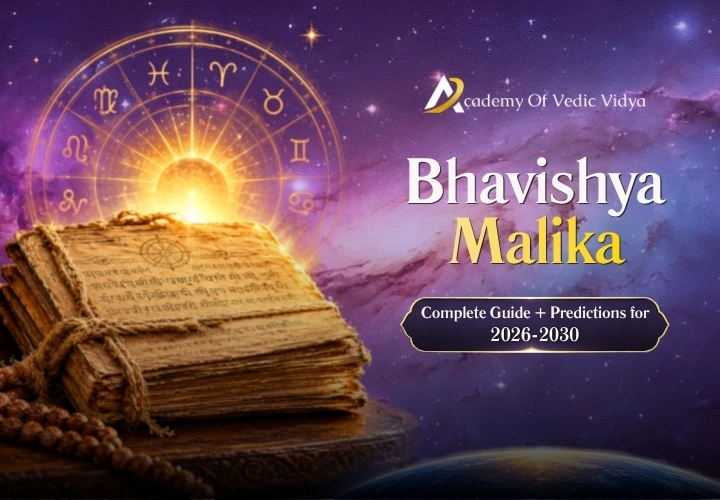
Bhavishya Malika is a body of Odia palm-leaf literature in the genre of prophecy, attributed to Achyutananda Das and the other Four saints of Panchasakha, on the end of Kali Yuga, the arrival of Kalki and the future of the Jagannath Temple of Puri. The subjects of the literature are old and abundantly available in historical records. The more specific dates between 2026 and 2032 are the result of interpretation of the literature by modern scholars and the original verses do not name the dates.
This document explains both layers. You will find out the contents of Malika, the authors, how it is authenticated, what it predicts about Kali Yuga and Kalki, and what it says about Puri, India, 2026 and 2030. Most importantly, you will find out how to test predictions you come across on social media.
What Is Bhavishya Malika? (Meaning in English)
Bhavishya means “future” and Malika means “string.” Bhavishya Malika, then, means “a string of prophetic verses.” Accordingly, this book (or series of books) provides prophecies in the Odia language (originally recorded on palm leaves) written in the form of poetic verses.
If you want to read predictive texts with discipline instead of through viral clips, structured training changes how you evaluate them, and a well-built online astrology course teaches the method classical systems use to derive timing, which is the standard every prophecy claim should be held against.
Malika is a whole literary genre and not a single book. Odisha is rich with Malika literature and the texts of the Panchasakha are the most celebrated part of it. The Malikas are said to be preserved in the matha (monastic) and temple communities around Puri. The Malikas deal with spirituality, religion, human philosophy, universal vision, and aspects of all other kinds of literature:
- the decline of dharma in Kali Yuga,
- signs in nature, society and the Jagannath temple that mark the end of the age,
- the arrival of Kalki, the tenth avatar of Vishnu,
- the transition into Satya Yuga.
These days, the general readers get to know Malika mostly through some recent books. Two of the best known books are Pandit Kashinath Mishra’s Hindi book Bhavishya Malika Puran, published by Notion Press, 2023 and Sachin Mohapatra’s Bhavishya Malika: Decoded Prophecies of Kali Yuga and Kalki Avatar (Clever Fox Publishing) in English and Hindi. These books are not the palm-leaf originals.
Who Wrote Bhavishya Malika?
The authorship of the Malika is attributed to the Panchasakha (“the five companions”): Achyutananda Das, Ananta Das (known as Sisu Ananta Das), Jasobanta Das, Jagannath Das, and Balaram Das. Among the Panchasakha, most especially Achyutananda Das, are credited for composing prophecies, and “Bhavishya Malika by Achyutananda Das” is how most people search for this work.
Two points keep the picture accurate:
- Several Malikas, several authors. Different Malikas are linked to different saints, and the Achyutananda Malikas are only part of the larger body of work.
- “Bhavishya Malika” is often an umbrella name. Modern authors apply it to selected verses, compilations and commentary, which is why two books with the same title can contain different material.
Exact counts of manuscripts vary widely from source to source. Some say there are “Over 100,000 palm leaves.” Others say there are roughly 185,000 manuscripts, still others say there are over 4 million. For our purposes here, we can take the more exaggerated numbers as roughly representing “A very large corpus of manuscripts.
Reading a corpus this large without a method leads to cherry-picking, which is why many serious students choose to learn Vedic astrology online first: the same habits of checking sources, timing and context apply to prophecy literature as to a birth chart.
Who Was Achyutananda Das?
Achyutananda Das was a Vaishnava saint poet of Odisha, who, according to popular biographies, was born in the Puri region to Dinabandhu Mohanty and Padmavati. These biographies say that Achyutananda received his early education in Puri, took initiation from Sri Chaitanya Mahaprabhu, the saint from Bengal who spent the latter part of his life in Puri, and later became a member of the Panchasakha circle.
Achievements of a philosophical and devotional nature of Achyutananda Das include the composition of the Sunya Samhita. He is regarded as a trikaaldarshi in Odisha. This is the reason that the prophetic Malikas gravitate to him.
In order to understand Achyutananda Das properly, it is important to put him in the context of the 16th century Odisha, the Jagannath cult, the Bhakti movement and the Gajapati kings, with Puri being the center of all of this. The prophecies are easier to understand once you put them in this framework rather than in the context of making prophecies about our times.
For readers who are new to Indian predictive traditions and want a foundation before tackling prophecy texts, an online vedic astrology course for beginners gives you the vocabulary of yugas, dasha timing and planetary transits that Malika commentators borrow constantly.
Who Are the Panchasakha of Odisha?
Panchasakha means “five friends.” The five saints, Balaram Das, Jagannath Das, Achyutananda Das, Ananta Das and Jasobanta Das spread the Vaishnava devotion in Odia with Lord Jagannath as the presiding deity. Their literary work is in Odia, as opposed to Sanskrit, used by other saints of that period, making their work available to the ordinary devotees. It is for this reason that their literary work has survived till date.
For the Malika tradition, the Panchasakha school of thought is of great importance for a practical reason. When an article quotes “the Malika,” it is crucial to identify which saint they are attributing the verse to, and from which manuscript. Jagannath Das Malika and Achyutananda Malika are different texts and contain different materials.
When Was Bhavishya Malika Written?
The dating of the earliest manuscripts to the 16th century, during the rule of Gajapati king Prataparudra Deva (1497-1540 CE), has generally been accepted. These dates roughly coincide with the period of the Panchasakhas and Chaitanya Mahaprabhu in Puri. Some other sources, however, place this around the 15th century, or give vague dates like “about 500 years ago,” “around 600 years ago,” etc.
This variation in dating gives a fairly good idea about the nature of the sources. The sources do not agree because they do not work from a primary dated manuscript. A Malika is written on palm leaves, and copies are made multiple times over by different people, and sometimes edited, over a long period of time. Hence, a Malika contains a lot of variants, and different people attribute different ages to it.
Is Bhavishya Malika Real? Authentic or a Later Forgery?
The honest answer has three layers.
What believers hold. The Malika is an authentic prophetic record written by accomplished saints on palm leaf, and there are signs in it that indicate the end of Kali Yuga. This is a faith position that is based on the Panchasakha’s position in the Odisha Vaishnava tradition.
What the record shows. The tradition of the Malika is real. There exists literature in the Odia language in the genre of palm leaf prophecy attributed to the Panchasakha. Several published editions exist and have been printed over the years. What is absent in the discourse is an edition that critically examines the various sources and tells the reader the date and other relevant information of the source from which a verse is taken. Popular articles draw their conclusion mainly from a few modern authors, along with the influence of astrology and news, rather than manuscript citations.
What the comparison shows.There is scholarly consensus that the Bhavishya Purana, which is the most famous of the Sanskrit works in the purported area of future, exhibits what has been described as a “living nature” and continuous revision. It is not beyond the realm of probability to say that the same can be true for the Malika. It is normal and expected that later layers grow upon puranic and prophetic texts. So, it is not a discredit to the text to say that there are sections that have been added much later.
The working conclusion: The concept of the Malika is an authentic tradition. However, when a specific aspect of the Malika tradition is under consideration, every claim should be corroborated in an unambiguous manuscript before it can be accepted. A standard of evidence should be employed that is more stringent than what is employed for most viral videos and flat dismissal.
How to judge a viral claim
Ask four questions of any “Malika predicted this” post:
- Which Malika and which saint is it quoted from?
- Can the original Odia line be shown, with a translation?
- Does the line name a person, place or date, or is it a general description?
- Was the interpretation published before the event, or after?
A claim that fails questions 2-4 is an interpretation, not a prediction.
What Does Bhavishya Malika Say About the End of Kali Yuga?
In Puranic reckoning, Kali Yuga lasts 432,000 years. The Malika tradition, as described by modern commentators, says that figure is cut drastically short, to about 5,000 years, because accumulated sins shorten the age. On this reading the world is already in the sandhya, the twilight phase between ages, where old systems break down before the new age forms.
Writers who summarise the Malika list the same signs again and again:
- the decline of religious and moral values and the weakening of the traditional teacher-disciple relationship.
- widespread corruption and social unrest,
- intensifying heat, severe weather and repeated epidemics,
- a long run of conflict leading to a major war.
Notice what this list is. These are signs of moral and social decline, described broadly enough that every generation can find them in its own newspapers. That generality is the reason the signs feel “true” to so many readers, and it is the reason they cannot work as dated forecasts.
The Kali Yuga timeline is also the most disputed claim around the Malika, because the mainstream Puranic figure and the 5,000-year reading cannot both be correct as a literal count. If you want the full arithmetic and the competing yuga calculations, read our breakdown: Will Kali Yuga End?
Who Is Kalki According to Bhavishya Malika?
Kalki is the tenth and final avatar of Vishnu in Hindu tradition, the figure who ends Kali Yuga and restores dharma. The Kalki Purana describes him in detail, and the Malika tradition adds a distinctly Odia dimension: it links Kalki’s appearance to Lord Jagannath and to Puri.
Modern retellings of the Malika typically say the following, and each point is an interpretation by modern authors:
- Kalki appears when Kali Yuga’s burden of sin is at its peak.
- Kalki is connected with Jagannath, with Odisha as a setting for the story.
- After his intervention, the world moves into Satya Yuga.
Some online videos give Kalki a birth year and a village. Those specifics vary from video to video, and one widely repeated claim that Kalki would be born in 2024 has passed without a verifiable event. This is the clearest example in the whole subject of why you must separate the traditional theme (Kalki ends Kali Yuga) from the dated detail (a year and a place).
If you compare the Malika with the Kalki Purana, the Purana is a Sanskrit text with an established textual history, while the Malika is a regional vernacular tradition. They overlap on the avatar and diverge on setting and detail.
What Does Bhavishya Malika Say About Puri Jagannath Temple?
The Jagannath temple is the centre of the Malika. Popular summaries describe three groups of signs:
Signs in the temple. The text is said to describe omens at Puri, including lightning striking temples, flags and symbols failing, and sacred objects such as the Kalpa Vriksha tree falling, with an epidemic following when the tree breaks. Commentators point to events such as a fire on the flag atop the temple in March 2020 as a fulfillment. That is a retrospective match: the reading was attached after the event.
The departure of the deity. One widely shared prophecy says Lord Jagannath will leave Puri when Kali Yuga reaches its peak. Different retellings treat this as a literal departure or as a symbol of the withdrawal of divine presence from a corrupt age.
The last Gajapati. Writers link the line of Puri’s Gajapati rulers to the end of the age and identify the current Gajapati, Dibyasingha Deb IV, as the last in some readings, noting that he has no male heir. Treat this with care. It is a modern interpretation about a living person, not a settled reading of any manuscript.
Puri is also where Rath Yatra, Nabakalebara and the opening of the Ratna Bhandar treasury keep the temple permanently in the news, so every event there attracts a Malika reading. News attention is not evidence.
What Does Bhavishya Malika Say About India?
Modern commentary attached to the Malika makes several claims about India. The most widely repeated ones are:
- India will be led by a figure described as “Narendra,” described as ascetic-like in lifestyle while governing,
- India will stay out of the early phase of a major world war for about 13 months before joining,
- The war ends with a consolidated, unified Indian territory, often called Akhand Bharat.
These claims appear in modern authors and popular articles. They are not presented with manuscript citations, and the name “Narendra” is a very common Indian name, which gives the reading broad room to fit. As an instructor’s rule, a prophecy that can be matched to any of thousands of people after the fact has not predicted anyone.
The same applies to national-economy claims. One news analysis examined whether the Malika “predicted” the economic collapses of Sri Lanka, Bangladesh and Nepal and concluded that the text names no country and speaks broadly of wars, disasters, falling currency values and unrest, which could fit many places at many times.
What Does Bhavishya Malika Say About 2026?
Here the line between text and interpretation matters most. Popular readings of the Malika for 2026 lean on astrology, not on a dated verse:
- Saturn moved from Aquarius into Pisces on 29 March 2025, which commentators treat as the starting point of a period of global instability.
- A solar eclipse on 12 August 2026 is read as a marker for reckless decisions by leaders. That date has already passed, so you can judge for yourself what followed.
- Jupiter entered Cancer, its sign of exaltation, on 2 June 2026, which Vedic mundane astrology (Medini Jyotish) reads as a stabilising influence on economies and food security.
Notice the pattern. The Malika supplies the themes (instability, conflict, decline of institutions), while the dates come from planetary transits layered on by modern commentators. That is a legitimate method, because Vedic astrology has its own tradition of reading time through transits. It is also a different thing from saying “the Malika says 2026.”
A competent reader keeps both columns visible and credits each source with only what it said.
What Does Bhavishya Malika Say About 2030?
The truthful answer is short: no verse that is widely cited in the public record names the year 2030.
What exists is a timeline constructed by commentators. They take the claim that a third world war would last six years and six months, start counting from the Saturn transit in 2025 and arrive at an era of instability that will last until 2031. The claim that the Satya Yuga would begin around 2032 is the other basis, and the title of the book, ‘Bhavishya Mallika Purana: The Beginning of the Satya Yuga from 2032’, helped to cement that number into the public memory. If you count forward six years and six months from 2025, you arrive at around 2031-2032, so the two numbers match up nicely, but the starting point of the calculation is itself an explanation.
Bhavishya Malika predictions 2026 to 2030: what is claimed and how firm it is
| Claim in popular circulation | Where it comes from | Can it be verified? |
| Global instability begins after Saturn enters Pisces (March 2025) | Modern astrological commentary | No: it is an interpretive starting point |
| Third world war lasting six years and six months | Modern Malika books and articles | No: no dated manuscript line is shown |
| India joins the war about 13 months in | Modern commentary | No: depends on the war claim |
| Seven days of darkness between 2022 and 2029 | Modern book summaries | Not yet, and no date is firm |
| Major religions merge into a “Satya Sanatan dharma” by 2032 | Modern book summaries | No: a belief about the future |
| Satya Yuga begins around 2032 | Modern book title and commentary | No |
The table is the most useful thing in this guide: every claim for 2026-2030 sits in the modern-commentary column. If you hold that standard, you will not be frightened by a thumbnail and you will not be talked out of a sincere tradition either.
Which Bhavishya Malika Predictions Have Come True?
Believers cite a list that usually includes Gandhi, Indian independence, a leader named Narendra, the 2020 pandemic, and the flag burning incident at the Jagannath temple in March 2020. Compare each of these with the previous four questions.
- Gandhi and independence. These appear in popular scripts and videos with no manuscript line shown, so they fail question 2.
- The pandemic. The text is said to link an epidemic to the fall of the Kalpa Vriksha tree. Epidemics occur in every century, and readings like this are attached after the event, so it fails question 4.
- The flag fire. A reading attached after the event is a retrospective fit.
- Sri Lanka, Bangladesh and Nepal. As covered above, the text names no country.
A prediction counts as verified when it was written down before the event, named something specific, and matched without stretching. By that standard, no widely circulated Malika prediction has been shown to pass in the public record. That is not proof it is false; it means the claim has not been demonstrated.
Bhavishya Malika vs Baba Vanga and Nostradamus. News headlines often compare Achyutananda Das to Baba Vanga or Nostradamus. All three have a common weakness: broad language, which is interpreted after the fact. ‘Mallika’ is different in this regard, as it is embedded in a living devotional tradition and pure classical culture of Odisha, which gives it a seriousness that the other two do not have. It is a matter of context, not accuracy.
Where to Read Bhavishya Malika: Books and Translations
If you want to read the Malika rather than watch clips about it, these routes exist:
- English: Sachin Mohapatra’s Bhavishya Malika: Decoded Prophecies of Kali Yuga and Kalki Avatar is published in English and Hindi, and one listing describes an edition with the Odia text alongside the English translation.
- Hindi: Kashinath Mishra’s Bhavishya Malika Puran (Notion Press, 2023) is a short Hindi book with translations into other languages.
- Odia originals and older printed editions: University and library catalogues list earlier printed Odia editions of the Achyutananda Malika, including a 1966 edition, which is where a serious reader should start.
Read modern books as explanations and compare them with each other. When two writers disagree on a verse, you will find a verse that is worth following.
Frequently Asked Questions
Is Bhavishya Malika mentioned in any Purana?
No. Malika is a tradition of the Odia region and is not mentioned in the classical Puranas. The Sanskrit text on the future is the Bhavishya Purana, and the Kalki Purana describes the Kalki incarnation.
Does Bhavishya Malika predict a world war?
According to modern summaries, it describes a long and great war and its duration is six years and six months. This period and time are taken from modern commentary and no dated verses are shown for them in the published documents.
How many Malikas did Achyutananda Das write?
There is no consensus on the number. Various sources give numbers ranging from over 100,000 manuscripts to much larger ones, suggesting that these counts are devotional estimates, not a listed total.
Should believers worry about 2026-2030?
The traditional message of Malika, as its commentators also emphasize, is one of warning and moral renewal, not fear. Using it to feed your fears or financial planning goes beyond anything the book supports.
Final Word
Bhavishya Malika is best understood as three things: a genuine Odia prophetic tradition, a modern interpretation, and a stream of claims that have spread by mixing the two. Putting these apart, the point becomes clear. This tradition is ancient and deep. Its dates are 2026-2030 are modern readings. And the test for any prediction, whether from a saint, an author or an astrologer, is whether it names something specific before the event happens.
The Academy of Vedic Vidya’s Professional Vedic Astrology course teaches you, step by step, under the guidance of an experienced instructor, how classical Vedic astrology reads time-i.e., yugas, dashas, and planetary transits-so that you can evaluate any prediction based on its method rather than its quantity.
Enroll in the → Professional Vedic Astrology Course