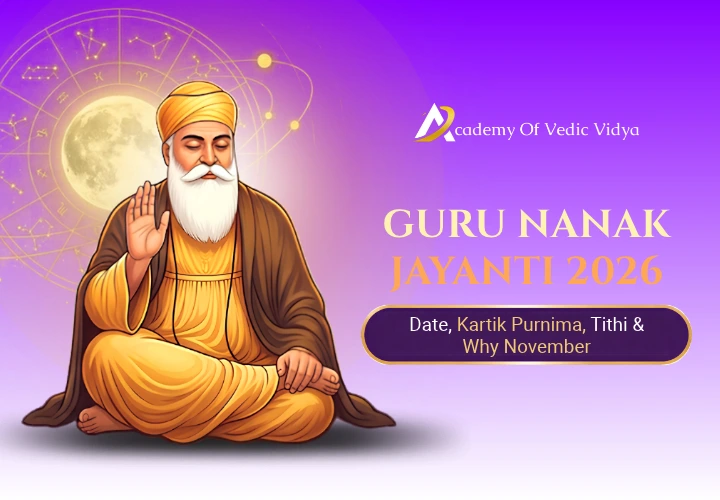
Many sources give Guru Nanak Dev Ji’s birth date as 15 April 1469, yet Sikhs around the world celebrate his birthday in November. Why?
November celebrations: Historians roughly calculate Guru Nanak Dev’s birth date as April 15th, 1469. However, the Sikh community acknowledges Guru Nanak Dev’s birthday as Kartik Purnima. This month falls between October and November. The date changes yearly according to the moon. In 2026, November celebrations will occur on Tuesday 24th November, which is a Central Government holiday. The community celebrates both the November and April traditions. Learn more below.
When Is Guru Nanak Jayanti in 2026? Date, Purnima Tithi Time & Holiday Details
Guru Nanak Jayanti 2026 is on Tuesday, 24 November, and marks the 557th Prakash Purab of Guru Nanak Dev Ji (2026 minus his birth year, 1469).
Guru Nanak Jayanti 2026 Date and Purnima Tithi Timing
| Detail | 2026 |
| Festival | Guru Nanak Jayanti / Gurpurab / Prakash Purab |
| Date | Tuesday, 24 November 2026 |
| Occasion | 557th Prakash Purab of Guru Nanak Dev Ji |
| Kartik Purnima tithi begins | 11:42 PM, Monday, 23 November 2026 |
| Kartik Purnima tithi ends | 8:23 PM, Tuesday, 24 November 2026 |
| Same day | Kartik Purnima and Dev Deepawali |
| Central government holiday | Yes (gazetted) |
Tithi timings follow Drik Panchang calculations for New Delhi and shift by a few minutes in other cities. Each gurdwara announces its own programme times.
A tithi is a lunar day, and like months and years, it does not begin at the stroke of midnight. For 2026, the Purnima tithi begins on the night of the 23rd and ends on the night of the 24th. Thus, Purnima begins on the 24th. Since the festival occurs on Purnima, and since November 24th is the day when the festival begins, it is celebrated on that day.
The festival happens about 16 days after Diwali, which occurs on November 8th. Sikhs celebrate Bandi Chhor Divas on the same day. Gurpurab is celebrated 16 days after this, on November 24th, as mentioned above.
Is Guru Nanak Jayanti a Gazetted Holiday in 2026?
Yes. “Guru Nanak’s Birthday” appears in the government of India’s gazette for 2026 on the 24th of November. Gazette holidays are observed by all central government offices. The state and union territory governments, schools and banks have their own list of holidays. The Reserve Bank of India (RBI) also announces bank holidays separately for each state. Check your state’s notification before you finalize your plans.
Why Does Guru Nanak Jayanti Fall on a Different Date Every Year?
Guru Nanak’s birthday, like all other Hindu festivals, follows the lunar calendar. The Gurpurab normally occurs during the full moon in the month of Katak. Since there are twelve lunar months in a year, compared to 13 in a solar year, a lunar month is 11 days shorter than a solar month. Due to this reason a lunar date drifts earlier in a solar calendar year. To rectify this, a lunar calendar inserts a thirteenth month once in a while, and a solar date jumps later in the calendar.
| Year | Guru Nanak Jayanti (Gregorian date) |
| 2024 | 15 November |
| 2025 | 5 November |
| 2026 | 24 November |
In 2025 and 2026, Guru Nanak’s birthday occurred 19 days later than in 2024, because a leap month was added in the Solar calendar in 2026. This means that the birthday of Guru Nanak always occurs within the window of the Kartik Purnima full moon, which is in the month of October or November.
Understanding Lunar Calendars and Astrology
Festivals such as Guru Nanak Jayanti are observed according to traditional lunar calendar calculations, where Tithi and Purnima play an important role in determining auspicious dates. Understanding these traditional calendar systems can be an interesting part of learning Indian astrology. Those interested in exploring these concepts in greater depth can consider enrolling in an Vedic astrology online course, which introduces learners to lunar calculations, Panchang, Tithi, and other traditional astrological concepts
Why Is Guru Nanak’s Birthday Celebrated in November?
There are various accounts regarding the fixing of the date of Guru Nanak’s birthday. These accounts are embedded in the traditional literary sources of the Sikhs. The later Sikh Calendars published by different Sikh institutions also contain these accounts. The following account attempts to reconstruct these accounts.
What Is Kartik Purnima and Why Is It Connected to Guru Nanak?
Kartik Purnima is the full moon day of the lunar month of Kartik. Three communities observe it in different ways:
- Hindus observe it as Dev Deepawali and Tripurari Purnima. Devotees take a holy bath at rivers and light lamps, and the Pushkar Fair in Rajasthan ends on this day.
- Jains make a pilgrimage to Palitana on this day.
- Sikhs observe it as the Prakash Purab of Guru Nanak, the day they remember the birth of the first Guru.
The Sikh observance has nothing to do with the Hindu rituals of the day. It is a Gurpurab, centred on kirtan, the Guru Granth Sahib and langar. The two observances share a date because both follow the same full moon.
Why Pakistan and Most Gurdwaras Celebrate It in November
Most sections of the Panth observe Guru Nanak’s birth anniversary (Prakash Parv) on Kartik Purnima; even on matters where different organizations hold differing views, they are in agreement regarding this date.
- SGPC and the Akal Takht. The Shiromani Gurdwara Parbandhak Committee (SGPC) observes ‘Prakash Parv’ on Kartik Purnima. According to documents published by them, Guru Nanak’s date of birth is April 15, 1469; however, this anniversary is celebrated on the day of the full moon (Purnima).
- Pakistan. The main celebrations take place in November at Gurdwara Janam Asthan in Nankana Sahib, the birthplace of Guru Nanak. Although the Pakistan Sikh Gurdwara Parbandhak Committee follows the original 2003 version of the Nanakshahi calendar for other dates, Gurpurab is celebrated at Nankana Sahib every year in the month of November.
- A rare exception. A research paper in the ‘Sikh Research Journal’ regarding the Nanakshahi calendar notes that, even in the original calendar based on fixed dates, two festivals remained aligned with the traditional lunar calendar. These two festivals are Guru Nanak’s Prakash Gurpurab and Bandi Chhor Divas.
Was Guru Nanak Born in April or November? The Birth Date Debate
There are two differing views regarding the month of Guru Nanak’s birth, both of which can be found in the records of the Sikh community. Historians tend to favor the account pointing to the month of Vaisakh (April), whereas, according to Sikh tradition, his birth is celebrated in the month of Kartik (November). The evidence supporting both perspectives, along with their respective sources, is presented below.
Why Some Sources Say 15 April 1469
The April date rests on the early janamsakhis, the traditional biographies of Guru Nanak.
- The Puratan Janamsakhi, the Miharban Janamsakhi, the Gyan Ratnavali of Bhai Mani Singh (1712) and the Vilayat Vali Janamsakhi all place the birth in the month of Vaisakh (Baisakh).
- These accounts give the third day of the bright fortnight of Baisakh in Samvat 1526. Modern conversions put that at 15 April 1469.
- The historian Karam Singh argued this case in his 1913 book Katik ke Baisakh. Scholars including Macauliffe, Hew McLeod, Kahn Singh Nabha, Khushwant Singh and Ganda Singh accept the Puratan account as the more reliable source for the birth month.
- Karam Singh also ran an arithmetic check. Santokh Singh’s Nanak Prakash (1823) accepts a Kartik full moon, yet gives the Guru’s age at death as 70 years, 5 months and 7 days. Counting back from the date of death brings the birth to mid-April.
This is the source of the 15 April 1469 date that appears in encyclopaedias and school textbooks.
The Kartik Purnima Tradition
The Kartik date has its own textual line.
- The Bala Janamsakhi records Kartik’s birth. It is the only one of the early janamsakhis to do so.
- Subsequent writings also follow this account. The text ‘Gurbilas Patshahi 6’ (1718) mentions that Guru Nanak was born on the full moon day of the month of Kartik; the same date is also adopted in Santokh Singh’s ‘Nanak Prakash’ (1823).
- Some accounts mention the ‘Bhat Bahi’-a record of the genealogies of ‘Bhat’ families-which notes a birth occurring on the day of Katak Purnima.
- Critics of the ‘Bala’ text point out that it was influenced by Hindali traditions and was composed at a later date compared to the ‘older’ tradition. Even those who support the month of April-such as the author of the ‘SikhNet’ article mentioned below-acknowledge that a strong tradition exists centered around the month of Kartik, and that the practice of celebration continues during that month.
One further explanation does not depend on the janamsakhi dispute. The Dabestan-e Mazaheb suggests that Kartik may mark Guru Nanak’s spiritual birth, his enlightenment in 1496, and not his physical birth. On this reading the November celebration honours the day the Guru’s mission began.
The Nanakshahi Calendar and What It Said About Guru Nanak’s Birthday
The Nanakshahi calendar is a solar calendar created by the scholar Pal Singh Purewal and published in 1992. It is named after Guru Nanak and starts in the year 1469, the year Guru Nanak was born. By using the tropic of cancer to determine the solar year, the dates of Gurpurab are fixed, meaning that they will always fall on the same date in the Gregorian calendar. The SGPC officially released the calendar in 1999 and adopted it in 2003.
The exception to the rule regarding fixed dates was made for Guru Nanak’s birthday. According to the Sikh Research Journal, the date for Prakash Gurpurab remained on the lunar calendar. This created a divide among Sikhs, with a minor population following 1 Vaisakh (14 April) and the remaining population following 10 November.
The SGPC amended the calendar in 2010 to restore the Bikrami dates. The amended calendar has the approval of Akal Takht. Many Sikh organizations in the US and the PSGPC follow the 2003 version of the calendar, as well as Sikh organizations in Delhi. Both calendars give different dates for Gurpurabs.
Does the SGPC Follow the Nanakshahi Calendar for Gurpurab?
The SGPC follows its own amended version of the Nanakshahi calendar, which the Akal Takht released again for Samvat 557 (2025–26). For Guru Nanak’s Prakash Purab, that calendar and the SGPC’s observance both use Kartik Purnima. The SGPC records the birth as 15 April 1469 and holds the anniversary on the full moon.
In short, the calendar disputes mostly concern other Gurpurabs. The Kartik Purnima date for Guru Nanak’s birthday is the most widely observed date across the Panth.
Gurpurab vs Guru Nanak Jayanti vs Prakash Utsav: What’s the Difference?
The three terms overlap, and each has a distinct meaning.
Gurpurab means “the Guru’s festival.” Gurpurab commemorates significant milestones in the lives of the ten Sikh spiritual leaders, including their births, martyrdoms, and accessions. Every Guru Nanak Jayanti is a Gurpurab, but not every Gurpurab is Guru Nanak Jayanti.
Guru Nanak Jayanti is the popular name for the birth anniversary of Guru Nanak Dev Ji. News outlets, holiday lists and calendars use this name, since Jayanti is the common Indian word for a birth anniversary.
Prakash Utsav, Prakash Purab and Prakash Parv are the terms Sikhs use for the same day. Prakash means light or revelation, and in Sikh usage it refers to the appearance of the Guru in the world. SGPC publications use Prakash Purab.
Because Guru Nanak’s is the most widely celebrated Gurpurab, the single word “Gurpurab” usually refers to this day.
Significance and History of Guru Nanak Jayanti
Guru Nanak Dev Ji (1469–1539) was the founder of Sikhism and the first of the ten revered spiritual leaders of the Sikh faith. He was born at Rai Bhoi di Talwandi, Nankana Sahib Pakistan in the house of Mehta Kalu and Mata Tripta.
According to Sikh tradition, Guru Nanak was one day bathing in a river and never returned. He returned to teach that there was no distinction between Hindu and Muslim. He then began to travel throughout the entire subcontinent and beyond on journeys called the Udasis, usually with the musician Bhai Mardana, and he taught through hymns. In his later years he settled at Kartarpur on the banks of the Ravi, where the community lived by farming, shared meals and daily kirtan. Before his death in 1539 he appointed Bhai Lehna as his successor, who became Guru Angad Dev Ji.
His teaching rests on one idea and three practices.
- Ik Onkar: There is one Creator, present in all. The Mool Mantar, the opening verse of the Guru Granth Sahib, begins with these words.
- Naam Japna: Remember the divine Name through daily meditation and prayer.
- Kirat Karni: Earn an honest living through your own work.
- Vand Chakna: Share what you earn with others, particularly those in need.
Langar, the free community kitchen where everyone sits together and eats the same meal, puts these teachings into practice. People of every religion, caste and background are served as equals. Langar runs at gurdwaras throughout the year, and Gurpurab carries it to its largest scale.
Guru Nanak Jayanti is a day of worship, and it does not centre on a deity in the Hindu sense. Sikhs believe in one formless, timeless God, known as Waheguru, and they remember the Guru through his hymns in the Guru Granth Sahib.
How Sikhs Celebrate Guru Nanak Jayanti
The celebrations build over several days. Each gurdwara announces its exact schedule, and the sequence below is the traditional order.
- Prabhat Pheris (days or weeks before). The sangat walks through the neighbourhood at dawn, singing shabads. Families along the route often welcome the procession with tea and snacks.
- Akhand Path (two days before). Readers take turns reciting the entire Guru Granth Sahib without a break. The reading takes about 48 hours and is timed so that the bhog, the completion, falls on the morning of Gurpurab.
- Nagar Kirtan (the day before). A procession leaves the gurdwara with the Guru Granth Sahib on a decorated palanquin, led by the Panj Pyare, the Five Beloved Ones. Kirtan groups, bands and gatka teams follow, and volunteers clean and decorate the route.
- Gurpurab morning. The day opens at amrit vela, the hours before dawn, with Asa di Var, a morning composition sung as kirtan. The programme continues with kirtan, katha (talks on the Guru’s life), the Ardas prayer, the Hukamnama reading and the distribution of Karah Prasad.
- Langar. Volunteers cook and serve a free meal to everyone. The service itself, called seva, covers cooking, serving water, and cleaning the shoes of visitors.
- Evening lighting. Gurdwaras and homes are lit with lamps, and kirtan often continues late into the night.
The Golden Temple in Amritsar, Gurdwara Bangla Sahib in Delhi and Takht Sri Patna Sahib in Bihar are among the major centres of celebration in India. [LINK: Golden Temple Amritsar Guide]
Nankana Sahib Celebrations 2026
Gurdwara Janam Asthan at Nankana Sahib, about 80 kilometres southwest of Lahore, marks the site of Guru Nanak’s birth. It is the focal point of the Gurpurab pilgrimage. The celebrations there open with an Akhand Path, followed by Gurbani recitation and a nagar kirtan, and langar is served at points around the town.
Indian Sikhs travel to Nankana Sahib in jathas, organised groups of pilgrims, under the India–Pakistan agreements on visits to religious shrines. The SGPC collects passports and recommendations through its Yatra Department, and the Pakistan High Commission in New Delhi issues the visas. The Government of India’s permission is also required, and it was granted in 2025 only after an initial refusal. Pilgrims should check SGPC announcements for the status of this year’s jatha, because the arrangement depends on both governments each year.
FAQs
When is Guru Nanak Jayanti in 2026?
Guru Nanak Jayanti 2026 is on Tuesday, 24 November. It falls on Kartik Purnima, and in New Delhi the Purnima tithi runs from 11:42 PM on 23 November to 8:23 PM on 24 November. Gurdwaras announce their own programme timings, so confirm the schedule with your local gurdwara committee.
Why is Guru Nanak Jayanti celebrated in November?
Sikh tradition marks Guru Nanak’s Prakash Purab on Kartik Purnima, the full moon of the lunar month of Kartik, which falls in October or November. Because the festival follows the lunar calendar, its Gregorian date changes every year, but it stays within the Kartik full moon window of late October to late November.
What is the actual birth date of Guru Nanak Dev Ji?
The early Puratan and Miharban janamsakhis give Vaisakh (April), usually converted to 15 April 1469, and historians generally accept this. Sikh tradition celebrates Kartik Purnima, following the Bala Janamsakhi and later texts. Both dates are held within the community, and the SGPC records the birth as 15 April while observing the anniversary on Kartik Purnima.
Is Guru Nanak Jayanti a public holiday in 2026?
Yes. “Guru Nanak’s Birthday” is a gazetted holiday on the central government’s 2026 list, on Tuesday, 24 November, and central government offices close that day. States and banks issue their own holiday lists, so check your state government’s notification and the RBI list for your state.
How do Sikhs celebrate Guru Nanak Jayanti?
Sikhs mark the day with Prabhat Pheris, a 48-hour Akhand Path, a nagar kirtan led by the Panj Pyare, and a Gurpurab morning of kirtan, katha and Ardas. Langar is served to everyone, and gurdwaras and homes are lit with lamps in the evening.
Sources and Further Reading
- Central Government gazetted holidays 2026 (CAG)
- Guru Nanak (Wikipedia) and Guru Nanak Gurpurab (Wikipedia)
Final Thoughts
The online Vedic astrology course teaches you how to read the Panchang, including tithis, lunar months and nakshatras, step by step, with the guidance of an experienced instructor, so you can work out dates like Kartik Purnima yourself.
Enroll now → Occult Science Courses