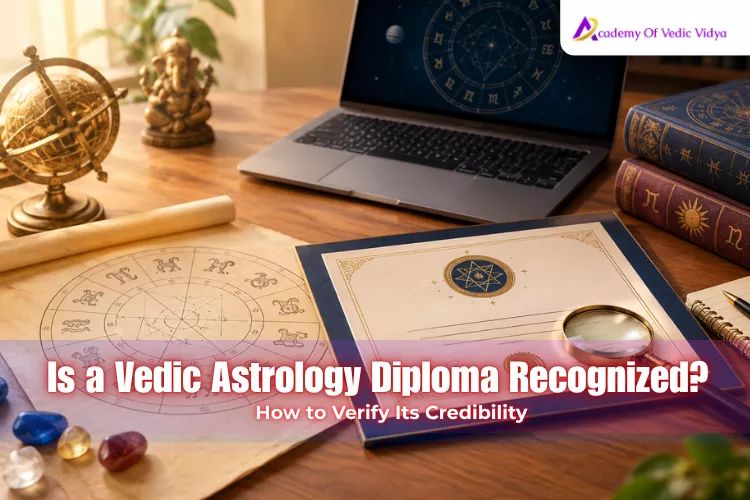
A diploma in Vedic astrology may indicate that a trainee completed a training module. When people use the term “recognized,” they may mean different things. For some, the term means the granting of a diploma by a professional body. For others, the term means a diploma is awarded by a university, a government agency, or an employer. Still, for some, the term means the diploma is awarded by a professional body after it has evaluated a trainee’s fitness to practice. Each of the above is different from the other.
Before enrolling, do not judge a course only by the word “diploma” on its webpage. First verify:
- Who issues the diploma?
- Is the issuing organization a university, college, private institute or professional training academy?
- Is the course approved or accredited by a named external body?
- Can the certificate or diploma be independently verified?
- What skills, assessments and practical training does the programme include?
- Is the qualification being presented honestly as a professional training credential rather than an academic degree?
- This guide explains how to check those details and how to interpret a Vedic astrology diploma responsibly.
Short answer: Holding a diploma in Vedic astrology indicates that an individual has undergone training in the subject. However, merely possessing a diploma does not make it a government-recognized degree. The extent of the diploma’s recognition depends on the issuing institution and whether that institution holds government approval or accreditation.
Diploma, Certificate and Degree: What Is the Difference?
Certificate
A certificate generally attests that a student has successfully completed a course, training program, workshop, or specific assessment. Such a certificate may be issued by a private institution, training organization, college, or university.
A certificate can demonstrate learning, but its value depends on factors such as:
- The credibility of the issuing organization
- The depth of the course
- The assessment process
- The practical experience included
- Whether the certificate can be verified
- How relevant organizations and clients view it
Diploma
A diploma normally reflects a longer, more intensive, and a more structured program than a certificate course. A diploma, however, does not confirm that a course is a university degree or a government degree.
A private professional diploma indicates the successful completion of a training course by a private institution. Such a diploma should not be given a misleading academic title, unless the relevant authority has authorized the private institution to award academic degrees.
Degree
Degrees are credentials awarded by authorized academic institutions. They are different from private training diplomas. Therefore, it is incorrect to consider a “Professional diploma in vedic astrology” as equivalent to a bachelor’s degree or master’s degree.
What Does UGC Say About Diplomas and Certificates in India?
In its Frequently Asked Questions, the University Grants Commission (UGC) states that it has not prescribed Diplomas and Certificates in the same manner as prescribed degrees. It further states that in the absence of any legal restriction, a university has the right to offer diplomas and certificates.
Hence, a student must find out the actual granting institution in order to assess the status of a diploma. A diploma earned from a university has to be assessed differently than a diploma earned from a private professional training institution.
It is the responsibility of the granting institution to verify the awards it confers. Therefore, an individual should approach the granting institution to find out how the award can be verified. The individual should also retain the award and completion documents.
You can read the UGC official FAQ on recognition of diplomas and certificates for the relevant clarification.
Important: “UGC-recognized,” “university-approved,” “government-certified” and “privately issued professional diploma” are different claims. An institute should use only the wording it can prove.
What Kind of Recognition Can a Vedic Astrology Diploma Have?
Recognition is not one single category. A course may have one type of credibility without having another.
1. Institute-Level Recognition
This means the institute itself issues a diploma after the learner completes its programme.The diploma may be useful as a record of training completed at that institute.
The institute should clearly display:
- Its legal or organizational identity
- The exact name of the programme
- The course duration
- Completion requirements
- Assessment or attendance requirements
- The name and designation of the signatory
- A method for verifying the credential
2. University Recognition
If a university awards or formally runs the programme, the course information should identify the university and the relevant approval or governing process. Students should verify the information directly with the university instead of relying only on an institute’s marketing statement.
3. External Accreditation
Accreditation should name the accrediting organization. A vague statement such as “internationally accredited” is not enough.
Before relying on an accreditation claim, check:
- The accrediting organization’s official name
- Its official website
- The accreditation scope
- The course or institution covered
- The accreditation number, if one exists
- The start and expiry dates
- Whether the accreditor is independent of the training provider
- Whether the accreditor publishes a public directory
4. Professional or Industry Credibility
The value of a diploma extends beyond merely obtaining a certificate. Factors such as the quality of training, the experience of the instructors, the opportunities for hands-on chart analysis, and the level of professional confidence gained upon completion are equally important.
However, the fact that a diploma is professionally useful does not make it a government- or university-recognized degree. It is, therefore, crucial to clearly explain this distinction to students so they understand that professional utility and official educational recognition are not the same thing.
How to Verify Whether a Vedic Astrology Diploma Is Credible
Use the following checklist before paying a course fee.
Check the Issuing Authority
Find the exact name of the organization that will issue the diploma. Ask whether it is:
- A university
- A college
- A private professional training institution
- A registered company or education provider
- An independent professional body
- The answer should be available in writing before enrolment.
Ask for the Exact Diploma Wording
Request a sample or specimen certificate, with sensitive information removed if necessary. Check whether it says:
- Certificate of completion
- Professional diploma
- Diploma awarded by a university
- Attendance certificate
- Certificate of participation
- The wording should match the course page, brochure and enrolment documents.
Verify Any Accreditation Claim
Do not accept “accredited” as a complete answer. Ask for the name of the accrediting body and verify it through an independent source.
If the institute cannot identify the accreditor, treat the claim cautiously.
Review the Curriculum
A credible professional programme should explain what students will learn. A Vedic astrology curriculum may include topics such as:
- Zodiac signs and planets
- Houses and chart construction
- Nakshatras
- Yogas and doshas
- Dashas and planetary periods
- Gochar or planetary transits
- Panchang
- Predictive methods
- Remedial measures
- Ethical consultation practice
A long list of topics is not enough by itself. Ask how the topics are taught and assessed.
Check for Practical Chart Work
Reading charts is a practical skill. Find out whether learners receive opportunities to:
- Work through real or anonymized birth charts
- Complete guided assignments
- Practise prediction techniques
- Receive instructor feedback
- Discuss mistakes during doubt-clearing sessions
- Complete a final assessment or project
Check How the Credential Is Verified
Ask whether the institute provides:
- A certificate number
- A digital verification link
- An official student record
- A written confirmation process
- A contact email for employers or clients
Verification details are especially important if you plan to use the diploma when presenting your professional training to clients.
Read the Terms Before Enrolling
The enrolment documents should clearly state:
- Course duration
- Class format
- Fee and instalment terms
- Refund or cancellation policy
- Assessment requirements
- Diploma eligibility
- Recording access
- Support included after completion
Do not rely only on a sales call or an informal message.
What Does the Academy of Vedic Vidya Diploma Represent?
The Academy of Vedic Vidya’s Professional Vedic Astrology course page describes a 5.5-month programme divided into basic and advanced phases. The page states that learners receive a Professional diploma in vedic astrology course awarded by the Academy of Vedic Vidya, a private professional training institution.
The same page outlines features such as live online classes, hands-on horoscope and chart analysis, instructor guidance, assignments, and access to class recordings. From this information, an interested student can gain a clear understanding of how the course is conducted and what type of certificate or recognition is awarded upon completion.
Based on this information, the diploma can be considered a vocational training diploma issued by the academy. However, it should not be classified as a university degree or a government-recognized educational qualification. To confirm whether such recognition exists, one would need to consult separate and up-to-date government or relevant documents..
Before publishing or updating this article, the academy should add or link to the following information if it is available:
- Exact accreditation body and official website
- Accreditation number or public verification page
- Diploma verification process
- Sample diploma wording
- Course assessment requirements
- Legal name of the issuing entity
- Clear explanation of what “recognition” means in the academy’s context
For curriculum, class format and admission details, readers can visit the Professional Diploma in Vedic Astrology course page.
Does a Diploma Guarantee a Job or the Right to Practise?
No educational credential can guarantee professional success by itself.
A diploma may show that you completed training, but professional development also depends on:
- Your chart-reading ability
- Accuracy and consistency of practice
- Communication skills
- Ethical conduct
- Client confidentiality
- Ability to explain interpretations responsibly
- Continued study and supervision
- Compliance with any local business or professional requirements
It is also advisable to clearly understand beforehand what kind of ‘placement assistance’ or job-related support a course offers. Find out exactly what is meant by ‘placement assistance’-whether it involves job referrals, career counseling, mentorship, help in securing clients or setting up a practice, or something else – because the nature and benefits of each type of support vary.
For more information about possible career paths after training, read the separate guide on career prospects after Vedic astrology certification.
Is a Vedic Astrology Diploma Worth It?
It may be worthwhile if the programme gives you a structured learning path, experienced instruction, regular practice and useful feedback.
Before deciding, compare the course on the basis of learning value rather than the title printed on the diploma. Ask:
- Is the syllabus clear and sufficiently detailed?
- Are classes live, recorded or a combination?
- Can I ask questions directly to an instructor?
- Will my chart analysis be reviewed?
- What is required to receive the diploma?
- Who issues the credential?
- How can the credential be verified?
- Are the recognition and accreditation claims written clearly?
- Is the fee transparent?
- Does the schedule suit my availability?
A transparent answer to these questions is more useful than a vague claim that a diploma is “globally recognized.”
Questions to Ask an Institute Before Enrolling
You can send the following questions to any Vedic astrology institute:
- Who exactly issues the diploma?
- Is it an institute-issued professional diploma or a university qualification?
- Is the course accredited by an external body? If yes, what is its exact name?
- Where can I verify the accreditation independently?
- What are the requirements for receiving the diploma?
- Are there assignments, examinations or practical chart-reading assessments?
- Can I see a sample diploma?
- How can an employer or client verify it?
- What topics are included in the curriculum?
- What support is available after course completion?
- What does placement support specifically include?
- What are the refund and cancellation terms?
An institute that answers these questions clearly makes it easier for students to make an informed decision.
Frequently Asked Questions
Is a Vedic astrology diploma the same as a degree?
No. A professional diploma and an academic degree are different credentials. The status depends on the issuing institution and the applicable approval or accreditation.
Is every Vedic astrology diploma government recognized?
No. The word “diploma” by itself does not establish government recognition. Students should verify the issuing authority and any specific approval claim.
Can a private institute issue a Vedic astrology diploma?
A private professional training institution may issue its own course-completion or professional training diploma, subject to the legal framework applicable to its operations. Students should check the exact wording and status of the credential.
How do I verify an astrology diploma?
Contact the issuing institution using its official contact details. Ask whether it maintains a student record, certificate number or digital verification system.
Is private accreditation the same as UGC recognition?
No. Private accreditation and UGC-related recognition are different claims. The accrediting organization, scope and verification method must be identified before the claim can be evaluated.
Does an astrology diploma guarantee a job?
No. A diploma may support your training record, but employment and client work also depend on practical skill, communication, ethics, experience and the requirements of the opportunity.
Can I learn Vedic astrology without a diploma?
Yes. You can begin through books, free resources, practice and mentorship. A structured diploma programme may provide a defined curriculum, instructor feedback and a formal record of course completion.
Final Thoughts
An education in Vedic astrology is valued for the technical skills taught, but recognition of diplomas should not be assumed.
Prior to taking a course, review the accreditation, curriculum and practical training. Verify the evaluation methodology and sample the content of the certificate to be issued. Describe the diploma as training issued by a professional institute, not as a University degree or government recognized diploma.
The best training providers differentiate between the areas covered by their courses, and the areas not covered, providing students with an opportunity to self-evaluate the worth of a training course prior to enrolling.
Relying on marketing language to sell training courses leaves students without the means to evaluate the worth of the training prior to enrolling. Students should have the opportunity to evaluate whether training meets personal academic goals.