You’ve come to the right place if you’ve been looking for the date of Devshayani Ekadashi in 2026 or if you want to know what this Ekadashi is about. Devshayani Ekadashi (or Ashadha Shukla Ekadashi) is one of the most significant Ekadashis in the Hindu calendar. For millions of devotees, this Ekadashi marks the turning point in the calendar year. This guide will give you the meaning of Devshayani Ekadashi, the story that goes with it, how to do the vrat, and things to consider when doing it for the first time. It’s all here.
What is Devshayani Ekadashi?
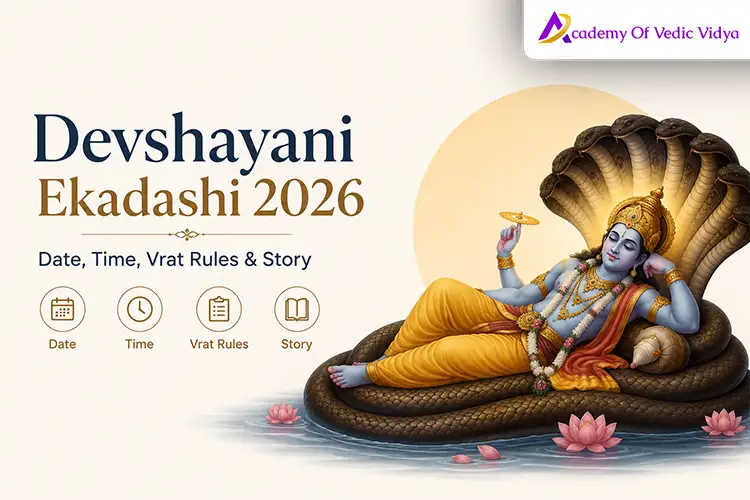
The Devshayani Ekadashi meaning is, in simple terms, when Lord Vishnu’s deep sleep begins. Where “Dev” means god, the term “shayani” refers to sleeping. So, “Devshayani Ekadashi” is the singular of the Lord Sleeping.
Devshayani Ekadashi is special due to the four month long sleeping period of Lord Vishnu which begins on this day. This day marks the point in the year for devotees and the calendar for Hinduism where the year shifts. From this point, the focus turns more inward and spiritual and the auspicious ceremonies are also put on hold for the year.
Devshayani Ekadashi Date & Tithi Timings 2026
According to the New Delhi Ekadashi calendar, Devshayani Ekadashi falls on Saturday, July 25, 2026. The tithi (lunar day) for this year’s Devshayani Ekadashi begins on the evening of July 24 and continues through July 25.
Since the specific dates and timings for Devshayani Ekadashi-as well as the times for worship and breaking the fast—may vary slightly depending on your location, it is advisable to consult a local calendar before the festival to confirm the exact timings.
Why is Devshayani Ekadashi Celebrated?
Devshayani Ekadashi pulls people of all faiths to celebrate the occasion. Legend says that this is the day Lord Vishnu begins his deep cosmic sleep for the year, which is called Yog Nidra.
People often ask why Lord Vishnu sleeps on Devshayani Ekadashi. The answer is that it is not like ordinary sleep. This is a cosmic event and Lord Vishnu decides to withdraw himself for a season from the affairs of the world.
People also ask how many days does Lord Vishnu sleep after Devshayani Ekadashi and the answer would be four months, which is called Chaturmas, after which it is said that he wakes up on Prabodhini Ekadashi.
Devshayani Ekadashi signifies the beginning of the Chaturmas period and therefore is a reminder to people that it is time to tone the celebrations of the material world down and instead devote time to prayers and live simply.
The Story Behind Devshayani Ekadashi (Vrat Katha)
Every major Ekadashi has its tales. In the story for the Devshayani Ekadashi however, the tales of King Bali play the biggest role.
As the story of Devshayani Ekadashi goes, King Bali had once conducted a big sacrifice yagna. During the yagna, Lord Vishnu, as a part of the sacrifice, asked King Bali for three steps of land. Within those three steps, Lord Vishnu covered the entire earth, the skies, and the heavens. Impressed by the devotion of King Bali, the Lord agreed to remain with him as a protector. However, in a clever manner, Goddess Lakshmi made King Bali her brother. By making him her brother, she was able to get Lord Vishnu’s permission to leave King Bali. It was then agreed that Lord Vishnu would take rest from all his duties for the next four months after this Ekadashi.
The story of Lord Vishnu and King Bali is one of the main reasons for the importance of this day. The Devshayani Ekadashi vrat katha is said to bring peace and prosperity and erase the sins of anyone who listens to the story with faith during the fasting period.
What Happens on Devshayani Ekadashi? (Rituals & Puja Vidhi)
If you are doing this for the first time, there is no need to worry.. The Devshayani Ekadashi puja vidhi is easy once you know the basic steps.
So, what to do on Devshayani Ekadashi? Most devotees wake up early, take a bath, and clean the puja room and set an idol or image of Lord Vishnu for the puja. The rest of the day is devoted for prayers and fasting.
Simple Devshayani Ekadashi Puja Steps for Beginners
If you wish to know how to perform the Devshayani Ekadashi puja at home, here is a simple method:
- Wake up at dawn and bathe before sunrise.
- First, clean the place of worship, then place the picture or idol of Lord Vishnu.
- Offer Tulsi leaves, flowers, and a lamp with devotion.
- Recite or listen to the Vishnu Sahasranama during prayer.
- Observe the fast throughout the day according to the type of fast you have decided to undertake.
- Break your fast at the right time after sunrise the next day.
These basic steps for performing a Devshayani Ekadashi puja at home are not complicated. All you really need is a sincere effort, and consistency. There is no need to be anxious about making a mistake when performing Ekadashi for the first time, because even basic, sincere attempts at the Devshayani Ekadashi rituals for the first time will be effective.
Devshayani Ekadashi Do’s and Don’ts
This is one of the more practical aspects of the vrat, because it deals with your everyday activities, especially with regards to food.
If you are trying to figure out what is to be avoided during the Devshayani Ekadashi, the answer is grains, some vegetables (like onions and garlic), and all types of non-vegetarian food. It is also customary to avoid anger, gossip, and fights of any kind. The day is supposed to be peaceful, and dedicated to devotion.
Knowing what to eat in Devshayani Ekadashi makes fasting much easier to manage. Fasting during Devshayani Ekadashi is usually done using fruits, milk products, and some of the fasting grains, like sabudana (sago).
Here’s a quick breakdown:
| Foods to Eat | Foods to Avoid |
| Fruits (banana, apple, mango) | Rice, wheat, and regular grains |
| Sabudana (sago) dishes | Onion and garlic |
| Milk, curd, and paneer | Non-vegetarian food |
| Dry fruits and nuts | Regular table salt (use rock salt instead) |
| Rock salt (sendha namak) | Lentils and beans |
Knowing which foods to avoid while observing the Devshayani Ekadashi vrat can help you plan your day to avoid unnecessary surprises. Some quick options (that are perhaps the most well known) that can be made within the rules of the fast, include sabudana khichdi. These also include fruit bowls and milk-based sweets that are easy to prepare and bring a lot of variety into the snacks prepared.
Devshayani Ekadashi vs Ashadhi Ekadashi vs Prabodhini Ekadashi
Devshayani Ekadashi vs Ashadhi Ekadashi – Are They the Same?
Is Devshayani Ekadashi the same as Ashadhi Ekadashi? Yes. They reference the same day. Ashadhi comes the month of Ashadha when this Ekadashi occurs, whereas Devshayani references the sleeping of the Lord. In Maharashtra, Ashadhi Ekadashi is what it is called as it connects to the major Ashadhi Ekadashi Pandharpur Yatra.
It would also help to read briefly on Devshayani Ekadashi vs Nirjala Ekadashi. Nirjala Ekadashi occurs much earlier in the year and is noted for a very difficult and complete fast. Devshayani Ekadashi is associated with the beginning of Chaturmas and the resting of Lord Vishnu.
Another Ekadashi is ‘Prabodhini’, also known as ‘Dev Uthan Ekadashi’. This Ekadashi arrives after a period of four months; it is believed that Lord Vishnu awakens from his slumber at this time, marking the conclusion of ‘Chaturmas’.
Speaking of the Pandharpur Vitthal-Rukmini Yatra held on the occasion of Devshayani Ekadashi, it is a massive pilgrimage. On this day, a vast number of devotees travel long distances to congregate at the Vitthal-Rukmini Temple in Pandharpur, making it one of the largest Ekadashi-centric pilgrimages in India.
Chaturmas and Devshayani Ekadashi – Why Auspicious Events Pause
To understand the significance of Chaturmas, we must first know what it is. It is the four-month period beginning on the Ekadashi that falls during the rainy season. It is meant to encourage what would normally be a focused spiritual practice, due to less worldly distractions. It is common to ask whether one can get married during Chaturmas after Devshayani Ekadashi. The traditional answer is no. Major ceremonial events are considered inauspicious during these four months. The answer to the next common question, why are auspicious activities stopped after Devshayani Ekadashi, can be understood in the same spirit. It is believed that during Lord Vishnu’s rest phase, asking for his blessings for significant life events is not a practice that is done. Families seem to wait until he “wakes up.” Answering the question of how long is Chaturmas after Devshayani Ekadashi, the period is roughly four months, ending on the Prabodhini Ekadashi. Looking at Chaturmas vs normal months significance, there is less emphasis on celebrations, significant life events, and more on fasting, pilgrimages, and devotion.
However, the Chaturmas Tulsi Vivah connection is the most interesting. Tulsi Vivah is the ceremonial event of Tulsi’s marriage to Lord Vishnu. It is celebrated around the time that Chaturmas ends, Lord Vishnu’s rest phase ends, and the return of the year’s auspicious ceremonies begins.
Final Thoughts
Devshayani Ekadashi offers a chance to slow down with devotion during the onset of Chaturmas. Simplicity is the key when it comes to Puja and routine do’s and don’ts to enhance the significance of the experience along with an understanding of the story behind the day. This significance is enhanced even further through a number of years devoted to the fast along with your very first fast.