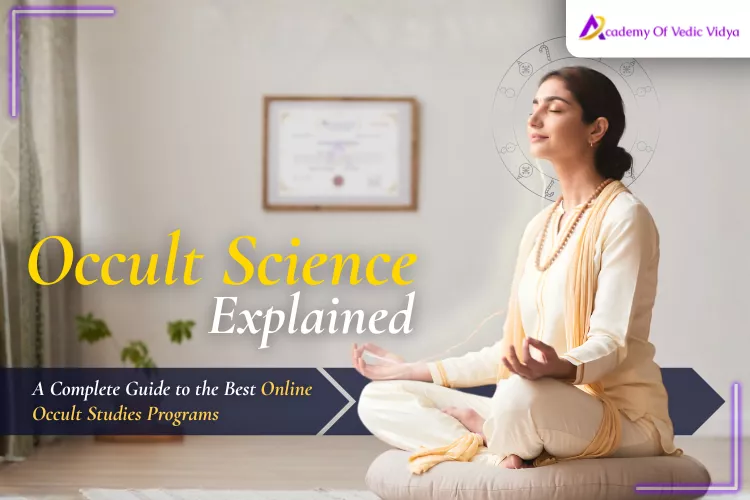
Few terms are as polarizing as “occult.” This term evokes everything from curiosity to suspicion. You might have run into this term while exploring tarot, astrology, or Kabbalah. You might also be wondering if there is an actual field of study tied to this term, or if it is simply a sophisticated term for “spiritual mystery.”
This guide will answer all of your questions. We honestly and simply explain what an occult science course is, whether it is substantiated, what differentiates it from witchcraft, and the real content of courses about it. We will also provide you the best resources to study occult science as we know that there are many of you who are open minded enough to explore this subject further.
What Is Occult Science? (And What Do People Mean by the Term?)
‘Occult science‘ primarily refers to the practice of secret or ‘hidden’ knowledge that lies beyond the scope of current explanations or recognition by mainstream science. It brings together disciplines such as astrology, tarot, numerology, alchemy, and ceremonial magic under a broad and organized framework.
So what is occult science, in the simplest terms? It’s the structured study of esoteric traditions and practices – not any single practice by itself, but the whole family of subjects that deal with hidden knowledge, symbolism, and metaphysical ideas. When people ask what do you mean by occult science, they’re often surprised to learn it’s less about spellcasting and more about the historical, philosophical, and symbolic study of traditions that have existed for centuries. It overlaps closely with what’s sometimes called esoteric science, and together, these fields make up what’s broadly known as occult studies.
Is Occult Science Real – Does It Actually Work?
Is occult science real? The honest answer is: the matter depends largely on what exactly you mean by ‘real.’ As a field of historical, cultural, and philosophical study—yes, this occult science is undoubtedly real; for these traditions have an actual existence, possess specific historical foundations, and are actively practiced and researched by scholars and practitioners across the globe.
But if the question is really “does occult really work” in terms of proving supernatural claims — whether a ritual can change outcomes or whether tarot can predict the future. That’s a whole other question and one where most fields of science do not have reliable and consistent evidence. Most of the people who are serious about this will separate the cultural and symbolic aspects (which are real and documented) from the rest and (remain unproven and debatable). This distinction helps avoid a lot of confusion later.
What Is the Scientific Basis for Occultism, If Any?
This is where the real point becomes clear, so it is better to answer thoughtfully rather than in a rush.
Is occultism scientific? The core supernatural aspects of occultism are unsupported by science. For example, divination is not thought capable of accurately predicting future events. Similarly, if rituals are thought to affect change in the physical world, science denies this as well. No studies validate these claims and no reputable researchers would devote time to them.
Nevertheless, there is a field of research called parapsychology which studies claims of the occult scientifically. The results of this research are widely thought to be inadequate. The occult science and pseudoscience debate centers on these claims. Supporters of occultism argue there are things science cannot measure. Critics of occultism, on the other hand, argue that these claims, as they are now, cannot be classified as science. Esotericism is also the focus on some newer, valid academic studies. In this field, universities focus historically and culturally on occultism and examine these claims without the supernatural assertions. Additionally, the other sides of the debate are appropriately focused on concerning the expectations of occult studies.
What Is Esoteric Science, and How Does It Relate to Occult Science?
Esoteric science knowledge systems that are usually deemed concealed, symbolic, or reserved for initiated or trained individuals. “Esoteric” translates to “inner” or “hidden,”. On the other hand, “exoteric” pertains to open and public knowledge.
Regarding “occult” science vs “esoteric” studies, there is not much of a rivalry. Espousal of both these terms is prevalent, considering their extensive overlap. Studies that can be classified as “esoteric” may be described as academic. In more broad and general terms, research under “occult” may be deemed to be mystical or more practice-oriented. Examples of Western Esotericism and Hermeticism comprising of Kabbalah, Alchemy and Hermetic Philosophy, can be described under either of the two or may be deemed to intersect based on the person describing or the use of context.
Occultism vs. Occult Science – What’s the Difference?
Many beginners struggle with these concepts.
Although occultism and occult science may seem synonymous, they are not. Occultism pertains to the practice, i.e. rituals and participation in esoteric traditions. Occult science refers to the study (with some structure) of the same traditions and their history, theory, and philosophy.
The leading difference between occultism and occult science is the distinction between the practice and the study. Actively performing rituals or participating in divination as a part of one’s spiritual practice shows a high level of devotion to occultism. Occult science, in contrast, is the research of the history and philosophy of the previously mentioned practices and rituals, while not partaking in the practice personally. In reality, these two are most often found to be in agreement. The majority of those who take an active interest in the traditions of philosophy also take an interest in ritual practice.
Is Occult Science the Same as Witchcraft?
Short answer: no, though they’re closely related and often confused.
Is occult science the same as witchcraft? No. Witchcraft refers to a practice that is often ceremonial and ritualistic and that can be aligned with various spiritual and/or religious traditions, such as Wicca. Occult science is more comprehensive and encompasses witchcraft, amongst other traditions.
When looking at occult science and witchcraft courses, the occult science course will likely be broader, dealing with more of a theoretical aspect, and covering a number of systems, including tarot, astrology, alchemy, and Kabbalah. A course on witchcraft will deal primarily with spellcraft and ritual practices of that particular tradition. Occultism and witchcraft can also be differentiated in that witchcraft is one of the more specific systems of what is classified more broadly as occult science. So, in that sense, there is more clarity on the relationship between the two.
What Subjects Are Covered in an Occult Science Course?
If you are curious what the written topics of occult science would be, there is a common forum of topics covered across well established courses.
A typical occult science course usually includes:
- The history and philosophy of esoteric traditions
- Astrology fundamentals
- Tarot and other divination systems
- Numerology basics
- Kabbalah and its symbolic framework
- Alchemy, both as historical chemistry and as spiritual symbolism
- Ceremonial and ritual magic theory
A common occult science course syllabus starts with historical and theoretical foundations before moving into specific practices. Many programs bundle related subjects together, so you’ll often see combined modules like a tarot and astrology course,
What Do You Actually Learn in an Occult Science Course?
If you are curious about what is taught in occult science on a day-to-day basis, you should know that most courses combine theoretical study and historical context with hands-on practice – such as laying out and reading Tarot cards or performing numerological calculations. Typically, the curriculum is structured in stages: it begins with fundamentals like terminology and history, gradually incorporating elements that build practical skills.
Good occult science training also usually pushes you to think critically – comparing traditions, understanding where practices come from historically, and forming your own perspective rather than just memorizing rules. This blend of theory and hands-on practice is usually what separates a genuinely educational course from one that’s mostly just entertainment.
Can You Study Occult Science in College? (Formal vs. Independent Study Paths)
Can you study occult science in college? Although within a very limited and specific scope, some universities do offer courses or full-fledged programs in fields such as Western Esotericism, Religious Studies with a focus on the occult, or the history of magic and mysticism; these are typically taught under departments of Religious Studies, History, or Philosophy. However, specific degrees in “occult science”—akin to those in biology or business studies—are rarely found, and most mainstream universities do not offer such degrees or curricula.
For this reason, those seeking formal certification or recognition in this field mostly turn to various institutions or online schools that conduct classes based on their own proprietary courses. occult science diploma programs. A government-accredited university degree isn’t the same as this, and we should be honest about that. A few specialized institutes do provide serious and advanced programs in occult sciences, but they are independently run and do not belong to recognized universities, so it is important to research the specific institute’s reputation rather than assuming any generic “accreditation” claim.
Who Teaches Occult Science Courses – and Where Can i Learn Occult Science Online?
Most instructors of occult science are a few groups. First, there are practitioners and students who have been studying and practicing for years. Second, there are independent researchers who have an academic background in the studies of religion or history. Third, there are dedicated institutes of units in the field of Esoteric. The best instructors usually have both — some academics, and some practice.
Where can I learn occult science online? There are a few online platforms that teach occult science. There are also individual occult practitioners who teach with the use of prerecorded video courses. When learning occult science, it helps to check an instructor’s background, seek sample lessons, and read honest reviews rather than relying on the marketing. Because of this, we will check the best online occult studies programs. You will learn more from this to help set your goals and work with your budget.
The Best Online Occult Studies Programs to Consider
If you’re ready to actually start learning, here’s where to look. These are some of the best online occult studies programs currently available, broken down by what they’re best suited for.
Best Free Option
There are many online courses available for free that can serve as an introduction to occult science. These courses consist of the early building blocks of trust from course creators to potential students. Usually, these course offerings contain the bare bones of occult science terminology, history, and a brief overview of a practice or two, such as tarot card reading or astrology. These courses are a great no-cost way to see if you really want to learn more about this subject.
Best Certified Option
There are multiple courses of interest to learn about occult science that are more advanced and are offered for a fee. Usually, courses of this caliber are more comprehensive and offer an assessment to receive the certification. When you are choosing courses, make sure to choose a course about occult science that emphasizes practice and the creation of a portfolio of work, as an assessment is really only of value if you actually look at it and learn something from it.
Best for Beginners
Pick courses labeled “introductory” or “foundational” for beginner options. Courses from dedicated occult schools usually offer more specialized and comprehensive content. However, beyond the single, specialized, and dedicated schools, there are some online platforms offering courses on different branches of occult science that are more economical and flexible. These include the Academy of Vedic Vidya and online listings on platforms like Coursera. While they are generally less comprehensive than full programs from dedicated occult schools, they are good options to familiarize yourself with the subject and are low-pressure options.
A flexible, cost-effective option to get started offers some of the course structures by the dedicated occult schools, without the pressure or commitment to lengthy specialized courses. This is a good option if you want to take your time and familiarize yourself.
It is important to be honest when picking a program and rating your level of interest or seriousness.
How Long Does an Occult Science Course Take?
Depth of study will affect duration, but this is a rough estimate.
The duration of Occult science courses varies. An introductory course, which may only touch on a couple of practices and a bit of history, may only take a few weeks to a couple of months. The duration of occult science courses with deeper study on several traditions, such as the study of tarot, astrology, Kabbalah, and alchemy, may be six months to a year or more.
Many programs are designed as self-paced occult science courses. This means that students are free to move through the material at their leisure, rather than having to stick to a fixed weekly schedule. Given the highly reflective nature of many of these subjects, this design is appreciated by students.
Is Occult Science Dangerous? What Beginners Should Know
This is a complicated question that deserves an answer that is not based in either fear or grown from emotion.
Is occult science dangerous? The majority of people who study the history and the symbolism of these practices have nothing to fear (similar to studying the history of a religion). The real dangers of occult science are becoming involved with a “teacher” who manipulates and exploits the vulnerable, spending a lot of money for promised “results” that will never come, and, for a small number of people, becoming truly upset or fixated on the fear of these practices.
The most safety for occult science is gained through common sense. Research teachers and schools before paying. Don’t trust someone who tells you they can change your life with a guarantee. If a practice is causing you anxiety or fear, it’s best to take a step back. Talk to a friend and see what they think. The most common mistakes of an occult science beginner are doing practices that are too advanced and leaving out important information. This can also be done with a lot of patience and a really good book or a course.
How Do I Start Learning the Occult as a Complete Beginner?
If this interests you enough to want to begin, I have a simple plan.
To learn about the occult, start by building a foundation with the history and theory before learning the practices. A beginning occult science starting point might look like:
First, learn the history of the Western hidden traditions to see where these practices are rooted.
Select one practice that you are interested in. A couple, more accessible options, are tarot and astrology.
Learn the terminology and symbolism of that practice. You can learn others after that.
When you feel comfortable, start learning other practices that may include numerology, Kabbalah, or alchemy.
While learning, find some good beginner occult science books to learn the topics without knowing everything beforehand to get you started on your journey to build your personal occult science — never the aim to master it immediately.
What Jobs Can You Get With Occult Science Knowledge?
Common careers that incorporate knowledge of the occult include tarot readers, astrologers, and numerologists who all provide paid services. Readings can be provided independently or through spiritual wellness platforms. Some practitioners combine multiple modalities and provide multiple types of readings, or they can choose to practice as a spiritual healer and combine their occult knowledge with other forms of wellness or healing practice.
There are also other options outside of spiritual practice that have a metaphysical focus, such as writing, teaching, creating online spiritually-based shops, or working in publishing or creating content related to the occult. Having real skill and a good reputation from continued practice tends to be of much more importance to the success of your practice than any singular certification, especially in niche fields like these, so be sure to think of your practice and skills as something that is constantly improving and evolving and not a destination.
Final Thoughts
For centuries, occult science has integrated history, philosophy, and pragmatics. Exploring this field may be rooted in commitment, curiosity, or concern. Regardless, it is often more beneficial to approach this field with realistic expectations. Select a practice to focus on, begin with some of the history, and choose a teacher or course carefully. Cultivating this practice will heighten your experience.