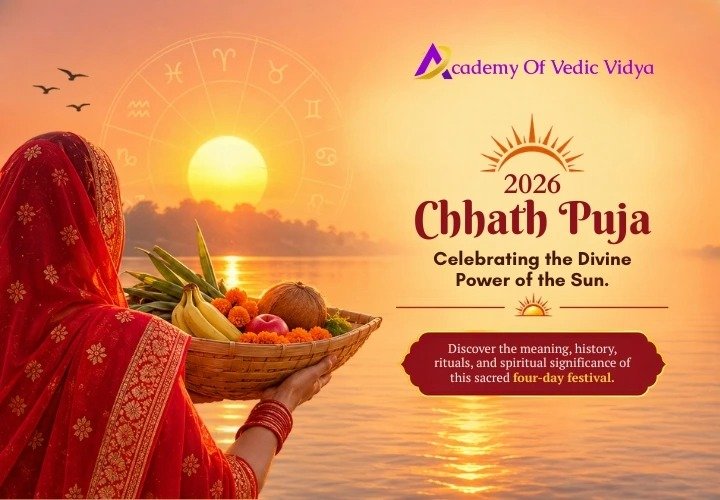
Why do thousands of people across the world take a dip in freezing cold water to celebrate Chhath? At sunset? What is the history and legend behind Chhath Puja? Find out the answer to all these questions in this article. We will provide you with the timings and dates of Chhath 2026, the story of Chhathi Maiya, the Chhath Puja vidhi, the Chhath Puja samagri, the rules and regulations, and the science behind Chhath Puja.
Chhath Puja is a four-day long festival dedicated to the deity Surya (the Sun) and Chhathi Maiya (the goddess who takes care of children). The word Chhath signifies the number six. Chhath Puja is also known as Surya Shashthi, Chhath Parva and Dala Chhath. The main rites of Chhath Puja are performed on the sixth day of the bright (Shukla) half of the lunar month of Kartik.
Chhath Puja 2026 at a Glance: The 4 Days
| Day | Name | Date (2026) | What happens |
| 1 | Nahay Khay | Friday, 13 November | Holy bath, a cleaned home, one pure meal |
| 2 | Kharna (Lohanda) | Saturday, 14 November | Day-long fast, broken after sunset with jaggery kheer and roti; the waterless fast begins |
| 3 | Sandhya Arghya | Sunday, 15 November | Offering to the setting Sun, standing in water |
| 4 | Usha Arghya and Parana | Monday, 16 November | Offering to the rising Sun; the fast is broken |
What Is Chhath Puja and Why Is It Celebrated?
The object of the ritual is to thank the Sun for providing all living things with the nourishment of life and to also make a prayer to the Sun for the health and wellbeing of all the members of the family. The public and austere nature of the ritual is most striking: the devotee, called a vratin or parvaitin, stands in a river, pond, or tank (and in recent times also in swimming pools) and offers water to the setting Sun, fruit and prasad directly to the Sun. Rich and poor stand in the same water and make the same offering, which is why many people describe Chhath as the most egalitarian festival in the calendar.
In Jyotish, the Sun is the Atmakaraka, the significator of the soul, and it governs vitality, authority and the father. That is why a Sun festival is also a health festival in tradition. Students who study Jyotish in a Online vedic astrology course in india learn to read the Sun by sign, house and dasha, and they see quickly why this one graha anchors an entire festival.
When Is Chhath Puja in 2026? (Date, Muhurat and Arghya Timings)
Chhath Puja 2026 begins with Nahay Khay on Friday 13 November and ends with Usha Arghya on Monday 16 November. The two arghya moments are fixed by your own city’s sunset and sunrise, not by a national clock.
The tithi logic is simple. According to Drik Panchang, Panchami ends at 11:23 PM IST on Saturday 14 November, and Shashthi then runs until about 2:00 AM IST on Monday 16 November. Shashthi therefore holds at sunset on Sunday 15 November, so the evening arghya falls that day. Reading a panchang this way is a core skill in any vedic astrology diploma course, because every festival date rests on the tithi that prevails at a particular moment.
Arghya timings in major Indian cities (IST, from Drik Panchang):
| City | Sandhya Arghya (sunset, 15 Nov) | Usha Arghya (sunrise, 16 Nov) |
| Patna | 5:01 PM | 6:07 AM |
| Ranchi | 5:04 PM | 6:03 AM |
| Varanasi | 5:10 PM | 6:16 AM |
| Kolkata | 4:53 PM | 5:50 AM |
| Delhi | 5:28 PM | 6:44 AM |
| Mumbai | 6:00 PM | 6:46 AM |
Different calendars show a difference of a minute or two for the same city. Families usually reach the water 30 to 60 minutes before sunset, so confirm the time with your local ghat committee or panchang on the day.
A caution on dates: some websites still list Chhath in October 2026. That is wrong for this year. The correct window is 13 to 16 November.
Why Is Chhath Puja Celebrated Twice a Year?
Chaiti Chhath is celebrated during the month of Chaitra (March-April) and Kartik Chhath in the month of Kartik (Oct-Nov). Both are celebrated on the Shukla Shashthi. The festival lasts for a period of four days in both cases. Kartik Chhath is a bigger festival in comparison to Chaiti Chhath. Celebrations are mostly confined to the state of Bihar and Jharkhand. Chaiti Chhath is a smaller affair.
The sources I reviewed do not give one agreed scriptural reason for the two dates, so treat any single explanation with caution. What is clear is the calendar logic: the same Shukla Shashthi vrata is kept in two different lunar months. That month, paksha and tithi logic is the same system you learn in a learn vedic astrology step by step online a lunar month, a paksha, a tithi, and the rule that the tithi at the right moment decides the day.
Is Chhath Puja Only Celebrated in Bihar?
No. Chhath began in the Bhojpuri, Magahi and Maithili regions and is kept most intensely in Bihar, Jharkhand, eastern Uttar Pradesh and the plains of Nepal. Migration has taken it far beyond.
Delhi, Mumbai, Kolkata and other major cities have hundreds or thousands of temporary ghats on the Chhath days, and the diaspora does it in the USA, UK, Canada, Australia, UAE, Singapore, Mauritius and elsewhere. In countries without rivers, communities have performed Chhath at lakes, tanks or artificial ponds arranged by local samitis.
Who Is Chhathi Maiya? (The Chhath Mata Story)
Chhathi Maiya is the other goddess who is worshipped during Chhath, and she is believed to be the goddess of children and give longevity to her devotees. She is identified with Shashthi Devi, and the Brahma Vaivarta Purana describes her as the sixth part of Prakriti, the creative nature principle. In the same tradition, she is also Devasena and is described as the mind-born daughter of Lord Brahma. Folk tradition of Bihar describes her as the sister of Surya. In some other traditions, she is described as Usha and Pratyusha (the lights of dawn and dusk). This description fits well with the nature of a festival which is celebrated around sunrise and sunset.
Some writers equate Chhathi Maiya with Katyayani, the sixth form of Durga worshipped in Navratri. Others keep the two distinct, and families follow their own lineage on this point.
The story of King Priyavrata. The best-known story, drawn from the Puranic tradition, concerns King Priyavrata, son of the first Manu, and his queen Malini. The couple had no child. After a yajna conducted by the sage Kashyapa, the queen bore a son, but the child was stillborn. As the grieving king prepared to give up his life, a radiant goddess appeared and said she was Shashthi, who protects all children. She revived the child and asked the king to spread her worship. Priyavrata observed her vrata on Kartik Shukla Shashthi, and the tradition says this is the root of the day’s observance.
Why Is Surya Dev Worshipped in Chhath Puja?
Surya is worshiped because in Hinduism the Sun is the only God that people can view and that every creature on the planet is dependent on. The Vedas depict that Sun is the visible form of the divine, source of life, nourishment and the pole around which seasons and time revolve. Chhath cultivates this thought into a concrete act. No idol stands between the worshipper and the Sun.
Chhath has a feature that differentiates it from the rest of the Sun worship. While others worship the rising Sun, Chhath worships the setting Sun, and then the rising one. It is believed that the teaching of gratitude applies to the fading as well as the rising. Most rituals worship the rising sun which symbolises growth. Gratitude for the setting sun teaches us to view the entire cycle of the day and of life as well.
The Jyotish Sun signifies the soul, the father and vitality of a person. A weak or afflicted Sun in a birth chart classically indicates low vitality, a strained relationship with the father, and/or lack of recognition. Sun worship, along with water are remedies to this. Water also enters the picture, since the Moon rules water and the mind, so standing in a river brings both luminaries into the rite. For a detailed analysis on the Sun and its impact in a natal chart, refer to.
Chhath Puja History: What the Mahabharata, Ramayana and Vedas Say
Tradition traces Chhath to the earliest Surya worship of the Vedic age, when sages are said to have kept long fasts and invoked the Sun with Rigvedic hymns. The Rigveda does contain hymns to Surya, and the structure of Chhath, standing in water and offering to the Sun, belongs to that old family of rites. Specific Chhath legends then come from the epics and the Puranas.
The Mahabharata connection
Several threads run through the Mahabharata. Kunti is said to have kept the vrata after the Pandavas escaped the house of lac. Karna, the son of Surya and Kunti, is remembered as a devotee who stood in water each day to offer arghya to his father, and the Anga region he ruled corresponds to the Bhagalpur area of Bihar. Draupadi and the Pandavas are said to have observed Chhath during their years of hardship, on a sage’s advice, to regain what they had lost. A village called Nagdi near Ranchi preserves a local belief that Draupadi worshipped there, and the festival is held at a spring rather than a river.
The Ramayana connection
In the Ramayana tradition, Rama and Sita fasted and worshipped the Sun on Shashthi after their return to Ayodhya, and Sita is said to have kept the Chhath vrata. Local traditions name places tied to her: the Sitacharan site on a rock in the Ganga at Munger, and the Narayani river banks in the Champaran and Chitwan region, where Sita is believed to have stayed at Valmiki’s ashram.
Other accounts name Buxar as the place of Surya’s birth to Aditi on this very day, and credit the Gahadavala rulers with spreading the festival from Varanasi. These regional accounts differ, and each family keeps the story its elders told.
Why Is Chhath Puja Not Performed in Temples? Which Water Body Is Used?
Chhath is not performed in temples because it needs no image, no priest and no enclosed shrine. The deity is the Sun itself, and the proper place to worship it is open ground at the water’s edge. The devotee makes the offering directly, without an intermediary.
Any clean, flowing or large body of water works: a river such as the Ganga, a pond, a lake, a canal or a village tank. Where none exists, communities build temporary tanks, and some families use a clean tub or a backyard pool. Water is the point because the arghya is poured as the Sun’s light touches it, and because standing in water is a mark of surrender and discipline.
Sun temples do exist, such as the Deo Surya Mandir in Aurangabad, Bihar, and some ghats have shrines nearby. The Chhath rite itself, however, does not depend on them.
Chhath Puja Vidhi: The 4 Days Step by Step
Day 1: What Is Nahay Khay in Chhath Puja?
Nahay Khay, “bathe and eat”, begins the vrata. The vratin takes a holy bath, ideally in a river, and the entire house and kitchen are cleaned. One sattvic meal is cooked without onion or garlic, usually bottle gourd (lauki) with chana dal and rice, often using rock salt. It is offered first and then eaten by the vratin, and the rest of the family eats afterward. This is the last full meal before the long fast.
Day 2: What Is Kharna in Chhath Puja?
Kharna, also called Lohanda, is a day-long fast. After sunset the vratin worships and eats rasiao, a kheer of rice, milk and jaggery, with roti. Many families cook it on a fresh clay stove with mango wood and prepare it without salt. The prasad is eaten in quiet and then shared with family and neighbours. After this meal the waterless fast begins.
Day 3: What Is Sandhya Arghya?
Sandhya Arghya is the main day. The day goes into preparing thekua and arranging the bamboo soop and daura. In the late afternoon the family walks to the ghat, often with the daura carried on the head and Chhath songs sung along the way. The vratin stands in the water and offers arghya, water or milk, while the soop of fruit and prasad is raised toward the setting Sun.
At home that night, many families perform kosi bharai: five to seven sugarcane stalks are tied into a canopy, and twelve to twenty-four diyas are lit beneath it with thekua and fruit placed inside. The same rite is repeated before dawn.
Day 4: What Is Usha Arghya?
Usha Arghya is the offering to the rising Sun. The family returns to the ghat before sunrise, and the vratin offers arghya and prays to Chhathi Maiya for the children and the household. Then comes parana: the vratin breaks the fast with a little prasad and water, and the prasad is shared with everyone present.
Why Do Women Fast for 36 Hours in Chhath Puja?
Women, who usually observe the fast, fast because the Chhath Vrat is a vow taken for the welfare of children and family, and the rigor of this fast is part of the sacrifice. The fast lasts from the Kharna Bhoj on Saturday evening to Parana on Monday morning, which is about 36 hours without food or water. This rigor, standing in cold water and waiting for the sun for a long time, is considered as penance.
Men also keep the fast, and Chhath is not a gender-restricted festival.
A health note. There are real risks to this long waterless fast. Pregnant or breastfeeding women, people with diabetes, heart disease, kidney disease, or high blood pressure, older adults, and those taking regular medication should consult their doctor before proceeding. Children should attend the alms without fasting. Traditionally, modified fasts or having a family member perform the fast on behalf of another person are permitted. If a person fasting experiences fainting, confusion or chest pain, they should stop the fast and seek medical attention.
Chhath Puja Samagri List
Prepare these before Nahay Khay so that nothing is missing on the day.
Core items
- Soop, the bamboo winnowing basket on which the prasad is raised
- Daura or dauri, the deep bamboo basket that carries everything to the ghat
- Thekua and kasar laddu (rice flour and jaggery)
- Sugarcane stalks with their leaves
- Bananas, coconut, sweet lime or citron, water chestnut, sweet potato, radish
- Whole turmeric and ginger plants with leaves, if your family’s custom includes them
- Diyas, ghee and cotton wicks
- A copper, brass or steel lota or kalash for the arghya water or milk
Puja items
- Rice, sindoor, flowers, betel leaf and supari, incense
- Ganga jal, if available
- New or freshly washed clothes: commonly a cotton sari for women and a dhoti for men
For Kharna
- Rice, milk, jaggery and wheat flour for the rasiao kheer and roti
Bamboo soops and dauras are sold in markets before the festival. Abroad, many families use a clean steel plate or a wicker tray when bamboo is unavailable.
What Is Thekua Prasad Made Of?
Thekua is the main prasad of the Chhath festival. It is a chewy, sweet cookie made from flour, jaggery and ghee. Many families add dried coconut, cardamom or fennel to it. The dough is pressed into a wooden mold called a sancha and slowly fried in ghee until golden-brown. Other traditional offerings are also kept alongside it. Kasar is a laddu made from fried rice powder and jaggery. Rasiya is a jaggery-based milk pudding eaten during the Kharna festival. In some regions, rice laddus filled with coconut and jaggery are added and the soup contains seasonal fruits. Everything is vegetarian and made without onions or garlic, and the person cooking does not taste the food while it is being prepared..
What Are the Rules of Chhath Puja? (Do’s, Don’ts and Eligibility)
Do’s
- Keep the home, kitchen and path to the ghat clean throughout the four days.
- Cook prasad separately, often on a new clay stove with mango wood.
- Use natural, biodegradable materials such as bamboo, clay diyas and leaf plates.
- Offer arghya exactly at your local sunset and sunrise.
- Break the fast only after Usha Arghya, and share the prasad first.
Don’ts
- Do not bring onion, garlic, meat, eggs or alcohol into the house for the four days.
- Do not taste the prasad while cooking it.
- Do not touch the offerings without bathing and purifying yourself first.
- Do not take plastic, polythene or synthetic items to the ghat or into the water.
- Do not drink water during the nirjala stretch unless your health requires it.
Can men observe the Chhath Puja fast?
Yes. Women are the majority of vratins, but Chhath is not restricted by gender, and many men keep the full vrata.
Can unmarried girls do Chhath Puja?
The sources I reviewed do not mention any specific rules. This vow is usually taken for family and children, so its practice varies from family to family and region. Follow your own family’s customs and ask your elders.
What happens if Chhath Puja is missed or the fast is broken?
There are variations from family to family. In some communities, once a family has taken the Chhath Vrat, they observe it every year, only stopping it if someone in the family dies, and the practice may be discontinued permanently if they take a break for a year. Other communities consider it optional. If the vow is broken for any reason, families usually consult their elders or the family priest about the proper way to continue the vow. Health is always paramount: If you need to drink water or eat something for medical reasons, do so and, as per tradition, another family member can observe the vow on your behalf.
Is There a Scientific Reason Behind Chhath Puja?
Many popular articles claim that Chhath Puja boosts immunity, absorbs solar energy, detoxifies the body, and delays aging. These claims are widely repeated, but the sources behind them do not show any controlled studies and this guideline does not consider them to be proven.
What can be said with confidence is more modest and still substantial:
- Sunrise and sunset timing. The ritual falls at dawn and dusk, when sunlight is gentle. Vitamin D synthesis needs stronger UV, which arrives at midday, so the timing is about devotion and discipline, not about Vitamin D.
- Ecology. No idols are immersed, and the materials are bamboo, clay, fruit and leaves. This makes Chhath one of the lowest-waste festivals in the Hindu calendar, and many communities clean the ghat together before the puja.
- Community and mental health. Shared preparation, folk singing and collective effort strengthen social bonds, and gratitude practice has recognised benefits for wellbeing.
- Fasting and cold water carry risk. They are physical stressors, which is why the health note above matters.
Treat Chhath as a spiritual discipline with ecological and social value, not as a medical treatment.
Chhath Puja Songs and Folk Traditions
Chhath Geet, the folk songs of the festival, are sung in Bhojpuri, Maithili and Maghi languages while making thekua, walking towards the ghat and waiting for the sun. These songs talk about the bamboo baskets bending under the weight of offerings, the mother’s vows and prayers for the well-being of the family. The late Sharda Sinha made many of these songs known beyond Bihar and her voice is still associated with the Chhath festival for millions of listeners. Listen to the version that is already sung in your family, as the tune often changes from village to village.
How Do You Keep Chhath Puja Abroad or Without a River?
The dates are the same around the world, November 13 to 16, but you will offer the offerings at sunset and sunrise in your own city. Do not use Indian time. The approximate local times for sunset on November 15 and sunrise on November 16 are:
| City | Sandhya Arghya (sunset) | Usha Arghya (sunrise) |
| New York | 4:38 PM | 6:44 AM |
| Toronto | 4:52 PM | 7:13 AM |
| London | 4:11 PM | 7:20 AM |
| Dubai | 5:32 PM | 6:37 AM |
| Sydney | 7:36 PM | 5:43 AM |
The United States and the United Kingdom have already changed their clocks, so sunsets are earlier. Check the exact time in your city that day. Where there is no river, there may be a community-approved lake, pond, or reservoir. At home, a clean tub or backyard pool works, and in cold weather, spend less time in the water. In an apartment, a clean container of water and a sunny location are acceptable for many families.
FAQs
Do I need a priest for Chhath Puja?
No. The core ritual involves no priest and no idol, and the devotee offers directly to the Sun.
Can children take part?
Yes, children can join the ghat visit and the arghya, but they should not keep the nirjala fast.
What is kosi bharai?
It is a night rite in which sugarcane stalks form a canopy with lit diyas beneath it, and prasad and fruit are placed inside. It is performed on the evening of Sandhya Arghya and again before dawn.
What should a vratin wear?
Clean, unstitched or freshly washed clothing is traditional, commonly a cotton sari for women and a dhoti for men. Families follow their own custom.
Can I visit a Chhath ghat if I am not fasting?
Yes. Family, neighbours and onlookers all take part, and anyone present may receive the prasad.
Final Thoughts
Chhath Puja 2026 requires four days of restraint: a clean house, a holy kitchen, a long fast, and a silent offering to the sun at the end of the day and on the return. Whether you observe this vow yourself, support a family member, or simply stand at the ghat, the festival teaches the same lesson. Gratitude should be expressed to both the setting and rising suns. Happy Chhath Puja to you and your family.
Festivals like Chhath rest on the panchang, the tithi and the role of the Sun in a chart. The Professional Diploma in Vedic Astrology at Academy of Vedic Vidya teaches you how to read all of it, step by step, with the guidance of an experienced instructor.
Enroll now → Professional Vedic Astrology Course