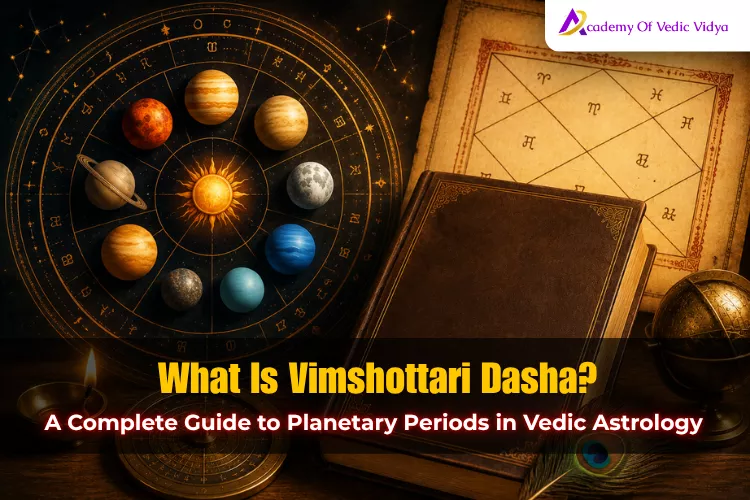
Most people who open their kundli for the first time ask the same question: “When will this actually happen to me?” Your birth chart shows potential – a strong 10th house, a well-placed Venus, a powerful Jupiter. But potential isn’t timing. Vimshottari Dasha is the system that tells you when that potential activates, and it’s the single most-used predictive tool in all of Vedic astrology.
Vimshottari Dasha is a 120-year cycle of nine sequential planetary periods. Then again, each is ruled by one of the nine grahas (Sun, Moon, Mars, Rahu, Jupiter, Saturn, Mercury, Ketu, Venus). So, which planet’s period you’re born into — and how much of it remains. After all, it is fixed by the exact position of the Moon in your birth Nakshatra. As a result, every major life event you experience is read through the lens. This is of whichever planet is “running” at that time.
What Is Vimshottari Dasha?
Vimshottari Dasha is a Nakshatra-based system of planetary time periods. This is, after all, used in Vedic astrology to time events in a person’s life. “Dasha” is Sanskrit for “period” or “state,” and in astrology it refers to the span of time. As a result. specific planet dominates the themes of your life. Your career, relationships, health, and mindset all take on the character of whichever planet is ruling.
Sage Parashara codified the system in the Brihat Parashara Hora Shastra. The foundational text of Vedic astrology, and also remains the default timing method taught in nearly every best Vedic astrology course online. This is because it applies to every birth chart without exception – unlike several of the alternative Dasha systems. Thus only apply under specific chart conditions.
Why Is It Called Vimshottari Dasha?
“Vimshottari” comes from the Sanskrit words vimshati (twenty) and uttara (more than), together meaning “one hundred and twenty.” The name, after all, refers directly to the total length of the cycle: 120 years. As a result, treated in Vedic tradition as the maximum natural lifespan of a human being. The name isn’t decorative but a literal description of what the system measures: your full potential lifetime, divided among the nine planets.
What Is Vimshottari Dasha Based On?
Vimshottari Dasha is calculated entirely from the Moon’s Nakshatra at the moment of birth. Not the Sun sign, not the Ascendant. The sky is, after all, divided into 27 Nakshatras, and each one is assigned a ruling planet in a fixed, repeating sequence. So, whichever Nakshatra the Moon occupies at your birth determines the ruling planet of that Nakshatra. And also, that planet’s Mahadasha is where your personal Dasha timeline begins.
This is exactly why Nakshatra knowledge has to come before Dasha knowledge. After all, you can’t calculate a Vimshottari Dasha without first correctly identifying the birth Nakshatra. And the Moon’s exact degree within it. So, if you haven’t worked through how Nakshatras function yet, it’s worth reading our guide on what Nakshatra astrology means before going further here, since every calculation below depends on it.
What Is the Order of Vimshottari Dasha Planets?
The sequence of planets in Vimshottari Dasha is always fixed – it never changes from person to person. So, only the starting point in that sequence changes, based on the birth Nakshatra. The full order, after all, with the number of years assigned to each planet, is:
| Order | Planet (Graha) | Duration |
| 1 | Ketu | 7 years |
| 2 | Venus | 20 years |
| 3 | Sun | 6 years |
| 4 | Moon | 10 years |
| 5 | Mars | 7 years |
| 6 | Rahu | 18 years |
| 7 | Jupiter | 16 years |
| 8 | Saturn | 19 years |
| 9 | Mercury | 17 years |
Added together, these nine periods total exactly 120 years — the full Vimshottari cycle. After Mercury’s 17-year period ends, the sequence loops back to Ketu and repeats, though few natal charts are read past the first full cycle. For a refresher on what each of these nine grahas actually governs in a chart before you study their Dasha effects, see our breakdown of the nine planets in Vedic astrology.
How Many Years Is Each Vimshottari Dasha?
Each planet’s Mahadasha length is fixed and never varies by individual – only when you enter it varies. For example. Venus and Saturn run the longest at 20 and 19 years; Sun and Ketu run the shortest at 6 and 7 years. Then again, a longer Mahadasha doesn’t mean a “better” or “worse” period. Instead, it simply means that the planet’s themes have more time to unfold and mature in your life, for better or worse depending on its placement in your chart.
How Is Vimshottari Dasha Calculated From Date of Birth?
Calculating your Vimshottari Dasha by hand takes three steps:
- Find the Moon’s exact Nakshatra and degree at birth. This requires an accurate birth time, date, and place, since the Moon moves roughly one degree every two hours – a birth time error of even 15–20 minutes can shift the Nakshatra reading.
- Identify the ruling planet of that Nakshatra. Each of the 27 Nakshatras is assigned one of the nine planets. As a result, its lord cycles through the Vimshottari sequence three times (27 Nakshatras ÷ 9 planets = 3 full cycles).
- Calculate the “balance of Dasha” at birth. You weren’t born at the exact start of that planet’s period – you were born partway through it. So, we calculate the balance proportionally: (degrees remaining in the Nakshatra ÷ total degrees of the Nakshatra) × the full Dasha length of that planet. This tells you exactly how much of the first Mahadasha remained when you were born, and from there every subsequent Mahadasha and Antardasha follows in fixed sequence and duration.
In practice, software handles this calculation today because of how precise the birth time input needs to be – but understanding the logic behind it is what separates reading a Dasha chart from actually interpreting one. This is exactly the kind of calculation you’ll work through hands-on in a complete Vedic astrology course, where you learn to verify software output rather than depend on it blindly.
What Are Mahadasha and Antardasha in Vimshottari Dasha?
Mahadasha is the main planetary period – the 6-to-20-year span ruled by one of the nine planets. Antardasha (also called Bhukti) is a sub-period within that Mahadasha. After all, each of the nine planets gets a smaller slice of time inside the larger one, in the same fixed Vimshottari sequence.
For example, during a Jupiter Mahadasha (16 years), you will pass through nine Antardashas in order — Jupiter-Jupiter, Jupiter-Saturn, Jupiter-Mercury, and so on – each proportional in length to that planet’s overall Dasha share. This is why two people running the same Mahadasha can have completely different experiences: the Antardasha lord layered on top changes the flavor of the period significantly.
To understand the exact differences and planetary relationships, read our detailed guide on Mahadasha vs Antardasha
What Is Pratyantar Dasha in Vimshottari?
Pratyantar Dasha (also called Pratyantardasha) is the third and even more precise layer of timing – a sub-period within the Antardasha. The full hierarchy of Vimshottari Dasha, from broadest to most precise, runs:
Mahadasha → Antardasha → Pratyantardasha → Sookshma Dasha → Prana Dasha → Deha Dasha
Most practical astrological readings work down to the Pratyantardasha level, since this is usually precise enough to pinpoint the timing of a specific event – a marriage, a job change, a relocation – within a window of weeks to a few months, rather than years.
How Does Vimshottari Dasha Affect Life Events?
A Dasha period doesn’t cause events on its own. Instead, it activates the themes that are already promised in your birth chart, at the time indicated by the ruling planet. To read a Dasha period correctly, an astrologer examines:
- Firstly, the house the Mahadasha or Antardasha lord occupies in the birth chart
- Secondly, the houses it rules and what life areas those houses represent
- Thirdly, its sign placement and dignity (exalted, debilitated, own sign, etc.)
- Fourthly, Aspects it receives from benefic or malefic planets
- Finally, whether it is functionally benefic or malefic for that specific Ascendant
A well-placed planet’s Mahadasha or Antardasha tends to bring growth in the areas it governs – career advancement during a strong 10th-lord period, for instance. A poorly placed or afflicted planet’s period tends to bring friction or delay in those same areas. This is why the same Mahadasha (say, Saturn) plays out completely differently for two different people – the planet is identical, but its placement, dignity, and house lordship in each chart are not.
A worked example: Marriage timing is one of the most common questions Dasha analysis is used for. In practice, astrologers look for the Antardasha of the 7th house lord (the house of marriage and partnership) occurring within a Mahadasha that also supports relationships – often the Mahadasha of Venus, the Moon, or the 7th lord itself. If the 7th lord is additionally well-aspected by benefics like Jupiter during that specific Antardasha window, the timing is read as favorable for marriage. The same logic applies to career changes (10th house lord’s Antardasha), health concerns (6th, 8th, and 12th house lords), and financial growth (2nd and 11th house lords) — the Mahadasha sets the broad multi-year theme, and the Antardasha narrows it down to the specific window when that theme is most likely to activate.
How to Find Your Current Dasha Period
To identify which Mahadasha and Antardasha you’re currently running, you need your accurate birth date, time, and place fed into a Vimshottari calculation – either through software or by working through the balance-of-Dasha formula described above. Once you know your starting Mahadasha and its balance at birth, every subsequent Mahadasha, Antardasha, and Pratyantardasha follows in the fixed nine-planet sequence with fixed proportional durations, so the full 120-year timeline can be mapped out in advance. What changes with experience is not the calculation – it’s the interpretation of what each period actually means once you factor in that planet’s unique placement in your specific chart.
What Happens During Rahu Mahadasha?
Rahu’s 18-year Mahadasha is one of the most-discussed periods in Vedic astrology because Rahu is a shadow planet (chhaya graha) with no physical body of its own – it represents desire, ambition, and unconventional paths. Depending on its house and sign placement, a Rahu Mahadasha commonly brings:
- Strong material and career ambition, often with rapid, unconventional growth
- Foreign connections – travel, relocation, or work tied to other countries
- Sudden, disruptive changes rather than gradual ones
- Themes tied to whichever house Rahu occupies and whichever house it rules
Because Rahu has no classical “own sign,” astrologers read its results almost entirely through its house placement, the sign it sits in, and the planets that aspect or conjunct it – more so than for most other grahas.
Is Vimshottari Dasha Accurate?
Vimshottari Dasha is the most widely applied and time-tested Dasha system in the Vedic astrological tradition, and it has been the default timing method taught and practiced for over a thousand years because it works across every birth chart without needing special conditions to apply. That said, a Dasha period on its own describes a theme and a timing window, not a guaranteed outcome. Then again, the accuracy of any reading depends heavily on having a precise, verified birth time, and on cross-checking the Dasha against the planet’s actual placement in the chart and its transits during that period. As a result, experienced astrologers rarely read Vimshottari Dasha in isolation; they confirm it against transits (Gochar). Also, in more complex cases, against a second Dasha system for the same window.
Vimshottari Dasha vs. Other Dasha Systems
Vimshottari is the most commonly used Dasha system, but it isn’t the only one taught in classical Vedic texts. Here’s how it compares to the other major systems:
| System | Cycle Length | Planets Used | When It’s Applied |
| Vimshottari Dasha | 120 years | All 9 (including Rahu & Ketu) | Universal — applies to every chart |
| Ashtottari Dasha | 108 years | 8 (excludes Rahu) | Conditional — specific birth-time/Paksha combinations |
| Yogini Dasha | 36 years | 8 (excludes Ketu) | Used as a faster, complementary cross-check system |
| Kalachakra Dasha | Variable | Nakshatra-Pada based | Used for finer-grained, non-linear timing |
| Chara Dasha (Jaimini) | Variable | Sign-based, not planet-based | Used mainly for career, fame, and public-life events |
Vimshottari remains the primary system most Vedic astrologers learn first and rely on most heavily, because unlike Ashtottari (which is conditional on the exact time and lunar phase of birth) or Yogini (which excludes Ketu entirely), it applies universally to every chart with no exceptions.
Common Mistakes When Reading Vimshottari Dasha
- Reading the Mahadasha lord’s general nature instead of its actual chart placement. Venus Mahadasha isn’t automatically about romance — it depends entirely on which house Venus occupies and rules in that specific chart.
- Ignoring the Antardasha lord. A benefic Mahadasha with a poorly placed Antardasha lord can still bring a difficult few months or years within an otherwise favorable period.
- Using an inaccurate birth time. Since the entire system starts from the Moon’s exact degree in its Nakshatra, even a small birth-time error can shift the starting Dasha balance and throw off every subsequent period.
- Treating Dasha as a standalone prediction tool. Serious practitioners always cross-check Dasha against transits and divisional charts before finalizing a reading.
FAQs
Does Vimshottari Dasha work the same way for every birth chart? Yes — it’s one of the few Dasha systems in Vedic astrology considered universally applicable, with no special birth-time conditions required, which is why it’s the default system taught first.
Can two people have the same Mahadasha but completely different experiences? Yes. The Mahadasha planet is the same, but its house placement, sign, dignity, and aspects are unique to each birth chart, which changes how that period actually unfolds.
Do Antardasha and Pratyantardasha use the same planetary order as Mahadasha? Yes — every sub-period level follows the identical nine-planet Vimshottari sequence, just calculated proportionally within the smaller time window.
Is a Dasha period the same as a planetary transit? No. A Dasha shows which planet’s themes are dominant in your life over months or years based on your birth chart; a transit (Gochar) shows where the planets are moving in the sky right now. Astrologers typically read both together for accurate timing.
Why do some astrologers use a different Dasha system instead of Vimshottari? Because certain charts, or certain questions, are traditionally read more clearly through a different lens — Ashtottari for specific Paksha-based birth conditions, Chara Dasha for career and public-life timing, or Yogini as a faster secondary check. Vimshottari remains the default starting point precisely because it applies to every chart without needing any of those special conditions.
Final Thoughts
Understanding Vimshottari Dasha at a conceptual level is the first step – actually calculating and interpreting Mahadasha, Antardasha, and Pratyantardasha for a real birth chart is a skill built through structured practice. Academy of Vedic Vidya, Online vedic astrology course with certificate walks you through Dasha calculation and interpretation step by step, with an experienced instructor, so you can read planetary periods with the same precision as the examples in this guide.
Enroll now → Occult Science Courses