If you’ve attempted to access your Akashic Records and nothing happened except thoughts in your head, chances are the issue is your brainwave state, and not the invocation you used. Most people try to access the Records while in a Beta state, and your brain never opens the Records from this state.
The Akashic Records are accessed in the Theta state, which is a slower 4-8 Hz brainwave cycle. People can learn how to get into the Theta state intentionally and safely, and that skill is what enables them to perform an effective Akashic Records reading. It’s the quality of the brain state that matters, not the invocation. This is the thing that most beginner’s guides completely miss, and it’s worth learning the basics of how your brain works before you do any meditating.
Your brain goes through several cycles as it relaxes, from Beta down through Alpha and Theta (and eventually Delta, if you fall asleep). The Akashic Records open most easily in the Theta state, which is also the hypnagogic state you’re briefly in for a few seconds every night as you fall asleep. The objective in learning a protocol for accessing the Records is to stay in this window long enough to receive the information you’re seeking, instead of simply passing through it on the way to sleep — the thing that most structured Akashic Records course training will teach you how to do.
This is also the place where things like binaural beats can be helpful, as they encourage your brain to settle down into the slower frequencies. A binaural beat encourages the brain to adopt the frequency it’s hearing, by playing slightly different tones in each ear, so that the brain hears a “beat” created by the interference of the two sounds.
However, learning how to get into Theta is only half the battle. Knowing how to navigate the Records safely and effectively – to ask the right questions, and to distinguish between your own thoughts and the answers coming from the Records – is the other, and it takes practice to develop that skill. This is what a self-paced Akashic Records certification course in India can help you to learn, which is why we’ll examine the science behind the process and walk through a basic protocol in detail.
What Is a Theta Brainwave State, and Why Does It Matter Here?
Theta brainwaves are generally in the 4-8 Hz range, and are associated with vivid imagery, relaxation, and a lessening of the normal filters that perception puts on reality. You experience this state twice per day, as you fall asleep and as you wake up – hence why so many people have strange impressions and insights at those vulnerable moments.
The reason that the Theta state is relevant to accessing the Akashic Records is related to what it suppresses: the Beta state is all of the processes in your brain that contribute to a sense of self-monitoring and filtering, and those are extremely useful skills in day-to-day life, but they also prevent you from having insight in the same way that the Akashic Records provide.
As your brainwaves slow from the Beta state down through the Alpha and into the Theta range, these processes begin to shut off, and the ability to have a psychic impression or an intuitive “flash of insight” becomes accessible again. A lot of people have trouble getting to the Theta state, which is why the first lesson in most beginner’s guides to reading the Akashic Records is learning how to access the state safely and consistently. For those comparing options and looking for the Best Akashic Records course, learning whether a program teaches this foundational practice clearly and provides enough guidance for developing consistency can be an important consideration, as it is often presented as a prerequisite for a successful reading.
The Brainwave Ladder: How Your Mind Moves From Beta to Theta
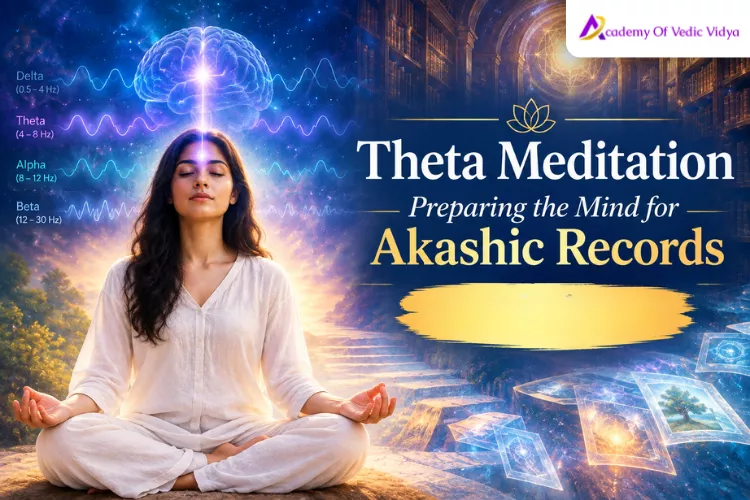
This is the ladder your brain climbs as it moves from the Beta state down into the Theta range and beyond, which is useful to know because it gives you context for what’s happening as you meditate.
- Beta (13-30 Hz): Alert, awake state associated with active thinking and problem-solving.
- Alpha (8-13 Hz): A relaxed but aware state; most people find themselves in this state in the first few minutes of practicing eyes-closed breathing.
- Theta (4-8 Hz): The meditative state, associated with decreased self-awareness and vivid mental imagery. This is where most people find themselves when they can first begin to access the Akashic Records.
- Delta (0.5-4 Hz): The state of dreamless sleep, useful for physical healing but not for conscious questioning or communication.
The purpose of a theta meditation protocol is to slow the mind’s activity level down from the Beta state, and to remain in the slower range long enough to access the Akashic Records.
What Role Does the Pineal Gland Play in Altered States?
The pineal gland is a structure at the center of your brain that produces the hormone melatonin, which regulates your sleep cycle. In many spiritual traditions, the pineal gland is viewed as the physical manifestation of the “third eye” and is associated with clairvoyance and intuitive vision; meditation practices to “open” the third eye generally focus on visualization at the space between your eyebrows in combination with breathing and darkness.
When it comes to the scientific basis for these beliefs, we know for a fact that deep meditation and relaxation increase levels of melatonin in the body – which is why it’s a good idea to meditate before bed, as it will help you to fall asleep faster. We also know that there is a correlation between intense out-of-body experiences and the pineal gland, due to its high concentration of serotonin receptors and its possible role in generating DMT, but that’s a controversial and unproven theory from the fringe of both scientific and spiritual thought – the fact that people have out-of-body experiences while in an altered state of consciousness is indisputable, but the exact reason for it is something of a holy grail for neuroscientists.
For anyone exploring these practices or comparing the Best Akashic Records course online, it is important to distinguish established findings about the pineal gland and meditation from spiritual interpretations and theories that have not been scientifically established. The experience itself can feel very real to the person having it, but explaining exactly why such experiences occur remains an open question.
How Binaural Beats Help You Reach Theta
Binaural beats are an audio file format that takes advantage of the way your brain processes sound, and requires the use of stereo headphones in order to work. A slightly different musical note is played in each ear, and your brain interprets the difference between them as a single beat, which creates a third tone that’s actually in the Theta range.
Your brain follows along at that frequency, which helps you to get into the Theta state faster than you might be able to on your own. This is a valuable tool for beginners, as it can help you get past the slower Alpha state and into the faster flow of the Theta range, where the Records can be accessed. Over time, most people find they don’t need it, as they get more comfortable with the feeling of the Theta state and can get there without the assistance of the beats.
Step-by-Step: A Theta Meditation Protocol for Opening the Akashic Records
- Set the scene, dim the lights: Find a place to meditate and put on your headphones. It’s important to get into a consistent space so that your brain learns to associate the location with the Theta state, which is why this is a good beginner’s exercise to leave out distracting background noises.
- Choose your entertainment track: Select a binaural beat or isochronic tone in the 4-8 Hz range and put it on at a comfortable volume.
- Lower your breathing: Sit (or lie) comfortably, close your eyes, and take five slow breaths in through your nose, holding the air in for a moment before exhaling evenly out through your mouth.
- Body scan into Alpha: Let your awareness slowly move from your toes up to the top of your head, relaxing as you go. Most people will notice a shift into the Alpha state as soon as they begin this process, and it generally takes about 3-5 minutes for most people to fully settle into that state.
- Shift to the space between your eyebrows: Allow your awareness to settle at the center of your brow, another traditional meditation focus point.
- State your intention: Declare that you intend to open your own Akashic Records for your personal guidance and highest good, either silently or aloud.
- Use an invocation: Say a prayer or invocation to open the Records. Many people at this point will use the Pathway Prayer Process, as it’s a standardized and easily-learned set of instructions for doing so.
How Long Should You Meditate, and How Will You Know You’ve Reached Theta?
Most people will need to use an entertainment track for 10-20 minutes before they can reach the Theta state for the first time, although some people (particularly more experienced meditators) will find that they’re able to get there in under five minutes. You can tell that you’ve gotten past the Alpha state when your perception of time becomes unsteady, your thoughts begin to lose the structure of full sentences, and you generally feel like your mind is floating. Some people will also experience what feels like a sudden hypnagogic jerk at the boundary between Alpha and Theta, which can be useful as a sign that you’ve just crossed into the range you’re looking for.
Common Mistakes That Keep You Stuck in Alpha
- Trying too hard: Effort and analysis are traits of the Beta state, and the harder you try to get to the Theta state, the more likely you are to keep finding yourself there.
- Skipping the body scan: Moving straight to the invocation generally keeps you in the Alpha state, as most people don’t become truly relaxed until they’ve allowed themselves to become aware of the tension in their bodies.
- Meditating at the wrong time of day: Meditation right after a stressful situation or while you’re still waking up can take significantly longer than usual.
- Opening your eyes to check the time: This will snap you right back into the Beta state, which is why it’s a good idea to use a timer function on your meditation app or phone that alerts you audibly when the session is over, rather than opening your eyes periodically to look at your watch.
- Not journaling right away: Your impressions from the session are surprisingly fragile – you’ll likely forget half of what you saw if you don’t write it down while it’s fresh.
Who Should Be Cautious With Brainwave Entrainment
In general, binaural beats and other brainwave-entraining sound files are completely safe for all healthy adults, but there are some special populations that should take caution and talk to their doctors before using them. These include people with epilepsy or a history of seizures (as repeated exposure to strong rhythmic stimuli could possibly trigger a seizure), people with heart conditions or pacemakers, and pregnant people, due to a lack of research on either side of the question. If you find that a session leaves you with a lingering feeling of dizziness or discomfort, stop the session and return to normal breathing. These kinds of tools are not a substitute for actual medical care, and people with diagnosed mental health conditions should contact their providers before adding this kind of mindfulness practice to their routines.
Beyond Beats: Other Ways to Reach Theta
Binaural beats are only one form of brainwave entertainment, and there are other similar practices that have different strengths and require different amounts of preparation. Isochronic tones work in a similar way to binaural beats, but take advantage of the way your brain processes sound, and can be heard through either a pair of stereo headphones or simply by playing the file out of your computer speakers.
They’re essentially the same as binaural beats in terms of effectiveness, but people often find them easier to hear and therefore more effective. Solfeggio and Tibetan singing bowl frequencies are another type of entrainment that accomplish a similar effect through the use of low tones, either as a constant hum or in rhythmic patterns that cause your brain to mimic the beat, and are useful for relaxation in a similar way that binaural beats help reach the Theta state.
What a Theta-State Akashic Session Actually Feels Like
Because people often go into a session expecting it to be extremely dramatic and end up putting the entire process down as a failure, it’s worth going over what a successful session actually feels like before you attempt it for the first time.
A session that successfully reaches the Theta state will feel subtly different from a normal dream, as the mind becomes more aware of the environment around it, but most people will find they have a greater ability to form coherent thoughts and carry an internal dialogue than they would in a normal dream.
This is often accompanied by a feeling of time passing more quickly, or a sensation of being suspended outside of time, but those are personal quirks and not universal signs of the Theta state. Some people will also find themselves becoming increasingly aware of physical sensations in their bodies, either warmth or tingling in unusual places, or random muscle twitches as their bodies relax. None of these are universal signs, but becoming aware of them can be a helpful way of identifying the Theta state when you’re first learning to find it.
Frequently Asked Questions
Do I need binaural beats to access the Akashic Records, or can I get there through silent meditation alone? Binaural beats simply speed up the transition into Theta for beginners; experienced meditators can reach the same state through breath and body-scan technique alone, without any audio track at all.
How do I know I’ve actually opened my Akashic Records and I’m not just imagining it? No instrument confirms this externally, which is exactly why discernment training matters — genuine impressions tend to feel unexpected, specific, and slightly outside your usual thought patterns, while imagination tends to follow your existing hopes or fears.
Is it dangerous to use binaural beats every day? For most healthy adults, daily use at a comfortable volume for 15–30 minute sessions is considered low-risk, though anyone with epilepsy, a heart condition, or a diagnosed psychiatric condition should consult a doctor before making it a daily habit.
Can children or teenagers safely try theta meditation for Akashic work? Because there’s limited research on brainwave entrainment in younger nervous systems, it’s reasonable to be conservative and hold off until adulthood, or to use only gentle, unaided breath-based relaxation instead of audio entrainment.
Final Thoughts
The Akashic Records Course at Av’s teaches you exactly how to reach and sustain a Theta state, open your Records safely, and tell genuine soul-level guidance apart from ordinary imagination – step by step, with the guidance of an experienced instructor.
Enroll now → Akashic Records Course