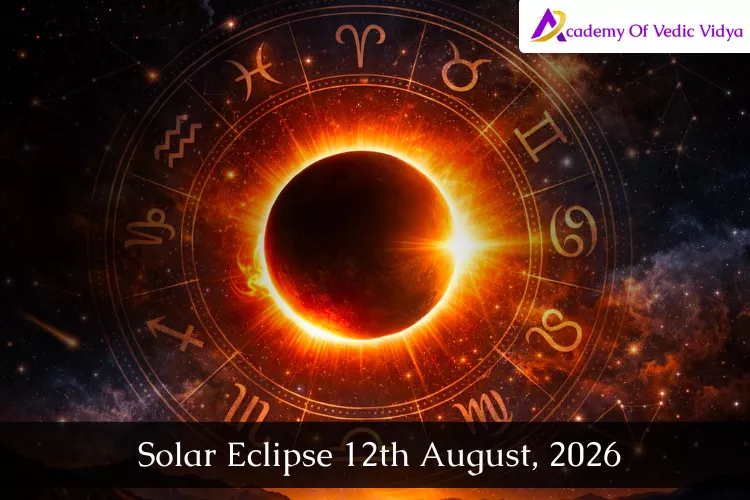
Missed eclipses in India are common for those in the know. Most nighttime eclipses fly over India and this one will do just that. Wednesday, August 12, 2026’s total Surya Grahan (solar eclipse) is set to start at 9:04 PM IST and continue into the hours of August 13. Totality will happen when most of India is asleep. Since this Surya Grahan won’t be visible anywhere in India, there will be no Sutak Kaal to be concerned by. This will be one of the most important eclipses of the decade for the locations that will be able to view it. It will be a total eclipse that will travel across the Arctic, Greenland, Iceland, and down through Spain and Portugal.
We break down all the important information here pertaining to this Surya Grahan. We have the time this Surya Grahan will happen, why India will miss it, the locations where this Surya Grahan will be total vs partial, the Sutak rules, the Vedic times, and most importantly how it can be viewed safely if you fall within the Surya Grahan (solar eclipse’s) path.
Solar Eclipse -Surya Grahan August 12 2026: Date and Time (IST & UTC)
On August 12, 2026, at around 5:30 PM in India, a total eclipse of the sun will take place and last for approximately 7.44 hours. It will even continue into the early hours of the 13th in Indian time.
| Phase | IST | UTC |
| Eclipse begins | ~9:04 PM, Aug 12 | ~3:34 PM, Aug 12 |
| Totality begins | ~10:29 PM, Aug 12 | ~4:59 PM, Aug 12 |
| Maximum/mid-eclipse | ~11:17 PM, Aug 12 | ~5:47 PM, Aug 12 |
| Totality ends | ~12:05 AM, Aug 13 | ~6:35 PM, Aug 12 |
| Eclipse ends | ~4:25 AM, Aug 13 | ~10:55 PM, Aug 12 |
This is why the path of totality produces some of the most incredible eclipse photography in terms of sunset colors.
Can Skywatchers in India See This Solar Eclipse (Surya Grahan)?
No. The August 12, 2026 solar eclipse (Surya Grahan) can be observed from India. The eclipse takes place in the night hours in India, therefore there will be no visible partial or total phases of the eclipse. People in India will be forced to watch the eclipse via a live broadcast if they want to see it at all.
Where Will the Surya Grahan Be Visible?
Every country in the path of the eclipse does not experience the same eclipse. This is the detail most coverage glosses over. It is worth noting that there is a real distinction between a total eclipse versus a partial eclipse.
Path of totality (100% of the Sun blocked): This eclipse can be seen mostly in the northeast of Portugal, northern Spain, Greenland, Iceland and a small part of north Canada. The total eclipse can only be seen in this narrow band.
Partial eclipse zone (only part of the Sun blocked): Most of Canada and Europe, northern Russia, northern USA, northwest Africa and a small part of Greenland will experience a partial eclipse of the sun, which can be best described as the moon taking a bite out of the Sun fully disappears.
Being in the “path” doesn’t mean being in the path of totality – that distinction matters if you’re planning where to stand and what kind of experience you’re actually going to get.
Is Sutak Kaal Applicable in India for This Eclipse?
No. Sutak Kaal cannot be applied for the eclipse in India. According to the Panchang system, Sutak is applied only for locations where the eclipse is seen. This eclipse is not visible anywhere in India, and hence, there is no Sutak applicable for India. There is no need to stop your daily work, and temples are open. There is no reason to stop cooking or worship.
Does Sutak Kaal Apply in Other Countries?
The presence of Sutak Kaal for places on the path of visibility of the eclipse (most of Europe, Iceland, Greenland, Spain) is dependent on personal or family belief rather than on a universal position. Some households and communities practicing Sutak will follow the restrictions of not preparing food, going out, and eating during the period of the eclipse, while others will not, especially in the context of the Hindu community. People are free to not follow the practices, and there is no rule that demands it. One important thing to note is to never look at the Sun directly without proper protection to avoid any injuries while watching any part of the eclipse.
What Does This Eclipse Mean in Vedic Astrology?
This eclipse is on Shravana Amavasya (Hariyali Amavasya) which is the new moon in the month of Shravana, and it happens on the day after Sawan Shivratri. As per Jyotisha, a Surya Grahan occurs when the Sun and Moon come near to the axis of Rahu and Ketu, thus eclipses are important in Vedic tradition even if they do not fall in any regions of the eclipse or in regions where Sutak is not applicable.
How to Watch the Solar Eclipse (Surya Grahan) Safely
- Pick your spot early. Scout a viewing point with nothing blocking your view toward the Sun’s path – no buildings, trees, or hills in the way – from start to finish.
- Get away from the city. Light pollution and general urban haze dull the experience – a rural or open location gives you a cleaner view.
- Check the sky. A clear sky is non-negotiable – cloud cover can ruin totality even if you’re standing in exactly the right spot.
- Never look directly at the Sun. Looking up at the Sun without protection is not safe at any point outside full totality – wear proper eclipse glasses.
- Bring binoculars or a telescope. With the right solar filters attached, they’ll give you a far more detailed view than the naked eye.
Do’s and Don’ts During a Solar Eclipse – Surya Grahan
Do:
- Use ISO-certified eclipse glasses or a solar viewer when looking at the sun.
- Ensure eye protection for children as well.
- Place a Tulsi leaf on the food; you can then go about your normal routine of eating, drinking water, and working.
Don’t:
- Don’t look at the Sun directly with the naked eye, through a camera, or through binoculars without a solar filter.
- Do not look at the sun with the naked eye-even if the eclipse is partial.
- There is no scientific evidence that food spoils or becomes toxic during an eclipse; therefore, there is no need to discard food for this reason alone.
FAQs
When is the next solar eclipse-Surya Grahan after this one?
–The next visible solar eclipse will be an annular eclipse on February 6, 2027, over part of Africa and all of South America. The next total (solar eclipse-Surya Grahan) will be on August 2, 2027, and will cover southernmost Spain, North Africa, and the Middle East.
Is this a total or partial solar eclipse (Surya Grahan)?
–It will be a total solar eclipse, but only for people living in the narrow strip of Greenland, Iceland, and northern Spain/Portugal. The rest of the path will be a partial eclipse.
Can I watch the August 12, 2026 Surya Grahan-eclipse from India?
–You can’t watch it from India at all. The best you can do is find a live stream to watch it.
Do I need to fast or avoid eating during this eclipse in India?
–No. For this eclipse in India Sutak Kaal doesn’t apply.
Final Thoughts
Even though Sutak Kaal and total Surya Grahan won’t be visible in India, it’s a special day when Shravana Amavasya, the total solar eclipse day, falls. This is an example of why it’s important to understand the eclipse cycle of Rahu-Ketu and the Nakshatra system in order to make predictions for your own birth chart.
Vedic Astrology Course teaches you how to read eclipse cycles, Rahu-Ketu transits, and your own birth chart with real depth — step by step, with the guidance of an experienced instructor.
Enroll now → COURSE