Raksha Bandhan 2026 falls on Friday, August 28, the Purnima (full moon) day of Shravana month. In 2026, the auspicious time for tying the Rakhi will begin after sunrise – specifically, around 5:57 AM – and will continue until 9:48 AM (IST). The best part is that there is no Bhadra Kaal during the Rakhi-tying period this year; therefore, the ritual can be performed without any hindrance during this auspicious window.
Below, all the essential information regarding Rakhi Purnima 2026 is presented clearly – such as why the 27th is not the chosen date, the correct date based on the Tithi (lunar day), timings for various cities, rituals and mantras for tying the Rakhi, activities to avoid on this day, and answers to the questions people search most about who can (and can’t) tie rakhi to whom.
When Is Raksha Bandhan?
Raksha Bandhan 2026 is on Friday, August 28, 2026. It falls on Shravana Shukla Purnima – the full moon day that closes the Shravan (Sawan) month in the Hindu lunar calendar. The date of Rakhi Purnima does not remain the same every year because it is determined according to the Hindu lunar calendar rather than the English (Gregorian) calendar. Consequently, while Rakhi fell on August 9 in 2025, it will be celebrated on August 28 in 2026.
What Is the Real Date of Raksha Bandhan in 2026?
This is where many people make mistakes, so it is important to clarify the matter. In 2026, the Purnima Tithi (full moon phase) does not begin on August 28; it will start at 9:08 AM on Thursday, August 27. So why isn’t the festival on the 27th?
Two rules decide it, and both point to the 28th:
Udaya tithi (sunrise rule): According to the Hindu calendar, a festival is typically observed on the tithi (lunar day) that prevails at sunrise. On August 27, 2026, the Purnima Tithi will not be present at sunrise; it will begin later, at 9:08 AM. However, the Purnima Tithi will be in effect at sunrise on August 28 and will continue until 9:48 AM. Therefore, in accordance with the rules, Rakhi Purnima will be observed on August 28.
Bhadra Kaal on the 27th: If anyone thinks that Rakhi can be tied on August 27 simply because the Purnima Tithi has begun, that would be incorrect. This is because Bhadra Kaal – a period considered inauspicious – will prevail from 9:08 AM to 9:34 PM on that day. According to Hindu religious beliefs, auspicious activities, including the tying of Rakhi, are avoided during this time. Therefore, considering all factors, Rakhi is not observed on August 27.
After considering all factors, August 28 has been determined as the correct date for Rakhi Purnima in 2026. This is because the Purnima Tithi will prevail until 9:48 AM on that day. Therefore, unlike in other years, the auspicious time for tying the Rakhi will be available in the morning rather than in the afternoon.
What Do People Do During Raksha Bandhan?
The core rituals of Rakhi Purnima remain largely the same. However, specific customs and the manner of celebration may vary depending on the Indian state or the country where it is observed.
The traditional ritual sequence:
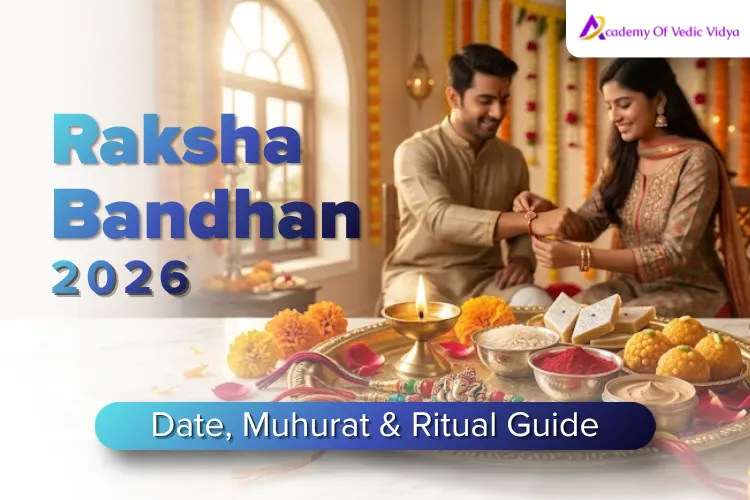
The sister first performs a brief aarti, then applies a tilak or an auspicious mark on her brother’s forehead. Next, the sister ties a Rakhi – a symbol of love – around her brother’s right wrist. She feeds him a sweet, traditionally something like ladoo or barfi. The brother gives a gift or cash, and makes a vow – spoken or implied – to protect and support his sister.
Regional variations that most guides skip:
- In Gujarat, alongside Rakhi Bandhan, a special festival named Pavitropan is also celebrated on the same day, centering on the worship of Lord Shiva.
- The festival of Narali Purnima is celebrated on the day of Rakhi Purnima in the coastal regions of Maharashtra and the Konkan area. On this day, the fishing community pays homage to the sea and offers coconuts to the waters, praying for a successful start to the new fishing season.
- In South India, members of the Brahmin community observe Avani Avittam or Upakarma on the same full moon day. On this day, they change their sacred thread (Yajnopavita or Paita). Religious rituals such as Jandhyala Purnima and Gayatri Jap are also performed. Although these observances are distinct from the brother-sister festival of Rakhi, they take place on the very same full moon day.
- Special religious rituals are also observed on this same full moon day in parts of Eastern India and Bihar.
- Among some tribal and rural communities, the Rakhi festival is known as Gamha Purnima. Their unique local customs, culture, and traditions are also intertwined with this festival.
Modern adaptations:
- If siblings live in different places, many people send the Rakhi via courier in advance. It is sent several weeks early, especially to ensure it reaches a brother or sister living abroad on time.
- Celebrating Rakhi via video call has now become quite common. Even when apart, the sister ties the Rakhi symbolically over the video call, and the brother, watching on the screen, completes the ritual of wearing it. In this way, siblings share the joy of the Rakhi festival despite the distance.
- Nowadays, the practice of tying Rakhi is no longer limited to biological siblings. Many people also tie Rakhi on close friends, cousins, or other cherished individuals. To them, Rakhi represents not merely a blood relationship, but a symbol of love, trust, protection, and a deep bond.
Raksha Bandhan 2026 Shubh Muhurat: Auspicious Time to Tie Rakhi
The core national Muhurat for 2026 is straightforward: tie the Rakhi any time from sunrise until 9:48 AM IST on August 28. This year, there are no astrological constraints associated with Bhadra during the auspicious time for tying the Rakhi. Therefore, unlike other years, there is no need to rush or constantly check the clock; the entire morning is auspicious for the ceremony.
Since sunrise times vary from city to city, there may be slight differences in the exact start time of this auspicious period. However, the auspicious window will conclude at 9:48 AM, as the Tithi (lunar day) ends at that time. This timing remains consistent across all parts of India:
| City | Muhurat Window (IST) |
| Kolkata | ~5:17 AM – 9:48 AM |
| Delhi | ~5:57 AM – 9:48 AM |
| Mumbai | ~6:22 AM – 9:48 AM |
The sun rises in Kolkata about 40 minutes earlier than in Delhi and approximately an hour earlier than in Mumbai. This is due solely to geographical location, not any difference in religious customs.
Sunrise times may also vary in cities not mentioned here – such as Bengaluru, Chennai, Hyderabad, and Pune. Therefore, it is best to consult a local almanac to find the exact time. However, a simple rule applicable to all locations is: tie it any time after your local sunrise and before 9:48 AM.
Raksha Bandhan 2026 Puja Vidhi and Mantra Chant
Step-by-step vidhi:
- Prepare a puja thali with the Rakhi, roli (vermilion) or kumkum, rice grains (akshat), a diya, and sweets.
- The brother sits facing east or north, as per family tradition.
- The sister performs a short aarti, waving the diya in front of him.
- She applies tilak on his forehead with roli and rice.
- She ties the Rakhi on his right wrist while reciting the mantra (below).
- She feeds him a sweet.
- The brother offers a gift and makes his vow of protection.
The traditional Rakhi mantra:
Yena baddho balī rājā dānavendro mahābalaḥ, tena tvām api badhnāmi rakṣe mā chala mā chala.
Meaning: “I tie on you the same protective thread with which the mighty demon-king Bali was once bound – O sacred thread of protection, may you not falter, may you not waver.”
This verse refers to King Bali from the Bhagavata Purana. It is believed that he, too, was bound by a similar protective thread. Therefore, this verse is recited while tying the Rakhi, invoking similar protection and well-being.
Regional and family variations: Not all families tie the Rakhi using the same mantra or ritual. Some offer a brief prayer, while others tie it simply by applying a tilak, without reciting any mantra. Certain families or communities may also use different Sanskrit verses in accordance with their own customs. Therefore, there is no single, mandatory mantra for tying the Rakhi. Although the mantra mentioned above is the most widely used, the true essence of the Rakhi festival – love, protection, and the bond of relationships – remains the same, regardless of which mantra is recited or if none is recited at all.
Raksha Bandhan 2026: Time to Avoid for Rakhi Rituals
There is no restriction regarding the Bhadra Kaal period on the day of Rakhi this year, as it concludes on August 27 – before sunrise on August 28. Therefore, unlike in other years, there is no need to search for a specific auspicious time to tie the Rakhi; the entire morning is considered auspicious for the ritual.
A few things still worth knowing:
Don’t tie the Rakhi on August 27, even though the Purnima Tithi technically begins that morning. The entire day falls within the Bhadra Kaal period, which is generally not considered auspicious for tying the Rakhi. Therefore, tying the Rakhi during this time would not align with established customs and traditions.
If you want to be extra cautious, some families also avoid the ‘Rahu Kaal’ period on August 28. Unlike Bhadra Kaal, Rahu Kaal is a specific inauspicious time that occurs daily, with its timing varying according to the day of the week. However, most families do not usually attach much importance to this regarding the Rakhi festival. If your family observes rituals based on auspicious timings, it is advisable to check the local Rahu Kaal timings for Friday, August 28, before tying the Rakhi.
Outside of Bhadra and, optionally, Rahu Kaal, there’s no other restricted window this year – the entire 5:57 AM–9:48 AM stretch (adjusted for your city’s sunrise) is considered clean.
Raksha Bandhan Dates and Days for the Next 5 Years (2026–2030)
| Year | Date | Day |
| 2026 | August 28 | Friday |
| 2027 | August 17 | Tuesday |
| 2028 | August 5 | Saturday |
| 2029 | August 23 | Thursday |
| 2030 | August 13 | Tuesday |
The date of the Rakhi festival changes every year. This is because it is not observed on a fixed date according to the English calendar but is celebrated on the full moon day of the month of Shravan, based on the lunar cycle. Consequently, depending on the year, Rakhi may fall either at the beginning or towards the end of August.
When to Remove Rakhi After Raksha Bandhan?
There is no fixed convention for how long Rakhi should be worn. Traditionally, Rakhi is worn until it falls apart or loosens on its own; it is not immediately removed after it is tied. Rakhi is not merely a piece of thread – it is connected to love, protection, and the bond of the relationship.
Some families or priests recommend leaving Rakhi on for at least 21 days, believing that its presence brings good fortune for that period. If the Rakhi does not come off by itself within those 21 days, it may then be removed. Many people remove the Rakhi after the next full moon, while others remove it out of practical necessity – for work, hygiene, or an upcoming religious observance.
In summary, there is no single rule for when to remove Rakhi. It shouldn’t be taken off casually, like an ordinary piece of thread; it is worn for a while to honor the love and the pledge that bonded the siblings, and removed only when it naturally falls away or when practical circumstances call for it.
Raksha Bandhan 2026: Who Can & Can’t Tie Rakhi to Whom?
Beyond the date and rituals, this is one of the most commonly searched – and most misunderstood – parts of Raksha Bandhan. Here’s what the tradition actually says about each situation.
Can a Girlfriend Tie Rakhi to a Boyfriend?
Traditionally, no – and most couples avoid it deliberately. Tying a rakhi is meant to establish a symbolic brother-sister bond, treating the two people as siblings from that point forward. Doing this with a romantic partner creates a genuine contradiction with the relationship, which is why the tradition generally advises against it if the couple intends to stay romantically involved.
Can I Marry a Girl Who Tied Me Rakhi?
Widely, no – this is one of the most firmly held cultural beliefs around the ritual. Once a rakhi is tied, the two people are treated as having entered a sibling-like bond, and marrying afterward is seen as going directly against what the thread symbolically established. This isn’t a codified religious law so much as a strong, near-universal social custom across Hindu communities in India, and most families would consider it inappropriate for exactly this reason.
Can Two Sisters Tie Rakhi to Each Other?
Yes. While the ritual traditionally centers on a sister tying rakhi to a brother, many families now also tie rakhi between sisters – particularly where there’s no brother in the family, or simply as a way to mark the sisters’ own bond. There’s no religious restriction against it; it has become an accepted variation of the tradition in many households.
Can a Wife Tie Rakhi to Her Husband?
This isn’t part of the traditional ritual, since Raksha Bandhan is specifically structured around a sibling relationship rather than a marital one. It’s uncommon and not a recognized part of the observance – though there’s no strict prohibition against a couple doing something symbolic in their own way, it simply falls outside what the festival traditionally represents.
Can Muslims Wear or Tie Rakhi?
There’s no single answer, and views genuinely differ. In large parts of India, tying rakhi has taken on a broader cultural meaning as a symbol of friendship and protection that extends well beyond its Hindu religious origin, and many Muslims participate socially – tying or receiving rakhi from Hindu neighbors, friends, or colleagues as a gesture of goodwill, in much the same spirit as exchanging greetings during Eid or Diwali across communities. At the same time, some Islamic scholars and clerics have held that the ritual is not appropriate for a practicing Muslim, citing its origins as a Hindu religious rite. Because of this, whether an individual Muslim takes part is generally treated as a personal decision shaped by their own religious understanding and family context, rather than something with one universally agreed answer.
Happy Raksha Bandhan Wishes
Raksha Bandhan Wishes for Brother
- “Happy Raksha Bandhan, bhai! No matter how far apart we are, this rakhi carries all my love and prayers for you.”
- “You’ve protected me in your own way for as long as I can remember – today, I tie this thread to remind you that I’m always in your corner too. Happy Raksha Bandhan!”
- “Some bonds don’t need explaining – ours is one of them. Wishing you a Raksha Bandhan filled with joy, laughter, and everything good.”
Raksha Bandhan Wishes for Sister
- “Happy Raksha Bandhan to the sister who’s been my strength since childhood. Today and always, I promise to have your back.”
- “This rakhi is a small thread, but the promise behind it is forever. Love you, and happy Raksha Bandhan!”
- “To the person who knows me best and still loves me anyway – happy Raksha Bandhan, sis. Here’s to many more years of this bond.”
Final Thoughts
This year, Raksha Bandhan falls on the 28th of August. The auspicious time for a pooja is 9:48 AM, and this year, there is no bad time (Bhadra Kaal) for the Raksha Bandhan celebration. This year, there is only one thing to remember, which is to not celebrate Raksha Bandhan a day before (on August 27th). Regardless of the methodology for performing the customary ritual of the Raksha Bandhan celebration, what remains true is that, in all the cities across all the countries globally, the significance of Raksha Bandhan remains the same. Keeping the 5-year cycle and annual ritual performance methodology, use the city-wise timings, and plan for the auspicious time for celebrating the Raksha Bandhan ritual. The celebration of the Raksha Bandhan ritual should take care of its form and procedure, and what remains the same and important everywhere is the bond and the significance of the Raksha Bandhan celebration.For more insightful topics like this, explore our blogs at Academy of Vedic Vidya.