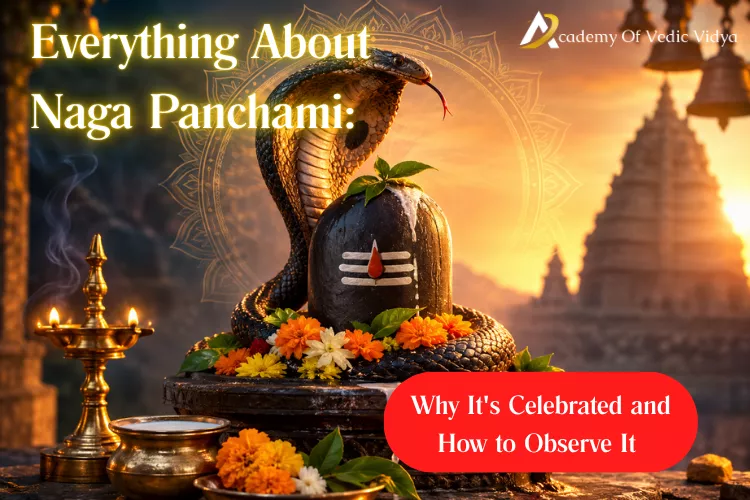
Most people searching for Naga Panchami are really asking one thing first: what is this festival, and why does an entire day get set aside to worship snakes? In 2026, Naga Panchami falls on Monday, August 17 – the fifth day (Panchami Tithi) of the bright fortnight (Shukla Paksha) in the sacred month of Shravan. This year carries extra weight because that same Monday is also the third Sawan Somwar, so serpent worship and Shiva worship converge on one day.
Naga Panchami is a Hindu festival dedicated to the Nagas – the serpent deities of Hindu cosmology – observed mainly across North, West, and South India, as well as in Nepal. Devotees fast, bathe early, and offer milk, turmeric, and prayers to images or idols of Nag Devta, seeking protection from snakebite and blessings for the family’s wellbeing. This guide walks through the meaning, the mythology, the correct puja vidhi, the eight principal serpent deities, the Kaal Sarp Dosh connection, and the do’s and don’ts – in the order a first-time observer would actually need them.
What is Naga Panchami?
Naga Panchami is the Hindu festival of serpent worship, observed on the Panchami Tithi (fifth day) of Shukla Paksha in the lunar month of Shravana, which falls in July or August. The word breaks down simply: “Naga” means serpent, and “Panchami” means the fifth day of the lunar fortnight.
On this day, devotees venerate the Nagas – divine or semi-divine serpent beings described in the Vedas, the Puranas, and the Mahabharata – through images, idols, paintings, or anthills, and in some regions, through live snakes. The festival sits within Shravan, a month already considered sacred to Lord Shiva, which is why Nag Panchami often overlaps with Shiva worship in practice. Traditionally, women observe a fast from sunrise to sunset and pray for the long life and safety of their brothers and families, a thread that runs through several of the festival’s founding legends.
Is Naga Panchami the Same as Nag Panchami?
Yes. Naga Panchami and Nag Panchami are the same festival – “Naga” is the fuller Sanskrit form, and “Nag” is the shortened, more commonly spoken version used in Hindi and other North Indian languages. You will also see it written as Nagpanchami or Nagula Panchami, depending on the region and the language.
The variation is purely linguistic, not religious. Whether a source writes “Naga Panchami” or “Nag Panchami,” the date, the deity, and the rituals being described are identical. The only genuine naming confusion worth watching for is with a different festival entirely – Nagula Chavithi – which is covered later in this guide.
Why is Naga Panchami Celebrated?
Naga Panchami is celebrated to honor the Nagas as protectors of the earth, guardians of hidden treasure, and custodians of cosmic balance, and to seek their forgiveness and protection from snakebite. In Sanatan Dharma, serpents occupy a unique middle position — neither purely feared nor worshipped as supreme gods, but honored as powerful beings who govern the Patal Lok (netherworld), fertility, wealth, and the unseen forces beneath the soil.
The timing itself carries agricultural logic. Shravan is the peak of the monsoon in India, when heavy rains flood burrows and force snakes out into the open, closer to human dwellings. Worshipping the Nagas at this exact point in the calendar is, at its root, an act of seeking coexistence with a creature that becomes genuinely more present – and more dangerous – during the rains. Layered onto this practical root is a set of scriptural stories that give the day its devotional shape, its mantras, and its specific rituals.
The Mythological Story Behind Naga Panchami
The most widely cited origin story comes from the Mahabharata and centers on King Janamejaya. After the Naga king Takshaka killed Janamejaya’s father, Parikshit, by snakebite, Janamejaya performed a Sarpa Yajna – a sacrificial fire ritual designed to destroy the entire race of serpents in revenge. As the fire consumed naga after naga, the sage Astika intervened and persuaded the king to halt the sacrifice, saving Vasuki, Takshaka, and the rest of the serpent clan from annihilation. The day this sacrifice stopped became Naga Panchami, and the story is remembered as a lesson in mercy and the protection of living beings, not as a celebration of the sacrifice itself.
A second major legend involves Lord Krishna and the serpent Kaliya. Kaliya had taken up residence in the Yamuna and poisoned its waters, endangering the people of Gokul. The young Krishna dove into the river, danced upon Kaliya’s many hoods to subdue him, and then — rather than killing him – allowed him to live once Kaliya surrendered and agreed to leave the river. This story is commonly read as the triumph of divine power over poison, pride, and harmful behavior, and it explains why Krishna’s taming of Kaliya is retold at Naga Panchami gatherings even outside Krishna-centered traditions.
A third, more intimate legend explains the festival’s connection to sisters and brothers. A young woman’s brother was killed by a snake while gathering ketaki flowers for her puja. Grief-stricken, she fasted and prayed to Nag Devata with total sincerity, and her devotion restored her brother to life. This story is the scriptural root of why Naga Panchami, in many households, is observed specifically by women for the safety and longevity of their brothers – a theme that echoes the sibling-protection spirit of festivals like Raksha Bandhan, which falls in the same season.
Which God is Worshipped on Naga Panchami?
The primary deity worshipped on Naga Panchami is Nag Devta – the serpent god, most often represented through Vasuki, the king of the nagas, or Shesha (also called Ananta), the cosmic serpent on whom Lord Vishnu reclines in the Kshira Sagara. Households commonly place a silver, stone, or clay Naga idol, or a painted image on the wall, and offer it milk, turmeric, akshat rice, and flowers.
Serpent worship on this day also connects directly to Lord Shiva. Vasuki is depicted coiled around Shiva’s neck, a symbol of Shiva’s mastery over fear and death, and tradition holds that when Shiva drank the deadly Halahala poison during the Samudra Manthan to save creation, drops of it fell to earth and were absorbed by serpents – which is why serpent worship and Shiva worship are so tightly linked throughout Shravan. In yogic and tantric traditions, serpents carry a further layer of meaning: they represent Kundalini Shakti, the coiled, dormant spiritual energy said to rest at the base of the spine, waiting to awaken.
Ashta Naga: The Eight Serpent Deities of Naga Panchami
Ashta Naga refers to eight principal serpent deities named across the Mahabharata and the Puranas, worshipped individually for specific blessings and especially prominent in Kerala, South Karnataka, and parts of Tamil Nadu. All eight are described as children of the sage Kashyapa and his wife Kadru.
- Ananta (Shesha) – the eldest and most revered, the infinite serpent who serves as Lord Vishnu’s cosmic bed and is said to support the earth itself.
- Vasuki – the king of the nagas who wound himself around Mount Mandara as the churning rope during the Samudra Manthan, and who now rests coiled at Shiva’s neck.
- Takshaka – a naga king known for his fierce venom, remembered in the Mahabharata as the serpent who killed King Parikshit.
- Karkotaka -a powerful serpent associated with the story of King Nala in the Nalacarita, said to help those afflicted by misfortune when remembered sincerely.
- Padma – associated with prosperity and wisdom.
- Mahapadma– described in tradition as a ruler among the serpents of the netherworld.
- Shankhapala – venerated as a guardian of sacred lands and boundaries.
- Kulika – depicted with immense strength and, in some traditions, a thousand hoods.
Devotees propitiate the Ashta Nagas for relief from skin ailments, for fertility and safe childbirth, and – most relevant to the astrological side of this festival – to counter the ill effects of a poorly placed Rahu or Ketu in the birth chart.
Why Do People Worship Snakes on Naga Panchami?
People worship snakes on Naga Panchami because, in Hindu tradition, the serpent is treated as a symbol of renewal, hidden power, and the forces of nature that cannot be fully controlled — not simply as a dangerous animal to be feared. A snake’s ability to shed its own skin and continue living was read by ancient tradition as a lesson in transformation and rebirth.
Worshipping the Naga on this day is an act of humility toward a creature capable of real harm. Rather than trying to dominate or eliminate that danger, the tradition asks devotees to approach it with reverence — offering milk and prayer instead of fear and aggression. This same symbolism extends into Shaivite and Vaishnavite iconography, where serpents appear not as villains but as companions and instruments of the divine: Vasuki at Shiva’s neck, Shesha as Vishnu’s resting place, and Kaliya, subdued but spared, at Krishna’s feet.
What Do You Do on Naga Panchami? (Rituals and Puja Vidhi)
A typical Naga Panchami puja follows a clear sequence, and it can be performed at home with a few simple items.
- Wake before sunrise and bathe. Wear clean clothes, traditionally in a bright or auspicious color.
- Set up the puja space. Place an idol, stone, or painted image of a Naga Devta-commonly Vasuki or Shesha – facing east if possible.
- Prepare the puja thali. At minimum, this includes raw milk for abhishekam, turmeric and sandalwood paste, akshat rice, kumkum, marigold or jasmine flowers, a diya, and incense.
- Offer the abhishekam. Pour milk and water over the idol or image, never onto a live snake.
- Chant the mantras. The two most commonly recited are “Om Namah Shivaya” and “Om Naga Devataabhyo Namah.”
- Recite the names of the principal Nagas – Ananta, Vasuki, Takshaka, and the rest of the Ashta Naga – and pray for the family’s protection and wellbeing.
- Observe the fast. Many devotees, especially women, fast from sunrise until the puja concludes at sunset, breaking it with sattvic food.
- Prepare the prasad. Kheer and sabudana khichdi are the most common offerings, made without frying, and shared with the family after the ritual.
Regional practice adds its own texture: in West Bengal, the day overlaps with Manasa Puja, honoring the snake goddess Manasa; in Rajasthan and parts of North India, related observances called Goga Navami and Bishari Puja carry the same spirit of serpent reverence a few weeks later.
Significance of Milk Offering to Snakes on Naga Panchami
Offering milk to the Naga Devta is treated as an act of abhishekam – a ritual bath believed to symbolize purity, devotion, and the nourishing, life-sustaining role the Nagas hold in Hindu cosmology. The milk is poured over an idol, a painted image, or an anthill representing the serpent’s dwelling, and the gesture is meant as a mark of respect rather than literal feeding.
This distinction matters, because biologically, snakes cannot digest milk – they are reptiles with no adaptation to process dairy, unlike mammals. Where live cobras have historically been made to drink milk at fairs and roadside gatherings, this has typically involved snakes that were captured, defanged, and starved to the point of dehydration beforehand, so that milk was consumed out of desperation rather than nourishment. Correct puja vidhi, as taught in scripture and practiced in temples, directs milk toward the idol or the image – never toward a live, captive snake.
Is It Good to Worship Real Snakes on Naga Panchami?
Worshipping the symbolic form of the Naga – an idol, a painted image, or a natural anthill – is the practice supported by scripture and temple tradition. Forcing captive snakes to participate in worship is a separate, later practice that most classical texts do not call for, and it carries real animal-welfare costs that modern devotees and temple authorities increasingly discourage.
The tension is worth naming plainly rather than smoothing over. On one side, the reverence at the heart of Naga Panchami is genuinely about protecting serpents, not exploiting them – the Astika legend itself is a story of saving nagas from destruction. On the other side, the practice of snake charmers bringing captured, often mistreated cobras to be “fed” milk at fairs directly contradicts that founding spirit, since capturing, defanging, and starving a wild animal to make it perform is a form of harm the tradition’s own mythology argues against. Wildlife authorities in India have restricted the public display and handling of snakes for exactly this reason. A devotee who wants to observe Naga Panchami in its truest spirit worships the idol at home or at a temple, and shows a live snake – if one is ever encountered – distance and respect rather than handling.
What Should Not Be Done on Naga Panchami? (Do’s and Don’ts)
Certain restrictions are specific to this one day and don’t apply on ordinary days of the year.
What to avoid:
- Do not dig or plough the earth – serpents live beneath the soil and digging is believed to disturb or harm them.
- Do not cut, chop, or use sharp iron tools where avoidable.
- Do not fry food; many households prepare only steamed, boiled, or roasted dishes.
- Do not harm, capture, or force-feed a live snake under any circumstance.
- Do not eat non-vegetarian food, eggs, or consume alcohol.
- Do not treat the fast or the puja casually – the day calls for sincerity, not a token gesture.
Can you cut vegetables on Naga Panchami? No – cutting or chopping vegetables with a knife is specifically discouraged on this day. In earlier practice, households would roast or boil root vegetables whole rather than slicing them, since cutting was symbolically linked to the harm the festival asks devotees to avoid. Preparing meals with whole or coarsely broken vegetables, cooked without frying, is the customary workaround.
Kaal Sarp Dosh and Naga Panchami: Remedies and Significance
Kaal Sarp Dosh, in Vedic astrology, is formed when all seven other planets fall between the shadow planets Rahu and Ketu in a birth chart. “Kaal” means time and “Sarpa” means serpent, so Kaal Sarpa Yoga translates to “the serpent of time” — a placement traditionally associated with delays and obstacles in marriage, career, finances, and family harmony, regardless of how sincerely one works toward those goals.
Naga Panchami is considered one of the most favorable days in the year to begin remedial measures for this dosha, precisely because the day is already dedicated to Nag Devta worship. Commonly taught remedies include:
- Observing a fast on Naga Panchami and offering milk to a Naga idol, never to a live snake.
- Performing Rudrabhishek at a Shiva temple, since Rahu-Ketu afflictions are traditionally pacified through Shiva worship.
- Chanting the Maha Mrityunjaya Mantra 108 times, along with the Rahu and Ketu Beej Mantras on their respective days (Saturday for Rahu, Tuesday for Ketu).
- Donating a silver naga-nagin idol at a Shiva temple.
- Visiting a dedicated Kaal Sarp Dosh Nivaran Puja site, such as the temples at Trimbakeshwar or Ujjain, where the ritual sequence includes Ganesha Puja, Shiva Puja, and a Naga Devta ceremony performed together.
These practices are taught as a body of astrological remedy within the tradition, not as a guaranteed fix for any individual’s circumstances – a distinction worth holding onto rather than treating any single ritual as a certain cure.
Is Naga Panchami a Public Holiday?
Naga Panchami is not a centrally gazetted national holiday in India, but it is widely observed as a regional or optional holiday depending on the state. Some state governments and local district authorities declare it a public or restricted holiday in years where local observance is strong -for example, Dakshina Kannada in Karnataka declared it a local holiday for August 17, 2026. Schools, temples, and some private offices in Maharashtra, Karnataka, and parts of South India often close or adjust hours for the festival even where it isn’t formally gazetted.
Because the holiday status varies by state and even by district, the most reliable way to confirm whether your workplace, bank, or school observes it is to check your specific state’s official holiday calendar for the given year rather than assuming a blanket national closure.
Naga Panchami vs Nagula Chavithi: What’s the Difference?
Naga Panchami and Nagula Chavithi are related but distinct serpent-worship days, separated by both timing and, in practice, by the intensity of live-snake rituals involved.
| Naga Panchami | Nagula Chavithi | |
| Month observed | Shravan (July–August) | Kartika, four days after Diwali (October–November) |
| Tithi | Panchami – fifth day of Shukla Paksha | Chaturthi – fourth day after Amavasya |
| Region of prominence | North and West India, and Nepal | Andhra Pradesh, Telangana, parts of Karnataka |
| Typical worship site | Home altar, temple idol, painted image | Anthills (Putta) and snake pits, plus home idols |
| Live snake involvement | Discouraged in classical practice; historically present at some fairs | Historically more pronounced, including milk and egg offerings at snake pits |
Both days share the same underlying purpose – honoring the Nagas and seeking relief from Rahu-Ketu afflictions – and both are followed a day or two later by related observances (Nagasashti after Naga Panchami; a similar sequence around Nagula Chavithi). The clearest practical difference for a devotee deciding which to observe is regional custom: households in Andhra Pradesh and Telangana typically treat Nagula Chavithi as their principal naga-worship day of the year, while most of the rest of India centers its serpent worship on Naga Panchami in Shravan.
Frequently Asked Questions
What is the correct mantra to chant on Naga Panchami?
–Om Namah Shivaya” and “Om Naga Devataabhyo Namah” are the two mantras most commonly chanted during the puja.
Is Naga Panchami the same date across all of India?
–Broadly yes for regions following the standard Panchang, though Gujarat and a few other areas that follow the Amanta lunar calendar observe it roughly two weeks later, closer to early September.
Which temples are especially significant on Naga Panchami?
–Mannarasala Sree Nagaraja Temple in Kerala and the Nageshwar shrine inside Ujjain’s Mahakaleshwar complex – which opens to devotees only once a year, on Naga Panchami itself – are among the most visited.
Can Naga Panchami rituals be performed without a live snake or a physical idol?
–Yes – a painted image of a Naga Devta on paper or on a wall is considered a fully valid object of worship, and is in fact the form most classical texts describe.
Final Thoughts
Professional Diploma in Vedic Astrology Course teaches you how to read planetary placements like Rahu-Ketu afflictions and Kaal Sarp Dosh in a real birth chart, so festivals like Naga Panchami become informed practice rather than guesswork- step by step, with the guidance of an experienced instructor.
Enroll now → Occult Science Courses