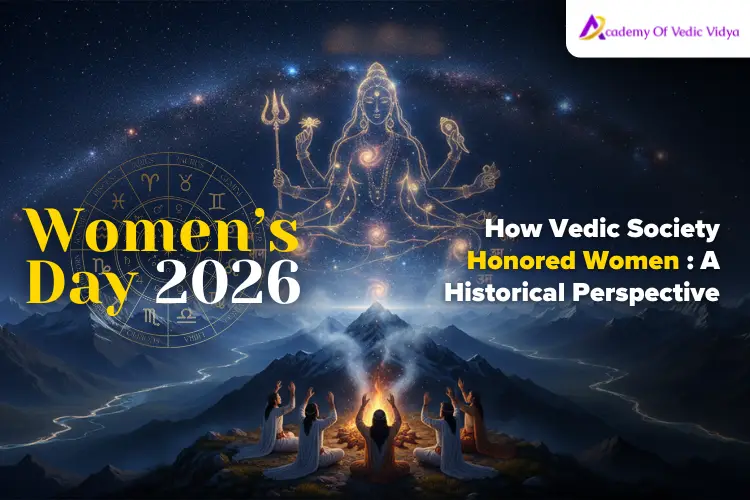
Women’s Day 2026 is a time to celebrate the strength, wisdom, and achievements of women across the world. Every year, International Women’s Day reminds us to reflect on the journey of women’s rights, equality, leadership, and empowerment. While modern discussions often focus on present-day challenges, it is equally important to look back into history and understand how ancient civilizations viewed women.
One such powerful example comes from Vedic society. The Vedic period of India presents a fascinating perspective where women were respected, educated, spiritually empowered, and socially active. In this blog, we will explore how Vedic society honoured women and what lessons Women’s Day 2026 can draw from that historical legacy.
When is Women’s Day 2026?
Women’s Day 2026 will be celebrated on 8 March 2026, continuing the global tradition of honouring women’s achievements and promoting gender equality.
The idea of International Women’s Day began in the early 20th century and was officially recognized by the United Nations in 1977. Today, it is observed worldwide as a day of awareness, appreciation, and action.
Understanding Vedic Society
The Vedic period (roughly 1500 BCE to 500 BCE) is one of the oldest recorded phases of Indian civilization. The sacred texts known as the Vedas, especially the Rigveda, provide valuable insight into the social and spiritual structure of that time.
Contrary to common misconceptions, early Vedic society granted women significant respect and opportunities. They were not confined only to household roles but actively participated in intellectual, spiritual, and social life.
Women as Scholars and Philosophers
One of the strongest proofs of women’s respected status in Vedic society is their role as scholars.
Women were allowed to:
- Study the Vedas
- Participate in philosophical debates
- Perform religious rituals
- Compose hymns
Famous Women Scholars of the Vedic Period
Several women sages (Rishikas) are mentioned in ancient scriptures:
- Gargi Vachaknavi – A renowned philosopher who debated on deep spiritual topics in royal courts.
- Maitreyi – Known for her profound discussions on immortality and self-knowledge.
- Lopamudra – A philosopher and poet credited with hymns in the Rigveda.
These women were not silent observers but intellectual leaders. Their presence in debates shows that Vedic society valued women’s knowledge and wisdom.
Education and the Upanayana Ceremony
In early Vedic times, girls had the right to education similar to boys. They underwent the Upanayana ceremony (sacred thread initiation), which allowed them to study sacred texts.
Two types of educated women were mentioned:
- Brahmavadini – Women who pursued lifelong spiritual knowledge.
- Sadyovadhu – Women who studied until marriage.
This structured educational system shows that women were seen as capable of intellectual growth. On Women’s Day 2026, this historical example reminds us that education has always been a powerful tool for empowerment.
Women in Spiritual and Religious Roles
Vedic rituals often required the presence of both husband and wife. A man alone could not complete certain sacred ceremonies without his wife.
This concept emphasized that:
- Husband and wife were spiritual partners.
- Women were equal participants in religious duties.
- Family life was considered a shared responsibility.
The divine feminine was deeply respected in Vedic culture through the worship of goddesses such as:
- Saraswati – Goddess of wisdom and learning.
- Lakshmi – Goddess of prosperity.
- Durga – Symbol of strength and protection.
The reverence for goddesses reflected society’s understanding of feminine power as sacred and essential.
Marriage and Freedom of Choice
In early Vedic society, women often had the right to choose their life partners through a ceremony called Swayamvara.
Women were not always forced into marriage at a young age. Many pursued education before choosing family life. Widow remarriage was also socially acceptable during the early Vedic period.
This indicates a level of autonomy and personal freedom that challenges many modern assumptions about ancient societies.
Economic and Social Participation
Women in Vedic society:
- Participated in agricultural activities
- Managed households independently
- Took part in artistic and cultural practices
- Engaged in trade and crafts
They were seen as contributors to both family and society. Property rights for women were also recognized in certain contexts, allowing them financial independence.
The Concept of Ardhanarishvara
The philosophical idea of Ardhanarishvara, a combined form of male and female energy — symbolizes balance between masculine and feminine forces.
This concept teaches that:
- Masculine and feminine energies are equal.
- Creation requires balance.
- Neither gender is superior
Such symbolism highlights the deep respect for gender harmony in Vedic thought.
Women’s Day 2026: The Evolution of Women’s Status from Vedic Times to Today
While early Vedic society offered women many freedoms, later periods saw gradual restrictions due to social, political, and economic changes. Foreign invasions, rigid social structures, and cultural shifts impacted women’s status.
However, the original Vedic ideals remain powerful examples of equality and dignity.
On Women’s Day 2026, revisiting these early principles can inspire modern society to reconnect with values of respect and empowerment.
What Women Can Learn from Vedic Society
As we celebrate Women’s Day 2026, there are important lessons we can draw from history:
1. Education is Empowerment
Vedic women scholars prove that knowledge creates confidence and authority.
2. Spiritual Equality Matters
Religious and spiritual inclusion strengthens societal balance.
3. Respect Must Be Cultural
True honour comes when respect for women becomes part of daily life, not just a slogan.
4. Balance is Essential
The Ardhanarishvara philosophy teaches that society thrives when masculine and feminine energies coexist harmoniously.
Modern Relevance of Ancient Wisdom
Today, women lead in politics, science, business, arts, and spirituality. Yet challenges like inequality, discrimination, and safety concerns still exist.
Women’s Day 2026 is not only about celebration but also reflection. Ancient Vedic society shows that gender respect is not a new concept, it is deeply rooted in Indian tradition.
Reconnecting with these principles can:
- Strengthen cultural pride
- Promote gender harmony
- Encourage equal opportunities
- Inspire future generations
Honouring Women Beyond One Day
While Women’s Day 2026 will be celebrated globally on 8 March, true respect for women must go beyond a single day.
In Vedic philosophy, women were:
- Teachers
- Philosophers
- Spiritual guides
- Leaders
- Creators of knowledge
Their honour was not limited to symbolic gestures but embedded in social structure.
Themes of Women’s Day 2026
The themes of Women’s Day 2026 continue to highlight the importance of equality, empowerment, and opportunity for women everywhere. Each year, Women’s Day reminds us not only to celebrate women’s achievements but also to reflect on the challenges many still face in education, work, leadership, and everyday life.
In 2026, the focus is expected to center around building a more inclusive world where women’s voices are heard and respected. It’s a time to encourage communities, workplaces, and families to support women’s growth and independence. More than just a celebration, Women’s Day 2026 is a reminder that real progress happens when everyone works together to create a future where women and girls can thrive with dignity and equal opportunities.
Conclusion
Women’s Day 2026 is not just about celebration, it is a reminder of our roots. From Gargi and Maitreyi to the worship of divine feminine energy, the Vedic era honored women as thinkers, leaders, and spiritual forces. Empowerment is not modern, it is timeless.
“Happy Women’s Day 2026”, Your energy shapes your reality and when your energy flows freely, life flows beautifully too.
For more such topics visit Academy Of Vedic Vidya. You can explore our Vedic Astrology Course or other occult science courses too. We also offer personalized mentorship. Each program is meticulously crafted to provide an in-depth understanding of vedic principles and their practical applications, equipping you with the knowledge and skills to become a professional and predict the future accurately.
For further information contact us at (+91) 7439041439.