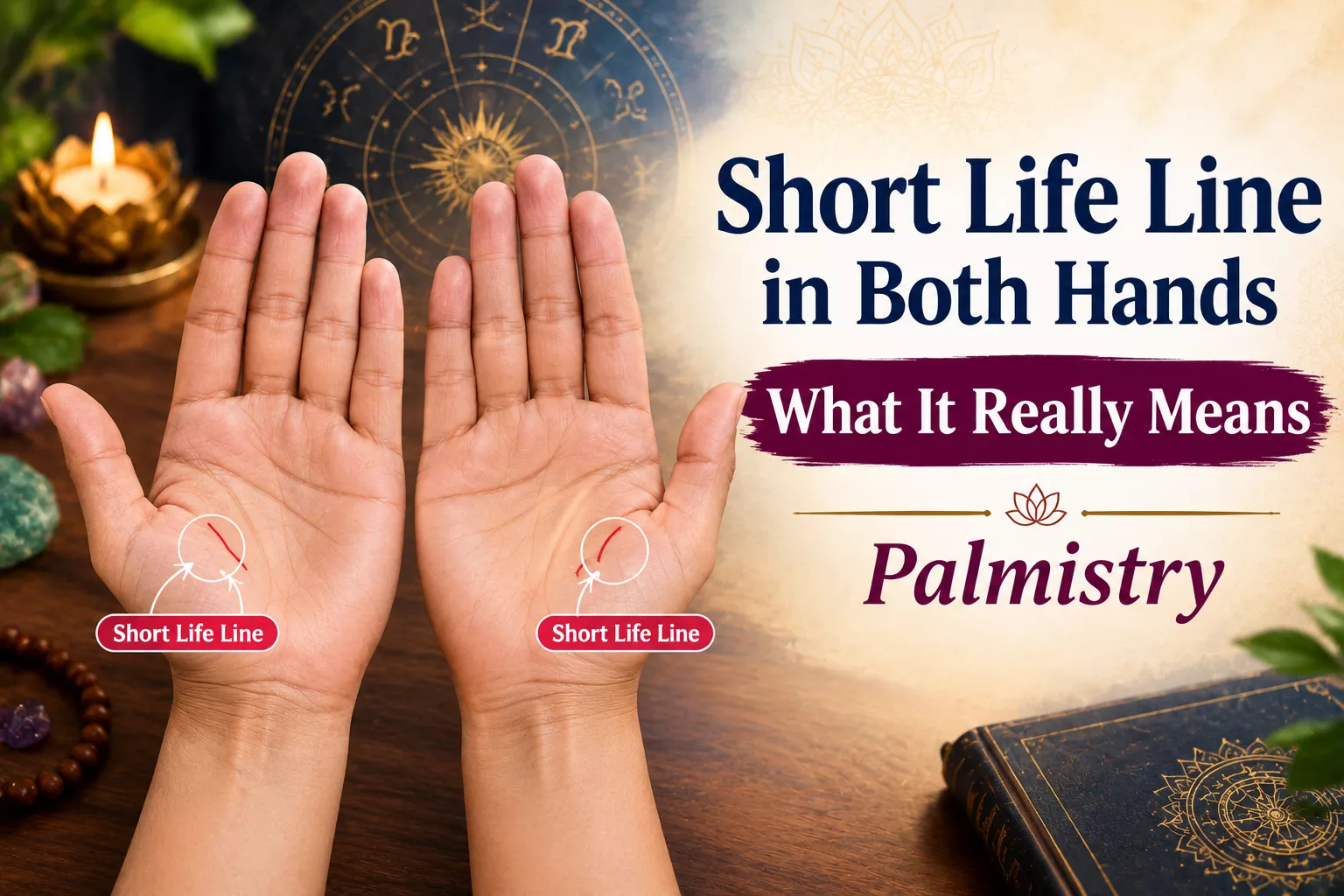
A common question about a short life line is, “Does a short line mean I’ll have a short life?” A short life line on both hands is not an indication of a short life expectancy. The life line, in the system of palmistry I practice, indicates the extent to which a person is affected by, and adapts to, change. It represents the vibrancy and the ups and downs of a person’s life. In the Indian system of palmistry, lines do not necessarily represent years. Furthermore, for the life line to appear short on both hands means there is a tendency for it to appear short on both hands. Since both hands are read together, the appearance of the line on both hands provides consistent information.
This response addressed the basics. Other information provided in this article includes variations in the line, other lines that interact with the life line, the myths surrounding a short life line, and the area of the palm where the life line is found.
What Does a Short Life Line Mean in Palmistry?
The life line extends from the base of the thumb and curves around the palm to the wrist. The length of this line is related to the depth of the line as well as the transparency and the condition of the mount it surrounds. Life lines by themselves do not tell a complete story.
In practice, a short life line is traditionally associated with:
- Lower physical stamina or energy that runs in bursts rather than steadily
- A need for more rest and recovery between periods of exertion
- Sensitivity to environment, stress, and lifestyle pressure
- A tendency toward major shifts or transitions rather than one continuous path
These features by themselves are not conclusive. A palmist looks at various features on the hand and integrates them into a conclusion, much in the same way a teacher incorporates other facts about a student when looking at a single test score. The resources available on this site do not look at palmistry in the context of other Vedic disciplines, but the resources available at the Academy of Vedic Vision and Arts provide an overview of the various disciplines, including Jyotish and palmistry.
This kind of hand analysis is part of what you’ll study in depth through a structured vedic astrology course in india, where palmistry is taught alongside the planetary and chart-based methods it complements.
Short Life Line on Both Palms vs. Just One Hand
This is the detail most articles on this topic skip, and it’s the one that actually changes the reading.
In Indian traditional palmistry, the left hand and right hand are not interchangeable. The left hand is called the hastha sadhana and is associated with traits that are unchangeable like one’s disposition, vital energy, and physical constitution. The right hand, hastha karma, is associated with traits that are developed through one’s actions and choices. Traditionally, women were assumed to have the left hand as hastha sadhana and the right hand as hastha karma. In recent times, most palmists read hand features based on their own discretion.
- Short line on one hand only – It may be that the trait is not yet fully expressed, or that it is related to your genetic predisposition or environmental situation, but not both.
- Short line on both hands – It is present in both your genetics and your environment. A stronger, more settled signal, but “stronger signal” still means “clearer pattern,” not “more negative situation.”
- Broken short life line on both hands – Breaks and pauses in an already short line usually signify disruptions in situations, for example transitions, or different situations that caused trauma and stress, including illnesses. Breaks in palm lines are always located in the line’s “body” roughly corresponding to the person’s age. However, exact ages are always considered as approximate.
If you’re comparing your left and right palm and seeing the same short line on both, that’s a signal worth understanding properly – a topic covered in more depth through Palmistry course training, where hand reading is taught as one tool within a full chart-reading practice, not a standalone party trick.
Does a Short Life Line Mean a Short Life? (Debunking the Myth)
No. While it’s very common knowledge that a short life line predicts a shorter lifespan, this is a myth that has been perpetuated by pop culture and has no basis in any classical theory of palmistry. Traditionally, the life line has been interpreted to gauge the overall quality of life and general well-being of the individual.
So, where does the misconception regarding life lines stem from? In part, it’s because of the terminology. The shorter the life line, the more urgent and ominous the condition is perceived to be. This is not the case. Palm lines are to be read in aggregate. Classically, the assessment of an overall long and fulfilling life has more to do with astrology and less to do with palmistry.
A few corrections worth stating plainly:
- Myth: A short life line means early death. Fact: Line length reflects vitality and energy patterns, not years remaining.
- Myth: A short line on both hands doubles the “bad” meaning. Fact: It reflects a consistent trait, not a compounded prediction.
- Myth: A straight or faint life line is inherently negative. Fact: Clarity and depth matter more than shape or length alone – a faint but well-supported line (backed by a full mount of Venus and strong surrounding lines) is read very differently from a faint line with no supporting structure.
If you’re going to read a palm – your own or someone else’s – properly, the discipline is in reading the whole hand together, never a single line in isolation. That systematic approach is exactly what’s taught step by step in a self-paced Palmistry Course course with lifetime access, so you learn to read hands the way a trained practitioner does rather than pattern-matching one line to one fear.
Why Is My Life Line Short and Faint?
A short and faint line together usually points to one of three things, and distinguishing between them is what separates a careful reading from a guess:
- A naturally quieter energy pattern. Some people are simply born with a hand that shows a shorter, finer life line — this is a constitutional trait, not a sign of decline.
- Current lifestyle load. Sustained stress, poor sleep, or overwork can make an already-short line appear fainter, since Samudrika Shastra treats the hand as something that reflects your current state, not just a fixed blueprint.
- The mount of Venus is underdeveloped. Because the life line curves around this mount, a flat or thin mount alongside a short line reinforces a “low reserve” reading, while a full, cushioned mount softens it considerably — the same short line means something different depending on what it’s circling.
Also Read : Life Line In Your Hand
Can a Short Life Line Change Over Time?
Yes. The classical theories of palmistry emphasize that palm lines are fluid and change based on environmental factors. From a reading of classical texts, it appears that the generally held belief among practitioners was that gradual changes in health and wellbeing were captured by the palm lines. Hence, the “record” is “updated.” Therefore, while lines may be initially formed at the time of birth, it is equally probable that lines may be formed or altered throughout the lifespan of the individual.
Just because your card reader said they can’t alter your life line, doesn’t mean your life line is set in stone, or that your life line isn’t meaningful. If you repeatedly find yourself frazzled and anxious with not enough gas in the tank, your reading isn’t an omen to tell you that rest and recharge efforts will be in vain.
Short Life Line with a Strong Health Line: What It Signals
The line starting near your wrist and heading toward your little finger is known as the health line, Mercury line, or the business line. This line is very telling when interpreting a short life line.
- Short life line + strong, clear health line: This combination generally softens concern about vitality. A well-formed health line suggests good bodily resilience and steady function, which offsets what a short life line alone might imply about stamina.
- Short life line + broken or absent health line: This pairing carries more weight toward the “watch your energy and lifestyle” reading, since neither line is compensating for the other.
- Short life line + strong heart line and head line: Emotional stability and mental clarity are traditionally read as supporting factors — a short life line surrounded by strong lines elsewhere on the palm is read very differently from a short life line on an otherwise weak or unclear hand.
It’s important to remember a short line in isolation carries very little if any meaning. This is why it’s very difficult to find an authoritative source on palm reading to alleviate your anxiety about a particular line.
Short Life Line in Vedic vs. Western Palmistry
| Vedic Palmistry (Samudrika Shastra) | Western Palmistry (Chirology) | |
| Life line’s core meaning | Vitality, energy, life quality | Vitality, energy, physical constitution |
| Lifespan claims | Explicitly rejected in classical texts – longevity is assessed via the birth chart (Ayurdaya), not the palm | Also rejected by modern practitioners, though the “short line = short life” myth is older and more entrenched in folk Western tradition |
| Hand emphasis | Both hands read together; inherited vs. present-life traits | Dominant hand often given more weight, though many modern practitioners read both |
| System integration | Palmistry is one branch alongside astrology, numerology, and other Vedic sciences | Palmistry is typically practiced as a standalone system |
| Remedial approach | Lifestyle, gemstones, and astrological remedies (through a qualified consultation) are traditionally paired with vitality concerns | Primarily descriptive; remedies are less codified |
The overlap matters more than the difference: both traditions agree, independently, that a short life line is not a lifespan prediction. When two separate systems land on the same conclusion, that’s a stronger signal than either one alone.
Common Mistakes People Make Reading a Short Life Line
- Reading the line in isolation instead of cross-referencing the health line, head line, and mount of Venus
- Panicking over length alone while ignoring depth and clarity, which matter more
- Assuming both hands “doubles” a negative meaning instead of understanding it as a consistency signal
- Treating a single online article as a full reading – palm analysis is a trained skill, not a lookup table
Frequently Asked Questions
Is a short life line rare? No. Short life lines are common and appear across a wide range of hands; they’re one of several natural variations in line length, not an anomaly.
Does a short life line affect career or relationships? Not directly. Career and relationship indicators come from the head line, heart line, and fate line — the life line speaks to vitality and energy, not these areas.
Should I be worried if my life line is short on both hands? No. Worry isn’t the useful response here — attention to energy, rest, and lifestyle is. Treat it as information, not a warning.
Can a palm reading tell me exactly how long I will live? No system of palmistry, classical or modern, claims to predict an exact lifespan from the hand. Longevity in Vedic astrology is assessed through the birth chart, not palm lines.
Conclusion
Findings from palmistry suggest it is unfavorable to read palms line by line. One should take the context of the surrounding lines into account. Sometimes, a short life line raises concerns on the duration of an individual’s life. However, palmistry focuses on other aspects of an individual such as their stamina, the way they confront and endure various challenges of life, and their overall vitality.
Various palmistry literatures, including the Vedic text Samudrika Shastra and chirology, suggest that a short life line means an individual is at risk of overexerting themselves, and as such, should be conscious of how they utilize their bodily reserves. A short life line in palmistry should be considered in association with other lines on the palm. The presence of a deep and clear line on the palm, for example, the line of the heart or the line of the intellect, suggests that the individual is strong willed and is not daunted by challenges of life.
A major goal of palmistry is to gain an understanding of the individual beyond the palms. Someone interested in knowing the science behind the art of interpreting palms is encouraged to take the Palmistry Course available online.