If you’ve been exploring the world of divination for a while, there’s one simple question that haunts beginning students: should I learn the Akashic Records, tarot, or Vedic astrology first? Blind selection often leads to a long, frustrating search for the right discipline, wasting months of effort on a system that ultimately proves unsuitable to one’s needs.
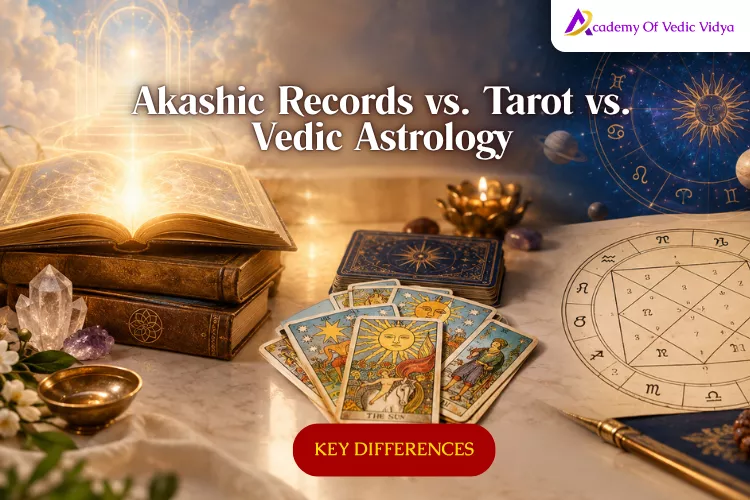
Here’s the short version: whereas Vedic astrology (Jyotish) is a predictive, calculation-based science that interprets the fixed positions of planets and the timing of events with surgical precision, tarot is a symbolic, present-mirroring art that reflects one’s current mental and emotional state through an archetypal lens. And the Akashic Records are something altogether different – a direct vibrational access to information encoded in the soul, bypassing both calculation and symbolism.
If your ultimate goal is to become proficient in accessing the Akasha field for yourself or others, an Akashic Records course is the most direct path to achieve it: after all, self-taught students have a notoriously hard time differentiating between genuine insights and their own self-indulgent projections, an issue that rarely arises with the study of a birth chart or a professionally-led tarot reading. Let’s examine the fundamentals of each in greater detail.
What Is Vedic Astrology (Jyotish)?
Vedic astrology, or Jyotish in its original Sanskrit, is a predictive, calculation-based system of divination that examines the positions of the sun, moon, and planets at the moment of birth to determine the timing of events in one’s life. Unlike many other forms of astrology, it examines not only the angles between planets (the so-called aspect) but also their placement within the zodiac signs and the 12 bhavas (houses) of the birth chart.
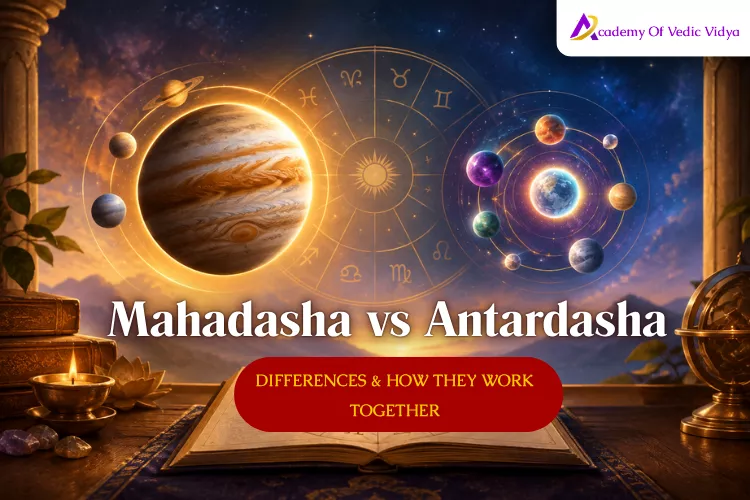
What makes Jyotish particularly interesting is the system of planetary periods (dasas) that define the transits and life events a person will experience at various points in their lifetime: depending on the position of your Moon at birth, you were born under the influence of one of 27 nakshatras (lunar mansions), each of which has a particular dasha attached to it.
This dasha, in turn, has a Vimshottari period of 120 years, which is further divided between Sun, Moon, Mars, Rahu, Jupiter, Saturn, Mercury, Ketu, and Venus. This is what allows the Vedic astrologer to speak with a degree of specificity not only about the types of people and experiences that will enter one’s life but also the approximate time frames in which they will appear. This being said, the Vedic astrologer is not doomed to a predetermined fate: events that transpire under a particular dasha can be mitigated with suitable remedies, and conscious effort can transform the trajectory of one’s life. For those who wish to explore these principles more deeply, studying Vedic astrology in a structured way – such as through a Vedic astrology diploma course – can provide a foundation for understanding the traditional techniques behind chart interpretation and prediction.
Also Read: What Is Vedic Astrology?
What Is Tarot?
Tarot is a symbolic, present-mirroring system of divination that utilizes a set of 78 cards decorated with alchemical and religious imagery to examine the current patterns in one’s life and their potential outcomes. The deck is traditionally divided into the Major Arcana (22 cards) and Minor Arcana (56 cards), the latter of which is further subdivided into the suits of Wands, Cups, Pentacles, and Swords.
Unlike Vedic astrology, tarot is not concerned with one’s birth date, time, and location: a person’s circumstances at the time of the reading determine the spread (the formation of cards) and the interpretations used to examine the querent’s question. This also means that the same question, presented at a different time, will rarely yield identical results: depending on one’s mindset at the time of the reading, the arcana will manifest in different positions and combinations, reflecting the changes in the situation. For those wishing to explore tarot beyond its basic symbolism, studying through a Tarot card reading course online can provide a structured introduction to card meanings, spreads, and the interpretive techniques traditionally used in readings.
As such, tarot is a uniquely flexible form of divination that can be applied to yes-or-no questions (though the answers are rarely definitive) but is much more effective when given a complex prompt: “What should I consider in my search for love?” For instance, will be much more informative than “Is he/she my soulmate?” Tarot is also significantly more accessible to beginners, as it does not require a detailed knowledge of planets, signs, houses, and aspects, only a basic understanding of the symbolism of the individual cards and their combinations.
The similarities between the two, however, are deceptive: an astrologer who has mastered the positions and aspects of the planets will find it much harder to read a person’s emotions than a professional tarot reader.
What Are Akashic Records?
Many spiritual traditions speak of the Akashic Records as the repository of all information regarding every living being that has ever existed. In the vedic tradition, the akasha (ether) is one of the five great elements, and everything that exists is made up of a combination of space, air, fire, water, and earth.
It examines the same kinds of issues as vedic astrology and tarot but from a different perspective: instead of relying on calculations and symbolism, the Akashic Records reader taps directly into the consciousness of the querent and accesses the information stored in their soul.
Those wishing to study the practice in greater depth may also explore an Akashic Records course in India, where the focus is typically on understanding the nature of the Records and developing a framework for working with them.
The process of reading the Akashic Records is extremely similar to meditation: the practitioner opens up their own Records (or the Records of the querent, if permission is given) and examines the relevant information with the help of a special invocation. Because the Akashic Records are not a physical object but rather a stream of information, there is no “tool” to read them apart from the mind of the practitioner.
An aspiring Akashic Records reader, therefore, is not likely to find success right away: they will need to invest considerable time and effort into becoming familiar with the process of opening and accessing the Records before they can provide meaningful insights to others. For a more detailed examination of the process, please refer to our beginner’s guide to reading the Akashic Records.
How Each System Handles the Same Question Differently
The most effective way of comparing the three is to apply the same question to all of them and examine the differences in their approaches and answers. For example, let us use one of the most common questions in divination: “Why do I keep finding myself in the same type of relationships?”
A Vedic astrologer would examine the placement of the 7th house and its lord, looking at the dasha period to see if they are afflicted or weakened. They would use that information to determine the approximate time of when this cycle of relationships began and when its effects will cease to be relevant. A tarot reader, on the other hand, would pull a spread (a specific formation of cards) to examine the current patterns in the querent’s life and determine what changes they may want to pursue.
They would most likely use a past-present-future spread or a “what am I missing” spread and interpret the results according to the traditional meanings of the cards without attempting to impose any specific judgment or condition on them. An Akashic Records practitioner, finally, would open the Records and specifically examine the relevant soul file, looking for any karmic patterns or agreements that may be responsible for the recurring issue.
Advanced Practice: Where Each Discipline Goes Beyond the Basics
An astrologer, for example, may use the antardasha periods (sub-periods within a dasha) to narrow down the timing of an event with greater precision. Meanwhile, the tarot reader may interpret a single card (or a combination of cards) in an unconventional but appropriate manner to reflect the uniqueness of the querent’s situation.
Finally, the Akashic Records practitioner may build their skill and focus enough to access more information than they were prepared for: determining the reason behind a lifelong pattern, an unconscious agreement from one’s past, or the purpose of a particularly challenging experience. Each discipline, therefore, allows the practitioner to develop unique skills that help them advance beyond the basics and become more competent in their practice.
Predictive vs. Symbolic vs. Vibrational: How Each System Actually Guides You
The real difference between these three systems isn’t which one is “more accurate” — it’s what kind of guidance each one is built to deliver.
- Vedic astrology is predictive. It works from a fixed birth moment and calculates forward, giving structured timing for events and life themes based on planetary periods.
- Tarot is reflective and symbolic. It reads present-moment energy through archetypal imagery, offering possible directions rather than fixed outcomes.
- The Akashic Records are vibrational and direct. They bypass symbols and calculation entirely, offering soul-level information through direct inner communication rather than an external system of interpretation.
| Vedic Astrology | Tarot | Akashic Records | |
| Access mechanism | Birth chart calculation (date, time, place of birth) | Card draw from a 78-card deck | Direct meditative/vibrational access, no physical tool |
| Time orientation | Predictive – timed via dasha periods | Present-moment – reflects current energy | Past, present, and potential future simultaneously |
| Nature of guidance | Structured, calculation-based | Symbolic, open to interpretation | Direct soul communication |
| Best for | Timing major life events and decisions | Present-situation clarity and reflection | Root-cause healing and soul-purpose questions |
| Learning curve for beginners | Steep – requires learning chart calculation and dasha math | Moderate – card meanings build with practice | Gradual – receptivity and discernment develop over time |
Which Discipline Should You Study First?
Should You Learn Vedic Astrology, Tarot, or Akashic Records First? If you are new to the practice of divination and have trouble choosing between these three, the choice should be guided by the types of questions that are most relevant to you.
Choose Vedic astrology if calculation and timing are of particular interest to you, or tarot if you prefer a more intuitive approach. And select the Akashic Records if you are most interested in uncovering the reasons behind situations rather than their timing or symbolism.
Common Misconceptions About These Three Systems
“They’re all just different flavors of fortune-telling.” While each of these systems examines the same categories of questions – life patterns, relationships, health, career, and spirituality – they do so from distinctly different points of view.
This is what makes them different: Jyotish times events, tarot reflects personalities, and the Records examine the reasons behind patterns. Trying to force-fit one into the framework of another rarely produces satisfactory results.
“You need to be psychic to read the Akashic Records.” Reading the Akashic Records is a skill, like any other: it may come more easily to some people than others, but it requires no special talent or training to acquire.
“Tarot predicts a fixed future.” Tarot is a reflective, present-mirroring system of divination: it examines the energy of the moment and the potential outcomes of the choices one makes in the present.
Frequently Asked Questions
Can I read my own Akashic Records without formal training?
Anyone can attempt to open their own Records with intention and a simple invocation, but without training in discernment, it’s difficult to tell a genuine impression from ordinary imagination.
Do I need my exact birth time for a Vedic astrology reading?
Yes the dasha system is anchored to the Moon’s precise nakshatra at birth, so even a few minutes’ error in birth time can shift the entire planetary period timeline.
Is tarot the same thing as fortune-telling?
No – most trained readers treat tarot as a tool for reflection and decision-making support rather than a fixed prediction of the future.
Can a beginner study Vedic astrology, tarot, and the Akashic Records at the same time?
It’s possible, but most instructors recommend building real competence in one system first, since each has its own learning curve and mixing methods too early tends to blur the specific skills each one requires.
How long does it typically take to become proficient in each system?
Tarot is usually the fastest to gain baseline confidence with, often within a few months of regular practice, since the deck’s 78 meanings provide a fixed structure to learn. Vedic astrology takes considerably longer to reach a professional level, because accurate prediction depends on layering multiple techniques – dasha, transits, and divisional charts – on top of the basic chart. The Akashic Records sit somewhere in between: the technique to open the Records can be learned quickly, but the discernment to read them with consistent clarity develops gradually with guided practice.
Do tarot, Vedic astrology, and the Akashic Records ever conflict with each other?
Not in principle. Since our tarot beginner’s guide explains, tarot reflects present-moment energy rather than fixed fate, while Vedic astrology times deeper structural patterns and the Records address their karmic root — used together, they tend to reinforce rather than contradict one another, since each is answering a different layer of the same underlying situation.
Conclusion
The Akashic Records Course at Academy of Vedic Vidya teaches you the invocation methods, ethical framework, and discernment practice needed to open and read the Records with genuine confidence — step by step, with the guidance of an experienced instructor.
Enroll now → Vedic astrology course online