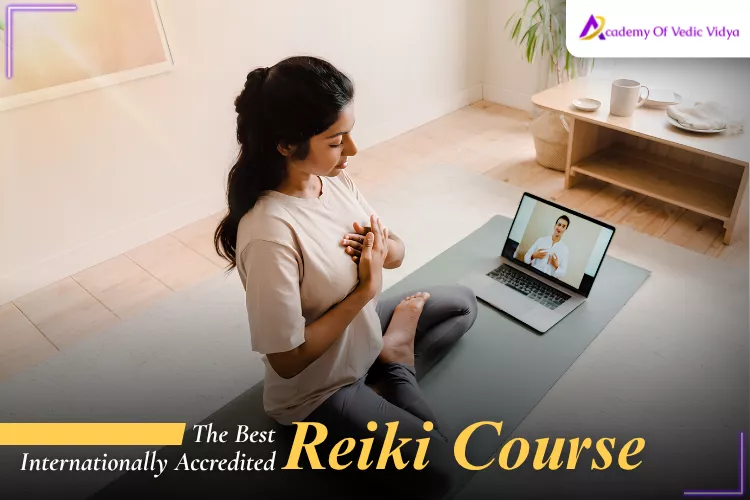
If you have ever looked for a Reiki course, you have likely noticed that almost every training institute claims to be ‘internationally recognized’ or ‘internationally accredited.’ But what does this ‘accreditation’ actually signify? Who-or which organization-granted it? Furthermore, how much practical importance or acceptance does this accreditation hold for a working Reiki practitioner-such as when applying for jobs, securing insurance, or establishing professional credibility? It is also crucial to understand the role it plays in enhancing a practitioner’s own skills and self-confidence.
This guide answers that directly. You’ll learn what accreditation actually means for a Reiki course. How can you distinguish between organizations that genuinely accredit ‘energy healing’ training and those that merely claim to be ‘accredited’ or ‘internationally recognized’ for the sake of publicity? It is also crucial to know what factors to consider before paying for a course.
What Does “Internationally Accredited” Actually Mean for a Reiki Course?
“Internationally accredited” means a Reiki Healing Course has been reviewed and approved by an organization that sets training standards recognized in more than one country – not that a government or medical authority has certified it, since Reiki has no statutory regulator anywhere in the world.
Here’s what you need to know before you enroll anywhere. Reiki is not a licensed medical profession. There is no Reiki Licensing Board or Reiki Bar Association. When a course says “accredited,” it means a private accrediting body-not a government-has reviewed the curriculum, the instructor’s credentials, or the number of training hours, and given its approval. The recommendation is worth what you’d say it is based on the reputation of the accrediting body.
This is also where certification and accreditation get confused. Reiki certification is the credential you personally receive after completing a course – A certificate with your name on it. Accreditation is the stamp that a particular course or school has been awarded by an external entity for meeting a certain standard. A course can be “certified” (you get a certificate) and wholly unaccredited. Visionary and real international training is almost invariably certified and accredited by a body that spans several countries.
Is Online Reiki Certification Legitimate?
Yes, online Reiki certification is completely legitimate provided the course contains elements such as guided attunement, practice hours, and assessments.
Legitimate online training is not necessarily about the delivery of the training, but rather about the quality. Reiki is a unique situation in that while physical therapy involves touch, Reiki does not. Many Reiki training organizations, including the International Center for Reiki Training (ICRT), are able to certify students through live online sessions because the attunement process can be done remotely.
Online training becomes questionable if it is entirely pre-recorded training with no real interaction. This includes no assessment and no feedback on hand placement or energy work, with a certificate being issued almost instantly after the payment has been completed. If a program does this, it is unlikely to teach anything that would be recognized by a credible accrediting organization.
Regarding becoming a certified Reiki practitioner completely online, the answer is yes, because thousands of practitioners have. However, just because a certification is online does not mean employers, insurers, or clients will respect it. This is because of the accrediting body behind the organization offering training.
Who Accredits Reiki and Energy Healing Training?
There is no global organization that accredits all Reiki training. Several organizations, primarily in the UK and the US, have become the de facto accrediting organizations that reputable schools apply to.
The organizations that appear most often on the websites of reputable, insurable Reiki schools include :
- CPD (Continuing Professional Development) Certification – a UK organization that tracks and issues certificates of participation for a limited number of continuing professional development hours. Their certifications are recognized by many employers and professional organizations, though CPD accreditation itself is issued by several different organizations, not one.
- CMA (The Complementary Medical Association) – one of the largest complementary and alternative therapies associations in the UK. Many UK and international insurance companies use CMA as a baseline for providing insurance.
- IPHM (International Practitioners of Holistic Medicine) – a UK-based association that accredits training and individual courses and Reiki schools, and hosts a public directory of accredited schools.
- ICAHP (International Council for Alternative Healing Practitioners) and NCCAP – these organizations are often mentioned along CPD and CMA on Reiki Master programs.
- ICRT (International Center for Reiki Training) – one of the most well known organizations in the world. ICRT is founded by William Lee Rand, who is a recognized Reiki grandmaster. ICRT directly trains and certifies Reiki Masters and many practitioners consider their certification to be the gold standard teaching credential.
- The Reiki Healing Association – again like other similar membership organizations, accredits specific course providers and issues recognized practitioner certificates.
IPHM vs. CMA vs. CPD vs. ICRT – What’s the Real Difference?
| Body | What it actually does | Best for |
| CPD Certification | Tracks and verifies ongoing professional training hours | Showing employers/clients you meet continuing-education standards |
| CMA | Membership and accreditation body for complementary therapists | Insurance eligibility, professional credibility in the UK/EU |
| IPHM | Accredits holistic training providers and courses globally | Verifying a school through a public accredited-provider directory |
| ICRT | Direct lineage-based Reiki Master training and certification | Practitioners who want a traceable, lineage-verified credential |
An observable discrepancy: not all accrediting bodies are reviewed independently. For example, IPHM is not accredited by The CPD Register, a different body that reviews CPD accreditors. This does not mean IPHM accreditation is without value. It means that accredited by X is only the first of two questions. The second question, whether X is recognized by anyone who matters, is consequential, and almost no course-selling pages will give you that information.
Is CPD accreditation important for Reiki courses? The absence of CPD accreditation does not make a course of little value while the presence of CPD accreditation is not sufficient to claim having the ‘best’ course. CPD accreditation only assures that a course meets a defined number of structured learning hours, and says nothing about the school’s Reiki lineage, attunements, and the quality of the school’s teaching. CPD accreditation should be perceived as the ‘bare minimum’ standard and not an endorsement of Reiki teaching and practice.
Is Reiki certification recognized internationally? In countries where Reiki is practiced in hospitals as a complementary therapy (this happens in parts of the US, UK, and other countries) hospitals and wellness centers typically set their own requirements rather than waiting for a universal accrediting body. This means that in these countries accreditation is not required to practice Reiki, but it is necessary to have professional liability insurance (if you choose to get it) and many clients, wellness centers, and employers want to see it.
Do You Need Accreditation to Practice Reiki Professionally?
Reiki is rarely regulated, thus is legally unencumbered to practice within most countries around the world. However, in all likelihood, clients, wellness centers, and some employers will expect you to have liability insurance and accreditation for the legal practice of Reiki.
- Legally : In most jurisdictions, especially legally, anyone is permitted to practice Reiki without any formal certification. There is, consequently, no license to revoke since there was never a license to hold.
- Practical/Litigable:Insurers, spas, hospitals, and corporate wellness programs will not engage you or provide you insurance coverage until they see proof of your training by an accredited service.
Online Reiki certifications -Wellness centers, spas, and most hospital integrated medicine programs will accept online certifications if the training was provided by an accredited service and includes documented hours of practice. The format is of less importance than the accrediting body.
If you wish to practice Reiki professionally, consider accreditation a requirement to obtain insurance and client trust, even if accreditation is not a legal requirement.
How Long Does It Take to Get Certified in Reiki?
Most students complete Level 1 in a weekend or a few weeks of self-paced study, while most take several months to a year to complete all levels and reach Master level.
Level 1(Shoden) : is foundational and includes attunement and self-practice techniques. Most students finish this level in one weekend or 20 to 30 hours of self-paced study.
Level 2 (Okuden) is an intermediate level and includes techniques for distance healing and the Reiki symbols. This level is developed after several weeks to a few months of additional practice following Level 1.
To reach the level which allows a Reiki practitioner to attune and certify other Reiki students is often the main goal of most Reiki master programs, and this level is the real core focus of most training. This level requires a documented apprenticeship and a given number of hours of practice, and many schools will not issue a Master certificate. Also, this is where the accreditation of a school is important. Training from an accredited school is needed to give the Master certificate some weight and importance if you choose to teach.
Each school sets its own hour-related minimum standards, and this is why it is important to investigate a school’s accreditation, even if you just assume that “Reiki Master” means the same training everywhere.
Where Can You Enroll in an Accredited Reiki Course Online?
Find a course that names its specific accrediting body instead of just saying “accredited.” Look for a course that shows you how to verify accreditation through the accreditor’s publicly available directory and includes documented practice or attunement hours, not a video followed by a certificate issued instantly.
In practice, this means checking three things before you enroll anywhere:
- The accrediting body is listed. For example courses will say “CPD accredited,” “IPHM accredited,” “ICRT-trained lineage.” Instead they give “internationally certified,” which gives no body to the claim.
- You can verify it yourself. IPHM, for example, has a public directory of accredited members. Schools that say they are accredited by IPHM should readily appear in that directory when you search for them.
- The format correlates with the claim. Legitimately accredited Level 2 or Master courses will require live sessions, guided practice, or submitted coursework. They will not offer a single click autoplay course.
Course formats worth understanding as you compare providers:
- Self-paced, lifetime-access courses suit students who want flexibility and don’t need a fixed schedule – common among CPD- and IPHM-accredited providers.
- Live cohort-based courses, often built on the ICRT curriculum, suit students who want real-time feedback on attunements and hand positions before certification.
- Bundled or multi-level packages (Level 1 through Master in one purchase) can be cost-effective, but check that each level still includes distinct practice requirements – not just unlocked video access.
What Accredited Reiki Training Typically Costs
Prices vary widely depending on level and accreditation, and the accreditation itself is rarely the biggest cost driver – live instruction and smaller cohort sizes are.
- Level 1, self-paced, CPD/IPHM accredited: commonly falls in a modest range, often discounted from a higher listed price as an introductory offer.
- Level 2, self-paced or blended: typically priced higher than Level 1 to reflect the additional techniques and distance-healing content.
- Master/Teacher level, live or mentored: the most expensive tier, reflecting one-on-one or small-group attunement guidance and the documented practice hours required for teaching-level certification.
A useful sanity check: if a Master-level, fully accredited program is priced dramatically below every comparable accredited competitor, ask what’s been cut – usually it’s live support, documented practice hours, or the accreditation itself.
Common Mistakes to Avoid When Choosing a Course
- Trusting the word “accredited” alone. Always ask: accredited by whom, and can I verify that independently?
- Assuming a higher price means better accreditation. Cost reflects marketing and production value more often than teaching quality or accreditation standing.
- Skipping the practice-hours question. A certificate earned without documented practice hours is unlikely to satisfy insurers later, even if the course itself was inexpensive or convenient.
- Choosing Master level as a first course. Reputable, accredited programs build Master certification on top of Level 1 and 2 practice — a program that lets you jump straight to “Master” with no prerequisite practice is a signal worth taking seriously.
FAQs
Is CPD accreditation important for Reiki courses?
As a benchmark, this quality signal is useful to signal structured learning hours, but it doesn’t evaluate the quality of Reiki teaching or the lineage, so check it along with something like CMA or IPHM, don’t check it instead.
Which Reiki certification is most respected?
None are ‘the best,’ but certifications that have a verifiable accreditor (CPD, CMA, IPHM) and a teaching lineage hold the most value to insurers and fellow practitioners.
Do I need Level 1 before I can take Level 2 or Master training?
Yes, in virtually every reputable accredited program – Reiki training is sequential and each level builds on the attunement and practice from the previous level.
Can I get insured to practice Reiki after an online course?
Yes, if the course is accredited by a body insurers recognize (CPD, CMA or IPHM) and includes documented practice hours – check with your intended insurer’s accepted-provider list before enrolling, since requirements vary by country.
What’s the difference between a Reiki “certificate” and a Reiki “diploma”?
In most accredited programs the terminology is used loosely and interchangeably; what actually matters is not the label but whether the document names the issuing school, the accrediting body, the level completed and the practice hours involved – a certificate with none of that is of very little consequence, no matter what it is called.
Choosing With Confidence
Every statement on a Reiki course sales page -internationally accredited,’ certified,’ recognized worldwide’- is reason enough to ask a question, and not an answer in itself. The students who end up with training which is valid for insurance, for clients and for their peace of mind, are the ones who took the time to name the accreditor, and double check if it is a genuine accreditor, and confirm the practice hours behind the certificate. That costs you nothing yet protects you from the one outcome you wish to avoid the most: spending money on a credential that is worth less than you think.
Conclusion
Reiki Healing Course teaches Reiki healing from foundational Level 1 attunement through Master certification, with accredited, verifiable credentials and live guided practice at every level – step by step, with the support of an experienced instructor.
Enroll now → Occult Science Courses